
New Zealand’s wholesale interest rates have fallen to a nine-month low on the back of weak economic data and a signal from the United States' Federal Reserve that it may begin to cut interest rates.
The two-year swap rate was at 4.77% on Friday morning, its lowest level since February, and other durations were at similar lows.
Swap rates are agreed-upon interest rates banks exchange with institutional investors or other banks. The trade helps banks manage interest rate fluctuations and shapes the terms they offer retail customers for mortgages.
On Thursday, Statistics NZ released gross domestic product data for the September quarter which was much weaker than expected.
Economic activity declined 0.3% and shocked forecasters who had predicted a roughly 0.2% expansion. Stats NZ also revised its previous GDP reports, removing 0.7% of growth from the past six quarters.
The weak GDP number was underpinned by a downturn in goods-producing sectors, although activity in the services sector was also lower than some had expected.
Daily swap rates
Select chart tabs
Fed pivot
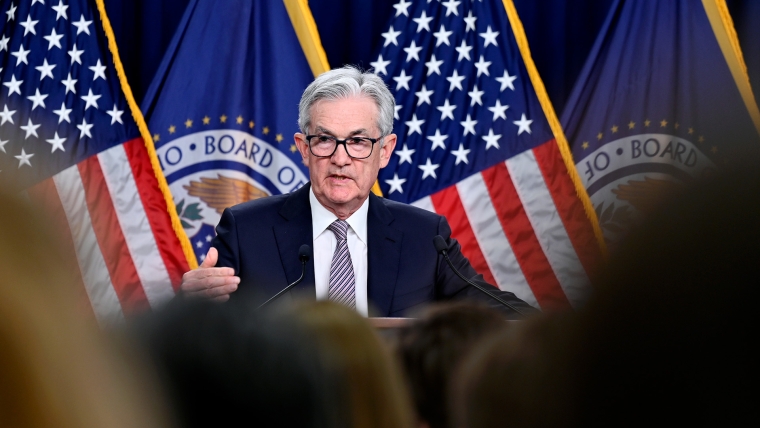
Also on Thursday, the US Federal Reserve triggered a market rally with a sudden signal that it could cut interest rates by as much as 75 basis points next year.
Chairman Jerome Powell said the central bank’s benchmark rate was "likely at or near its peak for this tightening cycle” which boosted market confidence. This sent stocks higher, and bond yields lower.
David Croy, a senior strategist at ANZ, said most market participants were expecting the Federal Reserve to strike a cautious tone after its meeting and were taken by surprise.
“Then GDP numbers came out and it was the straw that broke the camel’s back, really,” he said.
New Zealand bond yields fell with their US counterparts early on Thursday and were further encouraged by the weak GDP numbers later that day.
Nathaniel Keall, an economist at ASB, said market traders were now pricing in an “overindulgent” three or more cuts to the Official Cash Rate during 2024.
“That said, should reduced demand pressures in the economy translate into a swifter reduction in inflationary pressures, the risk is OCR cuts could come earlier than the early 2025 kick-off we presently forecast,” he said in a note.
Analysis by ANZ showed market expectations were for the Official Cash Rate to be cut from 5.5% today to below 4.5% by the end of next year.
This contrasts with the Reserve Bank’s view, outlined in its recent Monetary Policy Statement, which warned another increase to 5.75% was more likely than a cut in 2024.
Stocks and dollars
The movement in the interest rates has flowed downstream into currency and stock markets, as well. The S&P NZX50 climbed almost half a percent to its highest level since August, and the NZ dollar was up 1.5% against the US.
The kiwi dollar was trading at about 61.1 US cents prior to the US Federal Reserve’s announcement but quickly jumped to 62 US cents as markets processed the news.
It fell briefly after the weak GDP data was released but resumed its rally and was still trading above 62 US cents, just short of a six-month high, late Friday morning.
While the local currency was bolstered by a weakening US dollar, it fell relative to other key trading partners such as Australia, the European Union, and Japan.
Despite that, the Reserve Bank reported the currency’s trade weighted index was near a four-month high on Thursday afternoon at 71.98. The index is only published daily.
ANZ’s Croy said weakness in the US dollar following the Federal Reserve meeting had made the NZ dollar look stronger by comparison, but the soft GDP data had taken some of the shine away.
We welcome your comments below. If you are not already registered, please register to comment
Remember we welcome robust, respectful and insightful debate. We don't welcome abusive or defamatory comments and will de-register those repeatedly making such comments. Our current comment policy is here.