

New Zealand's inflation rate is still expected to fall below 3% by year end, but persistently high shipping costs provide "some upside risk", ASB economists say.
In a note on shipping costs, ASB senior economist Mark Smith says the run up in shipping costs has been swift – with a trebling in some rates in recent months.
Smith says unlike the surge in shipping costs during the pandemic, the latest rise appears to have been predominantly supply-driven. Current drivers include shipping disruptions in the Red Sea (Gaza conflict related) and Panama Canal (low water levels).
"The impact of higher shipping rates will depend on how persistent the uplift in shipping costs is - the longer that shipping rates remain elevated, the greater the potential impacts are. There is considerable uncertainty over how long shipping rates will hold up for, as this will depend on how tensions in the Middle East play out," Smith says.
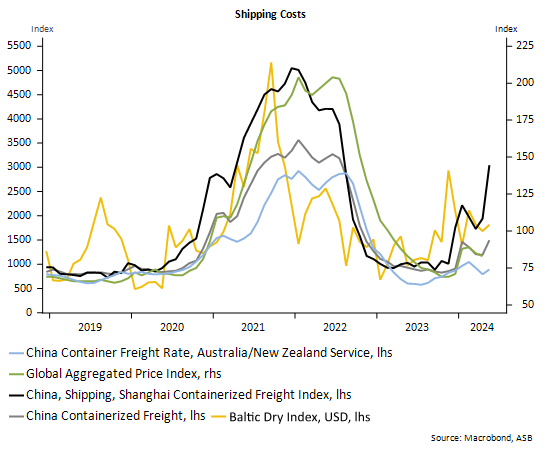
Smith says there is a lag of about six-to-nine months to retail prices in NZ, but the relationship is not exact.
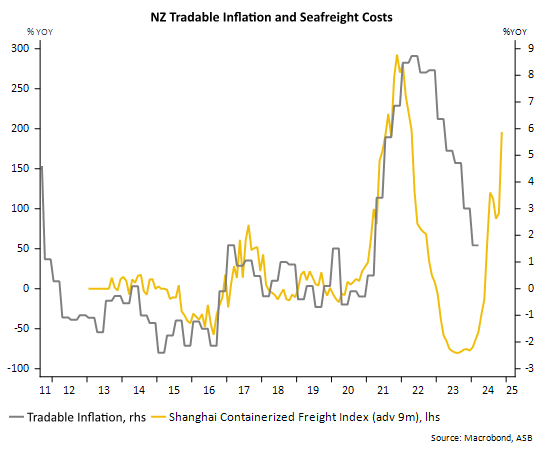
"If shipping costs hold up, the concern is that this could boost tradable goods prices in NZ, reducing the likelihood of annual CPI inflation falling below 3% by year end. This could delay RBNZ [Reserve Bank] rate cuts," Smith says.
After inflation began to soar in 2021 the RBNZ reacted by forcing the Official Cash Rate up from just 0.25% to 5.5%, where it is now. This has led to higher mortgages and subsequently reduced spending and a significantly dampened economy. The RBNZ aims for inflation within a 1% to 3% range. As measured by the Consumers Price Index (CPI), inflation was 4% for the March quarter. The RBNZ is forecasting that CPI inflation will be 2.9% by the end of 2024.
Smith says there are good reasons to expect "a considerably more modest inflation impact" in New Zealand from the latest shipping cost rises than during the pandemic rises.
"Freight is only one of the costs impacting consumer prices and firm profitability. Labour cost pressures (which usually constitute a larger portion of firm costs] look to be cooling.
"Our view is that the price and cost impacts from higher shipping rates will be considerably more isolated than in the 2021/22 episode and will not drive a generalised rise in inflation that the RBNZ will have to offset with tight monetary settings."
Smith still expects annual NZ CPI inflation to fall below 3% by year end, but concedes that persistently high shipping costs provide "some upside risk".
However, weak retail demand in New Zealand and the likelihood that retail inventory levels are high will mitigate the short-term impacts on NZ economic activity and inflation.
"There is limited scope for NZ firms to push through cost increases onto beleagured consumers, with high consumer resistance to accepting higher retail prices.
"Firms look to be under extreme margin pressure. Cost cutting in other areas and efforts to drive greater efficiencies (rather than price rises) could result as margins are rebuilt.
"Labour incomes are expected to be under pressure (job cuts and modest wage rises could be the result as firm’s trim costs).
"In other words, higher shipping costs are an adverse cost shock that will further crimp NZ and global household demand, one way or another.
"This will eventually weigh on NZ core inflation. The next move in the OCR will be down," Smith says.
We welcome your comments below. If you are not already registered, please register to comment
Remember we welcome robust, respectful and insightful debate. We don't welcome abusive or defamatory comments and will de-register those repeatedly making such comments. Our current comment policy is here.