
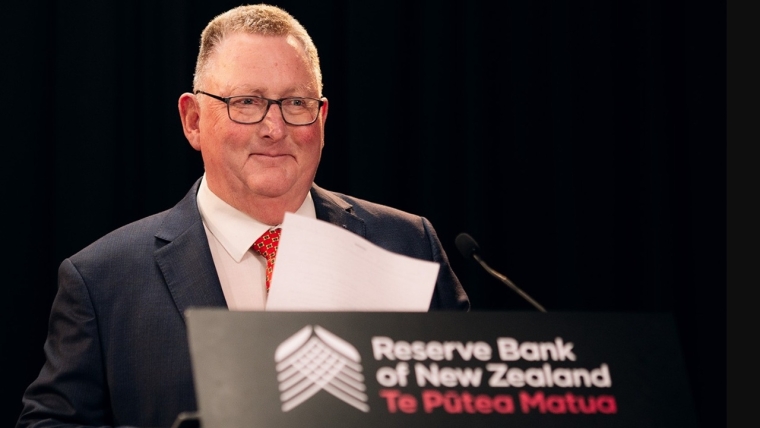
Departure of Governor Adrian Orr from the Reserve Bank may signal that the Official Cash Rate (OCR) now has "less downside" than would otherwise be the case, according to BNZ economists.
Orr left the RBNZ suddenly without explanation last week and a new governor will now be sought. At what turned out to be his last OCR decision media briefing on February 19 Orr strongly suggested the OCR would be cut by 25 basis points at each of the next two reviews on April 9 and May 28. The OCR's currently 3.75%, so, cuts as suggested would take it to 3.25%.
Economists at the country's major banks have proffered views on the departure of Orr, what it might mean and who might replace him.
ASB's economists note that the RBNZ is now "Orrless but not rudderless", while the Kiwibank economics team note "Adrian is out, with an Orr-fully abrupt exit".
BNZ head of research Stephen Toplis says the BNZ economists won’t be changing their rate cut expectations solely on the back of the "current ructions" down at the Reserve Bank, "but we warn strongly that the direction of risk to those forecasts is clearly upward".
Toplis says a potential "deal breaker" is NZ bank capital ratios, with higher ratios introduced by the RBNZ in 2022.
If Banks have to hold more capital, then lending rates will tend to be higher meaning that, all other things being equal, the cash rate needs to be lower to achieve any given lending rate, Toplis says.
"This is where it gets interesting. The current government is currently focussed on growth and sees the RBNZ’s current approach to bank capital as being overly restrictive to lending. Orr and Finance Minister [Nicola] Willis have been battling over this for some time and many speculate that their inability to resolve their differences was a major factor behind Orr’s departure.
"Willis has been 'taking advice on the amount of capital banks hold' and was putting a lot of pressure on Orr to change his mind. When Orr is replaced the RBNZ Board recommends a new Governor to the Minister of Finance who then approves (or not) the candidate. One can only assume the Board would be reluctant to suggest a replacement who had the same views as Orr on banking sector capital requirements.
"So, if the current proposed path of capital raising is moderated then, at face value, monetary conditions would become more stimulatory as lending rates would not be as high as would otherwise be the case, and the quantity of money available for lending would rise. This being the case, the cash rate would not need to fall as much," Toplis said.
Also talking about the capital requirements, ASB chief economist Nick Tuffley, says Orr was a strong proponent for lifting capital requirements "to a much stricter level than international norms".
"That added stability (and reduced economic and social damage from crises) comes at a cost of slower growth, so there is a trade-off to weigh up. Furthermore, the Depositor Compensation Scheme is due to come into effect this year, which would reduce the economic and social costs of any bank failure. The Government, in its Going for Growth agenda, appears set on reducing regulations that are in its view unnecessarily stifling growth and innovation. In the fullness of time we may hear more, but at this point we are merely a fly on the wall in a completely different building."
On a possible replacement for Orr, Tuffley said there are a couple of internal candidates, and several easy external names to reel off, though mainly quite orthodox candidates.
"The context for NZ (and the RBNZ) is an unstable world experiencing some huge shifts," Tuffley says.
"There is a case for the RBNZ Board to recommend someone with global experience and connections that will not only deliver on optimal monetary policy and prudential outcomes but also help burnish NZ’s reputation and connections with the rest of the world."
Tuffley says "someone with global clout would bring new perspectives".
He comments that being Governor of the RBNZ is a tough job.
"You make decisions, in a constant state of uncertainty, that can impact people considerably over the cycle. I hope Adrian gets some time to relax and enjoy some fishing."
Kiwibank's economics team of chief economist Jarrod Kerr, senior economist Mary Jo Vergara and economist Sabrina Delgado say in their weekly review that they were were "fiercely opposed" to many of the RBNZ’s actions in recent years, "from the near implementation of negative rates (which would not have worked), to the over stimulation and then heavy-handed hikes. Too much both ways. We’re moving on."
The economists say no one can deny that it has been an incredibly difficult and unprecedented time for the RBNZ.
"But perhaps the real kicker was the decline in communication and transparency from the Reserve Bank over Orr’s tenure. We look forward to a new governor as an opportunity for the Reserve Bank to improve its communication and transparency. We think it was fair to say the RBNZ was one of the most transparent in the world, and leaders in monetary policy… not today," they say.
The economists say RBNZ Deputy Governor Christian Hawkesby, Acting Governor until the end of the month, "should be in the running for the big role, and is a safe pair of hands".
"When thinking of who might come through as the next Governor a couple of names seem to be floating around the ring. Internally, Hawkesby and Assistant Governor Karen Silk are both seen as options. While externally, Dominick Stephens, who currently serves as the Chief Economic Advisor at the NZ Treasury, as well as John McDermott, the current Executive Director of Motu Economic and Public Policy Research, appear to be likely front runners. All great options."
We welcome your comments below. If you are not already registered, please register to comment
Remember we welcome robust, respectful and insightful debate. We don't welcome abusive or defamatory comments and will de-register those repeatedly making such comments. Our current comment policy is here.