

Here are the key things you need to know before you leave work today (or if you work from home, before you shutdown your laptop).
MORTGAGE RATE CHANGES
No changes to report today. All rates are here. And note, you can compare mortgage offers with our new calculator that takes into account other costs and cashback incentives, here.
TERM DEPOSIT/SAVINGS RATE CHANGES
There are no changes to report today here either. All updated term deposit rates less than 1 year are here, for 1-5 years, they are here.
PRICES FALL
QV says Auckland housing values have posted some significant declines with the biggest falls in the city's central and southern districts. There were also notable declines in Whangarei and Tauranga, but nationally, overall values were flat, they report.
LOWER STRESS
The November Equifax report about household credit stress reports improvements (less stress) in most categories reviewed. While past due exposure for home loans remains low, it got even lower recently. But the big improver was in past due risks for car loans, indicating borrowers are having an easier time servicing these liabilities. The report also signaled that loan application activity is now rising. For mortgages, this is weighted towards refinance and switching activity.
FHBs GETTING OLDER AS THOSE WHO MISSED OUT EARLIER TAKE THEIR CHANCE NOW
Westpac/Cotality FHB report confirms what others have previously report, that lower interest rates combined with lower house purchase prices are encouraging first home buyers into the housing market in increasing numbers. The retreat by mum-and-dad investors because there is now no practical return on their investment, is helping lower house prices. FHBs that were kept out of owning earlier because of affordability issues are taking the opportunity, and their entry is raising the average age of FHBs. On a 12-month rolling basis, the national average FHB age is currently 35.6 years, up from 34.4 five years ago. Auckland’s average FHB age is currently 37.0, with 35.8 in Wellington, and 34.8 in Christchurch.
CONCRETE OPTIMISM
Ready-mixed concrete production data for the September quarter was released today and it contains a suggestion that the bottom may have passed. Auckland volumes dipped slightly but are still near record high levels. Wellington volumes are still falling however and remain near decade lows. Christchurch volumes have returned to the stable levels they have had since 2018. It is the maintenance of the high Auckland levels that give the national optimism. And some regions like Northland and Waikato have shown good recent trends.
WMP IN BEAR PHASE
The overnight dairy Pulse auction of SMP and WMP was another negative result, especially for WMP which is retreating rather fast now, and at US$3460/tonne is now its lowest in a year, down almost -20% from its May 2025 peak.
IMBALANCE BUILDING
Meanwhile, while we don't have the industry production data for milk flow for the peak month of October yet, the September milk curve suggests it will be strong, helped by very good weather conditions. But New Zealand's rising production is mirrored i many other nations resulting is supply rising faster than demand.
CONFIRMATION OF PAYEE EXTENDS BEYOND BANKING SECTOR
Get Verified, the company set up by banks to provide a confirmation of payee to combat scammers, is extending its service to some non-banks Hnry, CentrePort, Health New Zealand, Te Whatu Ora and Givealiitle. It says more non-banks will follow in coming months and encourages the likes of fintechs, businesses and government agencies to "reach out to us now" to help plan for adoption early next year.
WE ARE HIRING
We have an opening in Wellington for a full-time Press Gallery journalist who can help us explain the New Zealand economy to New Zealanders. 2026 is Election Year, so there will be a lot to cover. See this.
NZX50 TURNS UP
As at 3pm, the overall NZX50 index is now up +0.4% so far on Wednesday. That puts it up +0.3% over the past five working days. And it is up +4.5% year-to-date. From a year ago it is now up +7.2%. Market heavyweight F&P Healthcare has dipped another -0.3% so far today. Mainfreight, Chorus, Oceania, and Kathmandu leads today's gains, Goodman, Skellerup, SkyTV, and Investore are the main decliners
NEW DATA BOSS
Colin Lynch has been appointed Government Statistician and Chief Executive of Stats NZ. He is currently Deputy Chief Executive, Policy at the Ministry of Housing and Urban Development, a role he has held since June 2024. From 2019 to 2024, Lynch was a Partner in Consulting at PricewaterhouseCoopers (PwC). Earlier he twice held Deputy Government Statistician roles.
LOTSA CHEAP FUNDING
Westpac's 5 year bond offer is now closed. They went into the market seeking $100 mln "plus oversubscriptions". They took $1 bln. It was priced at 3.868% yield including the 83 bps margin. More here.
BIG BANK PUTS ITS MONEY WHERE ITS MOUTH IS
ASB says it has allocated $1 bln of capital over the next five years for better use of pastoral land aiming to lift the productivity and resilience of 1,000 farms. They say access to this capital and the interest rates applied will be based on future returns, taking the new model into account, rather than current farm revenue. ASB will lend up to $5 million per customer, with wraparound advisory support over five years to help bring their new model to life. The loans will have a five year term. The claim is, based on research they commissioned, that this could improve GDP from these changes by $4.5 bln per year.
FULL-FLEDGED SURGE
In Australia, the value of new owner-occupier home loan commitments rose +9.8% in September from a year ago. Investment lending for housing soared +18.7% on the same basis to a record high. The housing surge is in full flight of unbridled enthusiasm.
SWAP RATES SOFTISH
Wholesale swap rates are probably a touch lower today especially at the short end. Keep an eye on our chart below which will record the final positions closer to 5pm. The 90 day bank bill rate unchanged at 2.47% on Tuesday. Today, the Australian 10 year bond yield is down -4 bps at 4.37%. The China 10 year bond rate is little-changed at 1.80%. The NZ Government 10 year bond rate is down -1 bp at 4.13%. The RBNZ data is now all delayed with Tuesday's rate is unchanged at 4.11%. The UST 10yr yield is down -4 bps at 4.08%.
EQUITIES FIRMISH
The local equity market is now up +0.5% in Wednesday trade so far. The ASX200 is up +0.2% in afternoon trade. Tokyo has also risen +0.2% at its open. Hong Kong is up +0.8%. Shanghai is up +0.2%. Singapore is up +0.1% at its open. Wall Street rose +0.2% on the S&P500 in modest Veterans Day trading.
OIL LITTLE-CHANGED
The oil price in the US is up +US$1 at just on US$61/bbl and the international Brent price is still just on US$65/bbl.
CARBON PRICE FIRMS BUT STILL LOW
There have been more active trading today and the price has firmed but only to $46.50/NZU. The next official carbon auction is on December 3, 2025 and likely heading for another failure. See our daily chart tracker of the NZU price for carbon, courtesy of emsTradepoint.
GOLD ON HOLD
In early Asian trade, gold is virtually unchanged from this time yesterday, still at US$4130/oz.
NZD FIRMER
The Kiwi dollar is up +20 bps from yesterday at just on 56.6 USc. Against the Aussie we are up +40 bps at 86.7 AUc. Against the euro we are up +10 bps at 48.9 euro cents. This all means the TWI-5 is up +20 bps at 61.1.
BITCOIN HOLDS
The bitcoin price is now at US$103,289 and down -2.3% from yesterday. Volatility has been moderate at just over +/- 2%.
Daily exchange rates
Select chart tabs
Daily swap rates
Select chart tabs
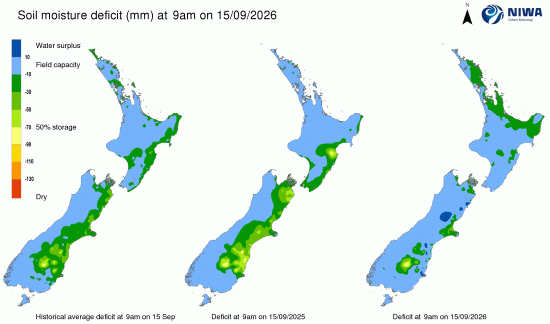
This soil moisture chart is animated here.
Keep abreast of upcoming events by following our Economic Calendar here ».
We welcome your comments below. If you are not already registered, please register to comment
Remember we welcome robust, respectful and insightful debate. We don't welcome abusive or defamatory comments and will de-register those repeatedly making such comments. Our current comment policy is here.