
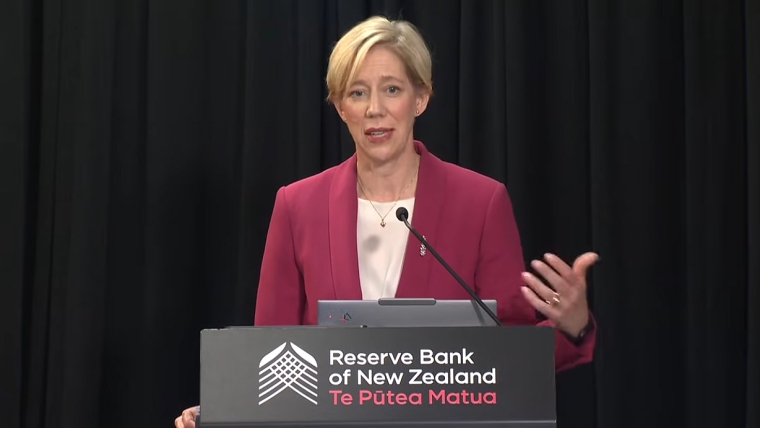
The Reserve Bank Governor says the November 7 general election wasn't a factor in the central bank’s decision to put the Official Cash Rate (OCR) on ice instead of increasing it by 25 basis points, as was widely anticipated.
Bank economists and financial markets had hotly anticipated that the Reserve Bank (RBNZ) would raise the OCR to 3% from 2.75% on Wednesday and were left stunned when it announced its decision to hold the cash rate at 2.75%. The pause follows two consecutive cash rate hikes from the RBNZ in July and September.
The NZ dollar fell 75 basis points against the US dollar and 100 basis points against the Australian dollar immediately after the decision was published.
Asked at a media conference in Auckland following the OCR announcement if the timing of the NZ election on November 7 was a consideration in the RBNZ’s decision, Governor Anna Breman said the Reserve Bank was focused on its mandate and bringing inflation back to target over the medium term.
“So since I took office, I have been very careful in emphasising how much the committee discusses the economic outlook and the conditions for reaching our mandate,” she said.
Later on in the conference, when questions about the election were raised again, Breman reiterated that election discussions don’t come up in monetary policy deliberations. She said the election came up when the RBNZ was preparing for media questions, but "not when we discuss monetary policy and bringing inflation back to target."
Eighteen minutes after the OCR announcement was released, Finance Minister Nicola Willis released a statement that said at 2.75%, the OCR was “half the rate it was under the Labour Government.”
“National’s disciplined spending and economic management has helped bring the OCR down from the 5.5% Labour left behind,” she said.
Willis' comments were raised at the media conference and Breman said her role was to comment on the inflation outlook, what the monetary policy committee had been discussing and how the RBNZ will deliver on its mandate.
“I think that's my role, and that's the comment that I have on that,” she said.
No 'predetermined' view
The OCR is the RBNZ’s main tool for striving to keep inflation within its 1% to 3% target range, with the RBNZ aiming for the midpoint sweet spot of 2%.
Currently, the RBNZ is forecasting that annual inflation, as measured by the Consumers Price Index (CPI), will increase to 4.4% in the December quarter, largely on the basis of current prices for oil futures. Annual inflation in the September quarter came in at 3.7%, largely driven by petrol prices, which were up 19.1%.
Global events like the falling exchange rate and rising fuel prices are adding to near-term inflation pressures in NZ. Domestically, the RBNZ also pointed to household consumption being weak, subdued employment growth and higher prices further reducing real incomes and purchasing power. House prices in NZ have also continued to decline, although the Reserve Bank is seeing some green shoots in Auckland.
The decision to keep the cash rate on hold at 2.75% ultimately resulted in a 4-3 split among the Reserve Bank's Monetary Policy Committee (MPC), which is in charge of OCR decisions. The committee is made up of four internal members, including Breman and three external members.
The RBNZ said internal members Breman and Rebecca Williams and external members Carl Hansen and Prasanna Gai voted to hold the OCR at 2.75%. Internal members Paul Conway and Karen Silk, plus external member Hayley Gourley, voted to increase the OCR by 25 basis points to 3% at the meeting.
The members wanting to hold the OCR at 2.75% said the cash rate hikes in July and September would allow the committee to take further time to assess the impacts of those OCR increases and economic developments. On the other side of the coin, members who voted to increase the OCR emphasised that core inflation had been above levels consistent with headline inflation at the target midpoint of 2% for some time.
The Reserve Bank said all of the committee members agreed that tighter monetary policy is likely to be required to bring inflation back into its target range – meaning more OCR hikes are on the horizon – but it remains conditional on the economic outlook.
At the media conference, interest.co.nz asked Silk, Conway and Gourley – who favoured increasing the OCR by 25 basis points – if they had wanted to hold the OCR at 2.75% before deciding to vote to increase it.
Silk said she didn't go into the meeting with a “predetermined view” on whether she was going to vote to increase or hold the OCR and that she decides as she proceeds through the meeting after receiving the full suite of information on the table.
Conway, the central bank’s chief economist who oversees the RBNZ’s forecasts and is normally not a man of few words, didn’t expand on his OCR vote and neither did Gourley.
Less pass-through
Back in early September, when the RBNZ released its latest Monetary Policy Statement, the RBNZ noted there had been a more “limited pass-through” of higher wholesale rates to term deposit rates, compared to mortgage and business lending rates.
Interest.co.nz asked if rate rises were still being passed through to borrowers faster than to savers since September. Breman said that the central bank had seen a “similar trend” since then.
“What we’re seeing is continued savings and also relatively subdued credit demand. So it means that we've seen the pass-through [of wholesale interest rates] being partial in both the deposit rate and the mortgage rate,” she said.
Silk said that the pass-through to both deposit rates and mortgage rates has been less than previously, but added that NZ was in a situation where banks were well funded, had higher deposit growth and were currently in a subdued credit demand environment.
In this environment, she said it was expected that there would be “less pass-through” of wholesale interest rates into deposits and mortgages.
“And that is what we have seen since the September meeting,” she said.
Please stop raising your prices
Earlier this year in March, Breman encouraged businesses that were able to “see through” temporary cost pressures to do so, rather than increase prices. Interest.co.nz asked her on Wednesday if she’d still advise businesses to focus on this in the current economic environment and Breman reaffirmed this position. She said cost pressures were tough on many businesses and were also tough on many households.
“That's why we're looking so carefully at how these higher fuel prices and shipping costs are flowing through onto other price categories,” she said.
Firms have told the central bank that it's been difficult to pass on cost increases onto households in the current environment, and Breman said the less businesses pass on price increases, the less inflation will climb.
“And then we're likely to need to increase the OCR less than if we saw a high pass-through,” she said.
Breman said the RBNZ will have a new set of economic forecasts and a new OCR path after its next monetary policy review on December 9.
The December meeting is the last OCR review for the year and will also be the first monetary policy meeting out of the gate following the NZ election.
We welcome your comments below. If you are not already registered, please register to comment
Remember we welcome robust, respectful and insightful debate. We don't welcome abusive or defamatory comments and will de-register those repeatedly making such comments. Our current comment policy is here.