

Health insurance revenue increased 14.7% in the June year, the Reserve Bank says, with revenue rising to $3.22 billion from $2.81 billion a year earlier.
Meanwhile life insurance revenue and general insurance revenue have remained broadly stable, the Reserve Bank’s (RBNZ) latest Financial Stability Report, released on Tuesday, said.
The report said life insurance revenue was $3.22 billion in the year to June, compared with $3.29 billion a year earlier while general insurance revenue was $11.28 billion in the year to June compared to $11.48 billion a year earlier.
“General insurers continue to report positive financial results and maintain strong capital positions, despite weather-related claims during 2026.”
For general insurance, the report said its service results declined from $4.16 billion to $3.33 billion, returning close to the level recorded in the year to June 2024.
“Commercial insurance premiums have softened, reflecting increased competition and greater participation by international insurers in the New Zealand market,” the report said.
Profitability has moderated from recent high levels, while solvency positions remained broadly stable.
“Climate adaptation and insurance affordability remain important challenges. Property insurers are increasingly assessing and pricing risk at the individual-property level, while emphasising the need for better hazard information and planning decisions that limit further development in high-risk locations.”
Aotearoa is viewed as the second riskiest country in the world when it comes to natural hazards, and since 2010, $64 billion has been spent on natural disasters, an average of around $4.2 billion a year.
And since 2000, the price of house insurance has increased 916% - which consumer advocacy organisation Consumer NZ says is the biggest price rise for goods monitored by the Consumers Price Index (CPI) over the past 25 years. Alongside this, premiums have increased three times more than CPI inflation since 2011.
‘Certainly opportunities for better linkages’
In May, the RBNZ’s (then acting) assistant governor of financial stability Angus McGregor told reporters the prudential regulator wanted banks to have a much broader sense of insurance coverage across their loan portfolio.
“There are some insurers and some banks, who are increasingly working closely together to ensure that data is more free flowing. We would really like to see that, ideally at a system level, so that lenders and insurers are sharing information more effectively,” he said at the time.
Asked about how this was progressing at Tuesday’s online media conference, McGregor said they were continuing to work on this.
“There are certainly opportunities for better linkages in that context and improved data on that. I would anticipate us reporting back on that over time as we get more insights.”
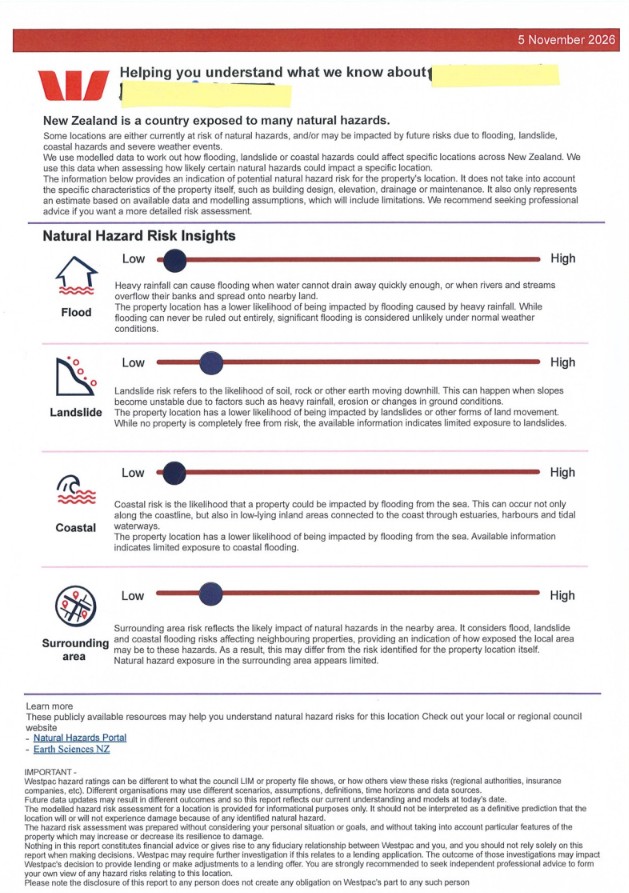
Loan lending, insurance and climate change was highlighted last week with Westpac announcing that it would be providing natural hazard risk information to would-be homebuyers wanting to take out a loan with them.
While the bank didn’t expect to decline any applications solely based on natural hazard insight, it said this may mean the amount it was comfortable lending on an at-risk property was less than it may have been before.
Asked if they expected other banks to do the same, Governor Anna Breman said the RBNZ had highlighted throughout the years that climate change and its implications such as increased flooding, will pose risks to insurance companies and this would have an impact on insurance affordability.
McGregor said Westpac providing natural hazard reports was an interesting development and thought it demonstrated an increased focus on the risks Breman was referring to.
He said the RBNZ would keep an eye on how the system is operating but whether banks would follow Westpac were commercial decisions for banks to be making.
Asked about whether the RBNZ saw a role for itself in requiring insurers to formally share information with banks, McGregor said the central bank’s strong preference was that banks and insurers worked together to share this information between themselves.
Asked what it would take for the RBNZ to step in and regulate to require insurers to formally share information with banks, RBNZ director of prudential policy Jess Rowe said: “What we’re always looking at, if you think about intervention and additional regulation, is do we have a solid evidence base that suggests that these risks are both systemic enough, large enough, and unable to be managed through the market and system participants.”
“And at that point, then we would think about what is the economic case for intervention, and which agency across the system is the right agency to do it,” Rowe said.
Rowe said to date, the RBNZ had not identified a systemic prudential risk with this and the central bank was very careful in the way it recommended interventions.
“We continue to work and source the data, but at this stage, that high burden for an intervention isn't met.”
Insurance revenues
Despite weaker results than a year earlier, general insurance service results remained “favourable and capital buffers remained substantial”, the report said.
“Aggregate results indicate that general insurers continue to absorb weather-related losses while maintaining positive financial performance and strong capital positions.”
The report said insured losses from four extreme weather events between January and April were about $265 million, broadly equivalent to the $278 million of extreme-weather insured losses reported for the whole of 2025.
'Further premium increases could place additional pressure on affordability and policy retention'
Meanwhile, health insurers continued to face pressure from elevated claims costs and healthcare inflation, the report said.
“Premium increases and other management actions have materially improved profitability and helped stabilise solvency margins, although further increases could add to affordability pressures and reduce policy retention.”
For health insurers, the “aggregate insurance service result before outwards reinsurance, which broadly reflects insurance revenue less claims and other insurance service expenses, moved from an $85 million deficit to a $209 million surplus.”
The RBNZ said the recovery followed significant premium increases and changes to products, benefits and claims-cost management introduced in response to the earlier escalation in medical claims.
“However, claims-cost and affordability pressures remain, with some insurers continuing to expect elevated claims ratios and further pricing and product responses.
“Industry-commissioned research also reports higher policy termination rates in 2025 than in 2022. Further premium increases could place additional pressure on affordability and policy retention, potentially constraining membership growth and affecting the composition of insured portfolios.”
When it came to life insurers, they remained profitable overall, the report said, but weaker earnings and challenges in disability income insurance were weighing on performance.
“Disability income insurance remained a key profitability challenge for several insurers and continued to weigh on overall sector earnings. Before outwards reinsurance, individual and group disability income recorded negative insurance service results of $37 million and $13 million, respectively.
“Several insurers reported adverse disability income or income protection claims experience and have responded by strengthening assumptions, increasing premiums and reviewing products and claims management. The sector is increasingly focused on improving the longer-term sustainability of disability income portfolios through repricing and closer portfolio management.”
Solvency pressure
The RBNZ said for life insurers, the most common sources of solvency pressure were mortality and morbidity claims associated with pandemic or infectious-disease events, together with disruptions to reinsurance arrangements.
“For health insurers, sustained medical cost inflation and higher claims utilisation could weaken profitability and solvency, particularly where affordability pressures constrained the timing or extent of premium increases.
“Cyber and operational incidents were generally not the primary driver of solvency stress but often amplified losses by increasing costs, disrupting services and delaying recovery actions.”
A 2025/2026 reverse stress test done on life and health insurers by the RBNZ, prompted some of them to strengthen their risk management.
This included doing things like having stronger capital triggers, reviewing reinsurance arrangements, increasing cyber cover and making improvements to recovery plans.
We welcome your comments below. If you are not already registered, please register to comment
Remember we welcome robust, respectful and insightful debate. We don't welcome abusive or defamatory comments and will de-register those repeatedly making such comments. Our current comment policy is here.