
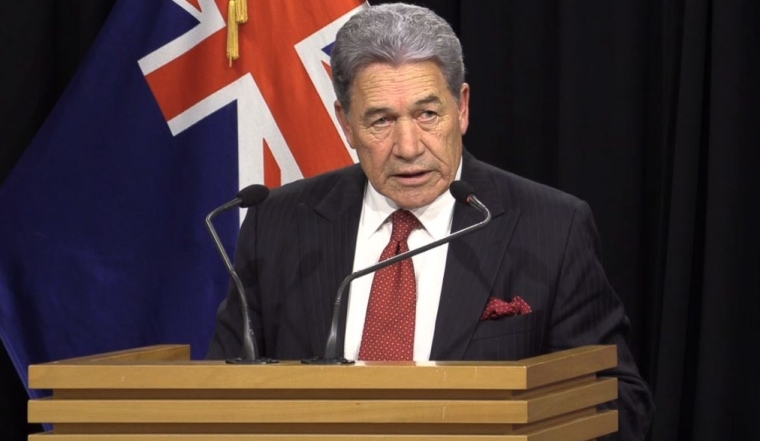
New Zealand First Leader Winston Peters says reinstating the Provincial Growth Fund (PGF) will be a bottom line for his party in any post-election coalition government negotiations.
He told the Taranaki Chamber of Commerce on Friday his party “regards the PGF in its current form as a pre-condition in any future government formation”.
Peters’ office confirmed to interest.co.nz this means the party will be seeking another $1 billion a year over three years for the PGF.
This is the first bottom line NZ First has revealed it will bring to the negotiating table post-election, should it have the opportunity.
National Leader Simon Bridges has ruled out working with NZ First, but Peters told the crowd (who live in a blue electorate): “Having been in politics a long time, and a member of the National Party for over 25 years, the one thing our Party is confident about is that the first call we will get on election night 2020 will come from the National Party.”
Peters stuck to the Coalition Government’s position that its focus is on a transition to a lower carbon economy, and didn’t mention the ban of new offshore oil and gas exploration permits affecting Taranaki.
He earlier in the day announced a PGF investment of $19.9 million in a hydrogen energy facility in South Taranaki.
Hiringa Energy will produce “green” hydrogen from renewable electricity and water, which will be used to power the Ballance Agri-Nutrients’ Kapuni plant.
Immigration cuts by an unspecified number
Peters indicated reducing immigration would again be a cornerstone policy for NZ First going into the election.
He didn’t put a number on where he thought net inward long-term migration should sit, as he did ahead of the 2017 election, when he said 10,000 people.
Rather he said “NZ First is going to lead the overdue debate about what is a sustainable population policy”.
“We think you need to make it clear to your politicians how many is too many. We will then act on your choice.”
Net migration has eased under the Coalition Government, but only to 44,000 people from a peak of nearly 64,000 in mid-2016.
Peters dubbed current levels “unsustainable”, saying: “Not only does it distort our economy but in our view we make it too easy to become a New Zealand citizen.
“Immigration settings are accentuating the flow of people into our cities, Auckland most profoundly, but at the expense of regional New Zealand.”
He said, a vote for NZ First would see:
- “the permanent residency qualification raised from two to five years;
- “the introduction of a rural visa scheme (replicating successful schemes in Australia and Canada, that will apply to communities with fewer than 100,000 residents, and which will place into law an obligation for migrants to stay in their specified place of settlement until they have secured permanent residency;
- “greater ministerial control exerted to ensure Immigration New Zealand administers agreed policy settings.”
Tax relief targeting SMEs
Peters also promised “targeted tax relief” to benefit small to medium sized businesses. His policy includes:
- “Accelerated Depreciation – That is, allowing business to depreciate at the same rate as Australia to help them bring forward their investment decisions;
- “A ‘Give it a Go’ Scheme – Where we will offer special tax concessions for certain business start-ups in rural and regional New Zealand.
- “An Instant Asset Write-Off Scheme – which would allow small businesses with turnover less than $1 million to claim immediate deductions for new or second-hand plant and equipment purchases such as vehicles, tools and office equipment up to a combined value of $3,000 annually.”
Peters also reiterated NZ First's opposition to a capital gains tax.
We welcome your comments below. If you are not already registered, please register to comment
Remember we welcome robust, respectful and insightful debate. We don't welcome abusive or defamatory comments and will de-register those repeatedly making such comments. Our current comment policy is here.