
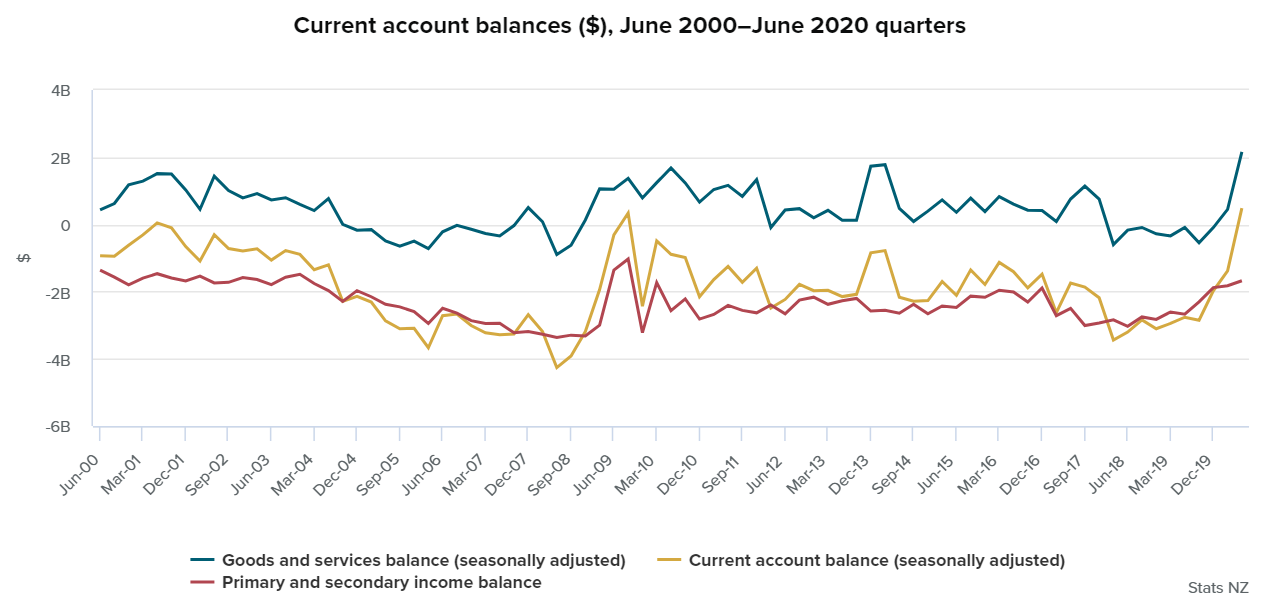
The country had a record current account surplus for the June quarter, while the annual current account deficit for the year to June fell to just 1.9% of GDP, which was better than economists' forecasts and was just half what the deficit was a year ago.
This is the smallest the current account deficit has been as a percentage of GDP since the year ended June 2010, when it was 1.7% of GDP.
Statistics New Zealand said on Wednesday that the country's annual current account was a $5.8 billion deficit (1.9% of GDP) for the year ended 30 June 2020, which compared with the $11.6 billion deficit (3.8% of GDP) for the year ended 30 June 2019.
In terms of the quarterly figures, Stats NZ said our Covid-19 lockdown saw imports fall more than exports, leading to a record seasonally-adjusted current account surplus of $482 million in the June 2020 quarter. This is the first seasonally adjusted surplus since 2009.
“New Zealand earned more than it spent in transactions with the rest of the world due to a sharp slowdown in international trade because of Covid-19,” international statistics senior manager Peter Dolan said.
“This reflects a slump in demand for oil imports and in spending by international tourists, while dairy exports held up in the June quarter, boosting the current account into the black.”
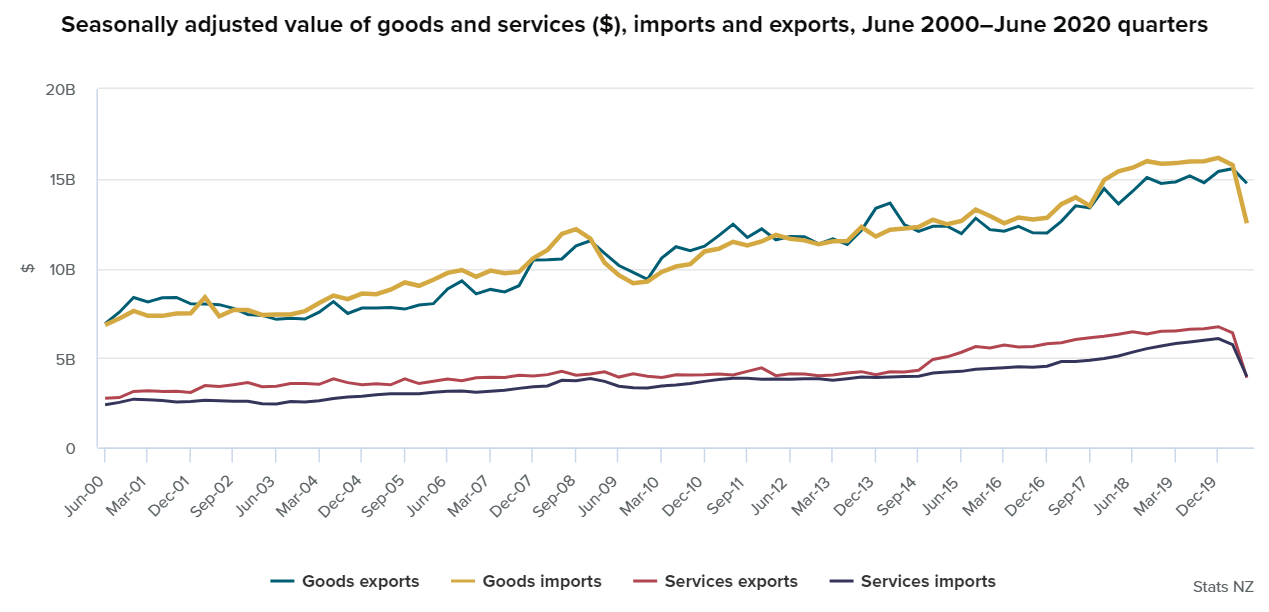
The current account surplus was driven by the goods balance turning from a deficit into a $2.2 billion surplus. Exports fell $0.8 billion in the quarter but imports fell much more, down $3.2 billion.
The detail was that seasonally adjusted goods imports fell 21% ($3.2 billion) to $12.5 billion while seasonally adjusted goods exports fell 5.2% ($812 million) to $14.7 billion. The seasonally adjusted goods balance was a surplus of $2.2 billion, the first quarterly surplus since the June 2014 quarter.
New Zealand’s seasonally adjusted current account surplus of $482 million in the June 2020 quarter is the biggest in the series since 1971, and compares with a $1.4 billion deficit in the March 2020 quarter.
“A current account surplus occurs when New Zealand’s earnings from the rest of the world from exports, income on investments, and secondary income are larger than our expenses to the rest of the world,” Dolan said.
“This is only the 11th quarterly seasonally adjusted current account surplus in the series. New Zealand typically runs a deficit, spending more than we earn – the last time we had a surplus was 11 years ago.”
But in marked contrast to what happened with goods trade, New Zealand’s services balance was in deficit in the June quarter for the first time since the September 1998 quarter.
Exports of services were $3.9 billion in the June 2020 quarter, down $2.5 billion from the March 2020 quarter. Travel services were $2 billion for the quarter, which was down 48% (or $1.9 billion), after the border was closed to overseas visitors.
Imports of services were also down in the June 2020 quarter, by $1.8 billion. At $4 billion it is the smallest quarterly value since the March 2014 quarter.
“Overseas tourist spending on travel and transportation services took a big hit in the latest quarter as border crossings were restricted. However, there were still international visitors in the country from before the lockdown and the limited number of flights increased the cost of transporting freight,” Dolan said.
On the big fall in oil imports, Dolan said domestic demand for crude oil imports fell as people stayed home during the lockdown, Dolan said.
“Crude oil imports were much lower than usual from April to June 2020, with much less travel by road and air," he said
"Oil imports fell to zero in July, just after the end of the June 2020 quarter. With only essential businesses allowed to operate during alert levels 3 and 4, wholesale and manufacturing trade also shrank, reducing the imports required for production and further hitting related suppliers.”
We welcome your comments below. If you are not already registered, please register to comment
Remember we welcome robust, respectful and insightful debate. We don't welcome abusive or defamatory comments and will de-register those repeatedly making such comments. Our current comment policy is here.