
Business confidence is flat - but inflationary expectations are not. Those are the key things to come out of the February ANZ Business Outlook Survey.
ANZ chief economist Sharon Zollner says Inflation pressures continue to build. Freight disruptions are worsening, and are most severe for the retail sector (inward) and manufacturing (outward).
“There is little sign of inflationary pressures abating as yet," she says
"A jaw-dropping net 67% of retailers expect to raise their prices.
"On the cost side, 90% of those in the agriculture sector, and more than 80% of manufacturers and those in construction expect higher costs.
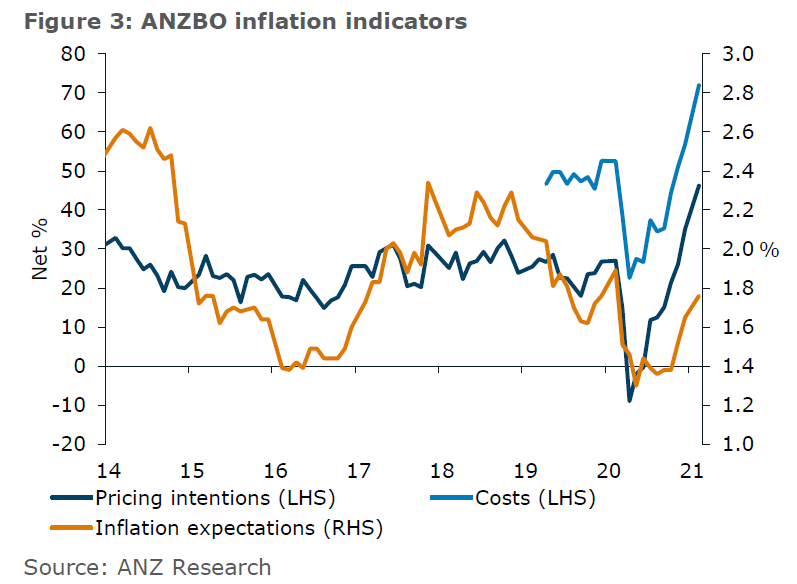
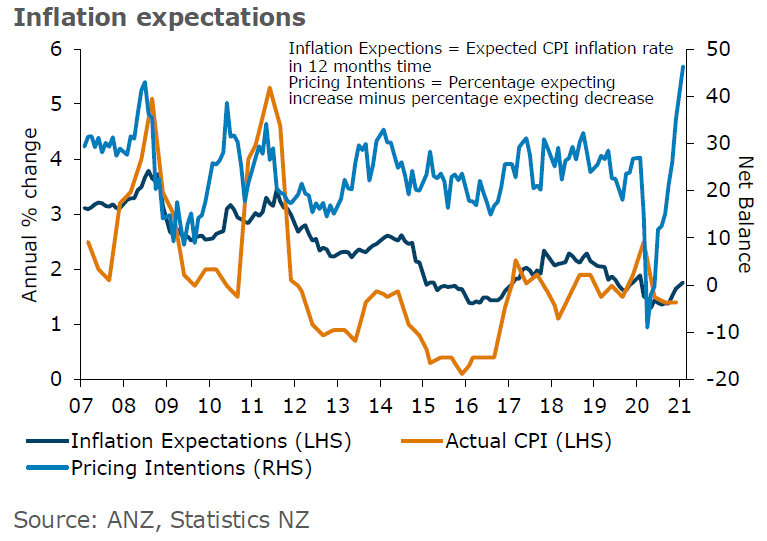
“Retail sector inflation expectations have cracked the 2% mark again for the first time since April 2019.
Commenting on the survey, ASB senior economist Mark Smith said the pricing details from the survey "remained worrisome" and point to a generalised firming in consumer prices.
"Cost pressures and pricing intentions remain elevated and capacity metrics have firmed, pointing to the risk of a protracted lift in prices that could see the [Official Cash Rate] moving up next year," Smith said.
"The issue will be for how long these pricing pressures persist for given rising costs and whether it heralds a firming in medium-term inflationary pressure that will see the RBNZ [Reserve Bank] raising the OCR.
"We expect the risks are tilting towards the latter, with the OCR to move up in August next year," Smith said.
ANZ's Zollner says the ANZ economists "take" for 2021 is that it "will not be an easy year for the New Zealand economy".
We are, however "absolutely better off than most", and will have less economic scarring, making our economy more resilient.
She said the overshoot in demand resulting from the disruptions of 2020 is beginning to dissipate, "and we expect the economy to go broadly sideways for a while as it digests the national income hit from the decimated tourism industry and as the housing market cools to something more sustainable".
“We have a lot going for us, but we’re not going to get away scot-free.”
Some of the detail of the survey:
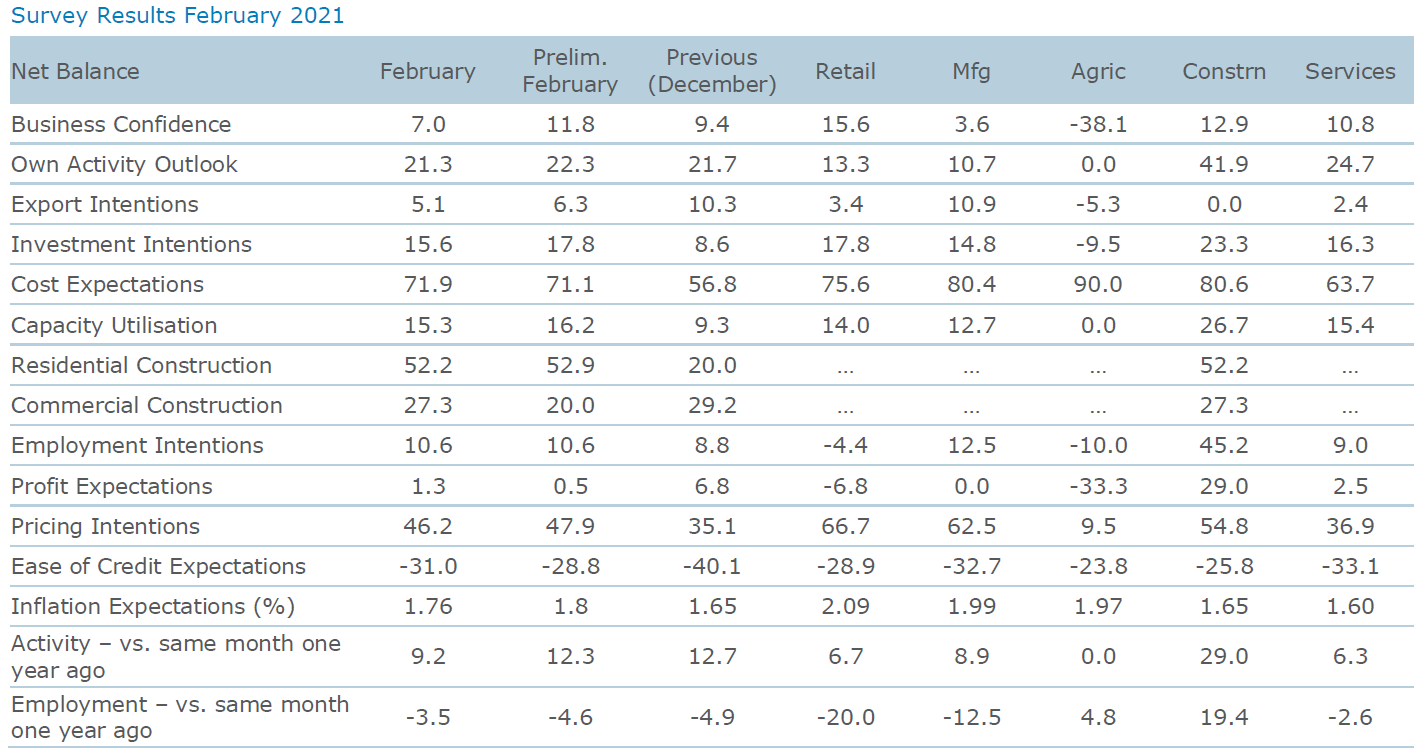
Headline business confidence fell a couple of points to net 7.0%, while firms’ own activity outlook eased 1 point to 21.3%.
Most indicators are slightly lower than their preliminary February readings, likely influenced by the snap lockdown.
·Business confidence fell 2 points to net 7.0%.
·Firms’ own activity outlook eased 1 point to 21.3%.
·Investment intentions lifted 7 points, to 15.6%.
·Employment intentions lifted 2 points, with a net 10.6% of respondents planning to hire more staff.
·Firms are busy on the whole, with capacity utilisation up 6 points to 15.3%. The construction sector is the busiest by far.
·Inflation pressure is rising. Cost expectations rose 15 points to a net 71.9% of respondents reporting higher costs. A net 46.2% of respondents intend to raise their prices, a historically very high level. General inflation expectations rose to 1.76%.
·A net 1.3% of firms expect higher profits, down from 6.8% in December.
·Export intentions 5 points to a net 5.1%.
·A net 31% of firms expect credit to be harder to get.
·Residential construction intentions jumped a massive 32 points, with a net 52.2% of firms expecting higher activity. Commercial construction firms’ intentions eased 2 points, with a net 27.3% of firms expecting higher activity.
·Inflation pressures continue to build. Freight disruptions are worsening, and are most severe for the retail sector (inward) and manufacturing (outward).
We welcome your comments below. If you are not already registered, please register to comment
Remember we welcome robust, respectful and insightful debate. We don't welcome abusive or defamatory comments and will de-register those repeatedly making such comments. Our current comment policy is here.