

Retail banks in New Zealand still have elevated leverage and there is no sign it is reducing.
This story updates our earlier analysis of bank leverage with results from the third quarter of 2011 from the latest Disclosure Statements to September 30, 2011.
Bank assets rose sharply to $352.5 billion at September 30, 2011, an increase of $13.6 billion from the quarter to June. This is the second highest level they have ever been, only eclipsed by the $357.4 billion at December 2008.
Total assets (which includes bank loans and advances) rose $3.4 billion at ANZ-National, were up by $3.8 billion at Westpac, rose by $4.6 billion at BNZ, but hardly changed at ASB (up by just $200 million).
Shareholder investment ("Shareholder Funds") however grew much more modestly, although they did rise to a record level of $25.4 billion for all retail banks.
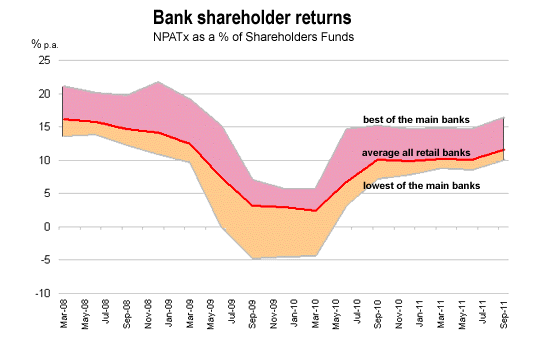
This was up $472 million, and in the year to September 30, 2011 these retail banks collectively earned an 11.6% return after tax on this investment.
This is the highest return we have seen since March 2009 when they collectively earned 12.4% after tax, and they were then coming off a long series of declining returns from very high levels.
Total after-tax profit for all retail banks in New Zealand over the four quarters to September 2011 was $2.888 billion.
In the quarter to September 2011, BNZ raised its shareholder investment the most (mainly through retaining excellent earnings), increasing them by $317 million.
Over the whole year to September, BNZ earned 16.4% after tax on its NZ investment, the highest of all the retail banks. ANZ-National earned 10.3% after tax, Westpac 10.1% after tax, and ASB 13.8% after tax.
At the other end of the scale, Kiwibank was the lowest earner, its shareholders achieving a 4.9% after-tax return.
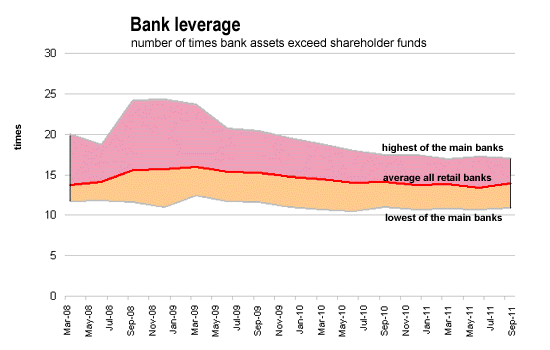
The broad relationship between total assets employed in the bank and the level of shareholder investment is termed "leverage".
Retail banks were leveraged 13.9 times at September 2011 - that is, they had 13.9 times more assets employed than shareholder investment.
This is high and represents high-risk business and funding strategies being employed.
Excessive leverage enables those very high rates of return to be achieved, but it also exposes them to high risks that seem very inappropriate in a financially uncertain world. (In our opinion, we think appropriate leverage should be at about half these levels at this time of the business cycle. You can read more of our opinion here.)
The lowest retail bank leverage is by ANZ-National (11.0 times) and Rabobank (11.8 times) as at September 2011. BNZ has the highest of the main banks at 17.0 times. Of all the retail banks, Kiwibank is the highest at 23.4 times.
Despite the very uncertain global situation which directly affects bank funding ability, there is absolutely no evidence New Zealand banks are making any efforts to reduce leverage. The main banks and Kiwibank all operate with an implicit "to-big-to-fail" taxpayer back-up even with the RBNZ's Open Bank Resolution policy - certainly customers and depositors continue to assume they will get bailed out in some way if there is a collapse by one or more retail banks. Average leverage of almost 14 times assets certainly appears high-risk.
And the high returns the shareholders are earning* reflect that high risk. At the current 11.6% after-tax per annum, shareholders get their investment back in about nine years. Said another way, nine years of after-tax returns will net them $25 billion at the current rate. (Having said that, however, the last nine years have not returned them that much because of the GFC impact, and the overturning of their aggressive tax positions.)
You can see a useful summary of this data here. It is updated as soon as each bank reports its results.
-----------------------
* Banks pay significant tax on these earnings. In fact ANZ-National is the single biggest taxpayer in the country, paying almost $0.5 billion in tax annually. Together, the four main banks paid more than $1 billion in income tax in the past year.
10 Comments
So many reasons to swap fiat dollars for tangible assets, so few tangible assets.
With a chance of the value of the shares dropping by 50% in the next few years, I'd say the PE is still far too high. Not that I'd waste my own labour on paper, especially not bank paper.
When I finally digested this, I felt sick. Tell me I missed something.
http://www.golemxiv.co.uk/2011/12/plan-b-how-to-loot-nations-and-their-…
Longish article, worthwhile, connecting many dots.
Bankrupcy law has changed in between 2003 to 2005 in the US and in most European countries and provided the incentives to leverage to infinity. And the wheel is turning faster and faster.
Trade in Derivatives increased in the 6 months to June 2011 by 18% to an astonishing 707 Trillion.
"If you want to bleed a man – kill him and you get about 5 litres/quarts. But strap him to a gurney with a catheter in his arm and a drip feed in his nose, and he will bleed for you for as long as his system can stand it."
And therein can be found the best analogy to help peasants understand what the banks and govt and especially the reserve banks, do to protect the banks and the bank profits because it's on those profits that the bank bosses harvest their bloated bonuses each year..every year...
Until it all explodes...but by then the bankers et al have moved to safe ground...no damage no loss...let the shareholders taxpayers and silly savers cop it in the face.
I am reminded of some fat sod blowing up a hot water bottle...until at the gargantuan point the rubberised water bootle skin just couldn't take any more expansion...and the onlooking crowd of gob smacked peasants were hit with a shockwave as the monster blew its guts out....there too goes the NZ economy because unregulated banking greed will always go on and on until the day it all goes bang.
Iffin you expected the RBNZ to be acting in the countries best interests...well fool you...it is the reserve bank...ie the bankers bank...not your bank ....it's there to make hay for the banks...using you as the serf...and the fatheads down the road in the Beehive to make sure the laws protect the banking credit...that's why you get shafted with the mortgage debt and not the bank that created the credit...sucker.
@ Gertraud T. - ...Tell me I missed something.
You got the whole story in one- lax regulation is at the core of all the problems we currently endure.
Another is the constant creation of liquidity to salve insolvency - impossible though it is.
The latest attempt undertaken by the US Federal Reserve is well descibed by ZH.
11% after tax return ? I wouldn't run a business for that return, especially a higher leveraged one. And hardly bloated profits I would thought based upon $25bln of shareholder funds which concerns me in that should they decide to to deleverage, and retain half acceptable return, along with cutting costs and services, they would have to start pushing out their margins.
And.....the RB's just given them Covered Bonds too! At our, depositors and taxpayers, potential peril. Whiggery outofcontrol.
Ergophobia
David, where are the bulk of these assets. which sector? can you delve a little deeper? If nzs population is falling, if the stats can be belieived and the rest of the western world is landuishing, this sort of growth is incredible. it reminds me a bit of SCF just prior to implosion. cheers
Australian Banks Given One Week To Prepare For European "Meltdown"
Australia’s banks have A$87.2b of exposure to Europe, or 2.7% of assets, with A$74.6b of it mostly tied to bank borrowers in France, Germany, Netherlands, AFR says, citing RBA statistics.
Australian Prudential Regulation Authority envision worst-case scenario of 12% unemployment, 30% drop in house prices, 40% fall in commercial property values, AFR says.
http://www.zerohedge.com/news/australian-banks-given-one-week-prepare-european-meltdown
We welcome your comments below. If you are not already registered, please register to comment
Remember we welcome robust, respectful and insightful debate. We don't welcome abusive or defamatory comments and will de-register those repeatedly making such comments. Our current comment policy is here.