
By Bernard Hickey
It's official.
Interest rates are on now on hold for the forseeable future after the Reserve Bank of New Zealand all but removed its monetary policy tightening bias on Thursday morning because of a surprising absence of inflationary pressures despite a strong-growing economy.
The central bank held the Official Cash Rate at 3.5% as expected and repeated its expectation of an unspecified "period of assessment" before it makes "further policy adjustment."
But the Reserve Bank did shift its language slightly about future rate hikes, dropping a comment used on September 11 about "some further policy tightening" being necessary to keep inflation near its 2% target. Instead, in this OCR statement, it simply said a period of assessment was needed before policy adjustment, without specifying it would be a tightening.
However, the bank kept its warning that it expected inflation to increase as the economy's expansion continued. It also repeated its warning that the New Zealand dollar was "unjustifiably and unsustainably" high, and continued to constrain growth in the tradables sector.
Economists described the statement as dovish and noted the bank had formally dropped its tightening bias.
BNZ Head of Research Stephen Toplis said the Reserve Bank had been spooked by the fact it could not find any inflation.
"Unlike the Fed, who this morning intimated that the near term drop in inflation was transitory, the RBNZ thinks it might be more permanent," Toplis said. "Accordingly, it has, for all intents and purposes, said it is on hold for the foreseeable future," he said.
In recent weeks economists have extended the length of the Reserve Bank's expected pause until September 2015 at the earliest after much lower than expected inflation figures in recent months, both in New Zealand and globally. This has lowered expected wholesale interest rates and has been passed on by banks as lower fixed mortgage rates in recent weeks. Wholesale 'swap' rates fell another two or three basis points after the monetary policy decision this morning.
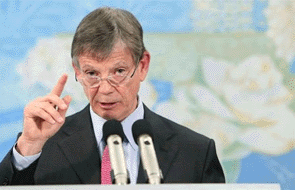
Reserve Bank Governor Graeme Wheeler said the global economy was growing at a moderate rate, although some data suggested some softening in major economies apart from the United States. Wheeler noted monetary policy was expected to remain supportive for longer in all the major economies.
New Zealand economic growth had been faster than trend through 2014, which had reduced unemployment and added to demands on productive capacity. Low interest rates, high net migration and strong construction were supporting growth, although the bank expected growth to moderate over coming years to a more sustainable rate.
Repeated NZ$ warning
Wheeler said lower commodity prices had taken some pressure off the New Zealand dollar.
"However, its current level remains unjustified and unsustainable and continues to constrain growth in the tradables sector. We expect a further significant depreciation," he said. This a repeat of the 'unjustified and unsustainable' language used by the bank's September 11 Monetary Policy Statement, which was published after the Reserve Bank intervened in the currency markets in August.
The Reserve Bank releases its September intervention figures this afternoon. The New Zealand dollar dropped 20 or 30 basis points to 78.0 USc after the Reserve Bank's statement at 9 am, having earlier fallen from 79.5 USc after the US dollar strengthened on the end of US Federal Reserve Quantitative Easing.
Wheeler said inflation remained modest in New Zealand with subdued wage inflation, anchored inflation expectations, weak global inflation, lower oil prices and the high New Zealand dollar being contributing factors. House price inflation had fallen significantly since late 2013 because of the 100 basis points of rate hikes from March to July and the bank's high LVR speed limit, he said.
"The economy appears to be adjusting to the policy measures undertaken by the Bank over the past year. CPI inflation is currently at a low level despite above-trend growth," Wheeler said.
"However, inflation is expected to increase as the expansion continues. A period of assessment remains appropriate before considering further policy adjustment," he said.
The bank said in its September 11 statement it expected some further policy tightening would be needed to keep future average inflation near 2%. The phrase around "further policy tightening" was dropped in this statement, as was the comment about the target of 2%.
Political reaction
Green Co-Leader Russel Norman described the bank's actions as a U-turn that showed its had run monetary policy too tight, causing unnecessary suffering through job losses and higher interest rates.
“Unfortunately the inflation projections were wrong and, more than that, the OCR isn’t the best tool to deal with inflationary pressures that do exist. This has been to everyone’s cost,” Norman said.
“Graeme Wheeler hiked interest rates on the expectation that inflation would rise, but that hasn’t been the problem. Beyond getting the inflation projections wrong, the bank relied too heavily on the OCR to try to crush illusory inflation by hiking interest rates across the board," he said.
“Higher interest rates have cost jobs, lifted homeowners’ mortgage payments and damaged exporters," he said.
“The inflation that is in the economy is rooted in house and electricity prices and that pressure remains because National has pursued its failed policy to leave it to failing markets to sort these things out.To be fair to Mr Wheeler he has used Loan to Value Ratios to try to limit house inflation, but this has hurt first home buyers more than house speculators. What we need is for the Government to play an active role in the housing market and to curb the anti-competitive behaviour of electricity companies."
Economist reaction
ANZ Chief Economist Cameron Bagrie said there were clearly more dovish nuances in the Reserve Bank's statement, validating ANZ's view that the OCR was on hold for an extended period. Here's his comments:
While the RBNZ still has a tightening bias (inflation is after all still expected to move up as the expansion continues), executing on this looks to be far off given current uncertainties and ambiguities, with the RBNZ in effect delivering a neutral statement. In fact one could easily take today’s statement as suggesting the tightening cycle is close to an end (trend growth, low inflation, easing house price inflation, etc).
However, the central scenario still looks one of slow uplifts in inflation going forward and on that basis further upwards tweaks to the OCR look inevitable (but not imminent). Looking forward, we expect a December 2015 start to OCR hikes, but for this to be highly data dependent given the uncertainties surrounding the outlook.
BNZ Head of Research Stephen Toplis said the Reserve Bank had dropped its tightening bias.
The RBNZ has been spooked by the fact that it can’t find any inflation. Unlike the Fed, who this morning intimated that the near term drop in inflation was transitory, the RBNZ thinks it might be more permanent. Accordingly, it has, for all intents and purposes, said it is on hold for the foreseeable future.
ASB Chief Economist Nick Tuffley said the Reserve Bank had removed its conviction about future rate increases and now had only a mild tightening basis. Here's his comments:
Today’s RBNZ statement reinforces that the RBNZ is a lot more wary of the risks of inflation being persistently low. The RBNZ is effectively questioning whether further OCR increases will be needed – the most significant shift in the RBNZ’s view. It has a tightening bias still, but it has been watered down considerably. Just for the record, we see OCR cuts as unlikely, particularly if the NZD continues to moderate over time and provide an effective loosening in monetary conditions. Moreover, fixed-term rates remain lower than they were before the RBNZ started lifting the OCR.
We shifted our OCR view to a 25bp hike in September 2015 and a further final hike in March 2016 after last week’s very benign inflation outcome. Headline inflation is likely to remain near 1% over the following 2 CPI releases, which in our view virtually rules out OCR increases over the next 6-9 months. But we do expect inflation to start heading up markedly in the second half of next year, in part as the NZD falls further in time.
Risks are balanced to our forecast of further OCR increases. Any substantial weakness in the NZD or sharp rebound in dairy prices would reverse some of the reasons for recent RBNZ restraint. Migration could continue to strengthen and the housing market also look less benign. And the RBNZ’s assumptions that the inflation-generating process is now milder and slower in occurring could turn out to be wrong. But the longer the RBNZ remains on hold the greater will become the conviction that growth, migration and the housing market are past their peak, and the less likely future OCR increases become.
Westpac Chief Economist Dominick Stephens said the Reserve Bank now had only the barest of tightening biases. Here's his comments:
Significantly, there is now no explicit reference to lifting the OCR. However, there are a couple of clues within the new policy guidance sentences that do indicate that the RBNZ considers the next move is more likely to be up than down. First of all, the indication that inflation is expected to rise serves to rule out OCR cuts in the foreseeable future. Second, the words further policy adjustment must refer to an upward move in the OCR.
Markets were prepared for a dovish statement, but the removal of any explicit reference to future hikes was a modest surprise. The two-year swap rate fell three basis points, and could fall further in the days ahead.
This statement endorsed our OCR forecast, which is for the OCR to remain unchanged until September 2015, when a modest second tranche of hikes will begin.
More fuel for Auckland?
Carmen Vicelich, the managing director of property information service Valocity, said the decision would add fuel to Auckland house prices, although much of the rest of the country was subdued.
“Dropped talk of future rate hikes will also fuel the property market, particularly in Auckland where we are seeing significant pockets of soaring house prices," Vicelich said.
"However, When we look across NZ we can see the recovery post GFC has not been consistent. Auckland and surrounding areas are certainly reaching record highs and even surpassing previous peak values. Contrastingly though and somewhat alarmingly, some areas of New Zealand have not yet recovered since 2007 and continue to be in decline," she said.
"The holding of interest rates should help these areas recover."
(Updated with NZ$, interest rate reaction, economists' comments, Russel Norman comment, Carmen Vicelich comment, chart)
Mortgage rates
Select chart tabs
We welcome your comments below. If you are not already registered, please register to comment
Remember we welcome robust, respectful and insightful debate. We don't welcome abusive or defamatory comments and will de-register those repeatedly making such comments. Our current comment policy is here.