
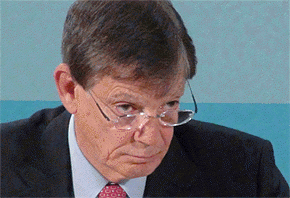
By Bernard Hickey
The Reserve Bank of New Zealand held the Official Cash Rate (OCR) as expected in its latest monetary policy decision, but has opened up the possibility of interest rate cuts if inflation continues to be weaker than expected and well below the Reserve Bank's 1-3% target band.
The bank said it expected to keep the OCR on hold for "some time", appearing to drop its December Monetary Policy Statement outlook for a tightening of policy late in 2015 and early 2016.
Instead, it opened up the potential for a rate cut if inflation was unexpectedly weak and said a period of deflation was possible in 2015 before inflation moved back towards 2%.
"In the current circumstances, we expect to keep the OCR on hold for some time," Governor Graeme Wheeler said in his statement, which is the regular short statement 'in between' full quarterly Monetary Policy Statements that include fresh forecasts.
"Future interest rate adjustments, either up or down, will depend on the emerging flow of economic data," Wheeler said.
This is the first time the bank has openly talked about the possibility of a rate cut. The New Zealand dollar immediately dropped to a fresh three year low of 73.75 USc from over 74.3 USc before the OCR announcement.
Economists said the bank had dropped its tightening bias and was now formally back to 'neutral', with the talk of a possible rate cut reinforcing financial market bets that a rate cut was possible in 2015.
Fixed mortgage rates have dropped sharply in recent weeks as weakening inflation expectations globally and news of money printing in Europe has driven European bond yields to their lowest levels since the 1400s. That has flowed through into lower wholesale interest rates in New Zealand, which has allowed banks to cut fixed mortgage rates to closer to 5%.
Wholesale interest rates fell around 9 basis points after the announcement and financial markets have fully priced in the chance of a 25 basis point cut later this year.
Oil price slump
The Reserve Bank noted a weaker than expected outlook for trading partner growth and the 60% fall in oil prices since June last year. It said the sharp fall in fuel prices would increase household purchasing power and lower the cost of doing business.
However, annual GDP growth in New Zealand was above 3% and supported by rising construction activity and household incomes.
"The housing market is showing signs of picking up, particularly in Auckland," Wheeler noted without comment on what he might do about it.
He warned again that the high currency remained unsustainable, unjustified and the bank expected a further significant depreciation. Wheeler then went on to comment in more detail than usual about the low outlook for inflation.
"The high exchange rate, low global inflation, and falling oil prices are causing traded goods inflation to be very weak," Wheeler said.
"Non-tradables inflation remains moderate, despite buoyant domestic demand and an improving labour market," he said.
"Headline annual inflation is expected to be below the target band through 2015, and could become negative for a period before moving back towards 2 percent, albeit more gradually than previously anticipated."
Economist reaction
ASB Chief Economist Nick Tuffley said the Reserve Bank had moved to an explicitly neutral bias, although he still saw the risks towards a hike rather than a cut.
Any catalyst for a cut would most likely be an adverse global development. Nevertheless, markets will continue to price in the prospect of OCR cuts and the shift to the neutral bias will fuel the move further," Tuffley said, adding the New Zealand had joined a growing list of central banks that had softened their stances in a short space of time.
"The probability of a rate cut implied by the local OIS (wholesale interest rate) prices has clearly increased. A rate cut is now almost fully priced in over the next year (22 basis points vs. 12 basis points prior to the meeting)," he said.
ANZ Chief Economist Cameron Bagrie said the inclusion of the “up or down” phrase "signals a clear dovish undertone."
"The market will gun for cuts even more aggressively after today’s statement," Bagrie said, adding he saw the risks tilted towards a cut, but they weren't concrete enough yet to formally predict a rate cut.
Westpac Chief Economist Dominick Stephens said the Reserve Bank's new neutral stance was a "watershed moment", given the bank had held a tightening bias in one for or another since July 2013.
"While we anticipated the shift to a neutral bias, we still judge this press release to be more dovish than anticipated because the RBNZ failed to argue against the possibility of OCR cuts," Stephens said.
"We reiterate our call that the RBNZ will have to tighten macroprudential policy this year, amid low interest rates and a resurgent housing market," he said, adding he now saw a 20% chance of rate cuts.
Here is the Reserve Bank's full statement:
The Reserve Bank today left the Official Cash Rate unchanged at 3.5 percent.
Trading partner growth in 2015 is expected to be similar to 2014, though the outlook is weaker than anticipated last year.
Divergences continue among regions, with growth in China, Japan and the euro area easing in recent quarters, while growth in the US has remained robust.
World oil prices have fallen 60 percent since June last year, which will boost spending power in oil importing economies but reduce incomes for oil exporters. The oil price decline, together with uncertainties around the transition of US monetary policy, has led to an increase in financial market volatility.
The lower oil price will have a significant impact on prices and activity in New Zealand. The most direct and immediate effects are through fuel prices, with the price of regular petrol falling from a national average of $2.23 in mid-2014 to $1.73 currently. This will increase households’ purchasing power and lower the cost of doing business.
Annual economic growth in New Zealand is above 3 percent, supported by rising construction activity and household incomes. The housing market is showing signs of picking up, particularly in Auckland. However, fiscal consolidation, the reduced dairy payout, the risk of drought, and the high exchange rate will weigh on growth.
While the New Zealand dollar has eased recently, we believe the exchange rate remains unjustified in terms of current economic conditions, particularly export prices, and unsustainable in terms of New Zealand’s long-term economic fundamentals. We expect to see a further significant depreciation.
The high exchange rate, low global inflation, and falling oil prices are causing traded goods inflation to be very weak. Non-tradables inflation remains moderate, despite buoyant domestic demand and an improving labour market. Headline annual inflation is expected to be below the target band through 2015, and could become negative for a period before moving back towards 2 percent, albeit more gradually than previously anticipated.
In the current circumstances, we expect to keep the OCR on hold for some time. Future interest rate adjustments, either up or down, will depend on the emerging flow of economic data.
Official cash rates
Select chart tabs
(Updated with currency move, chart, economist reaction)
We welcome your comments below. If you are not already registered, please register to comment
Remember we welcome robust, respectful and insightful debate. We don't welcome abusive or defamatory comments and will de-register those repeatedly making such comments. Our current comment policy is here.