
By Gareth Vaughan
Those who saw my Top 10 last week may recall the first item was entitled; The milk powder paradox?
This highlighted a book by ex-pat New Zealander Michael Parker called The Pine Tree Paradox; why creating the New Zealand we all dream of requires a great university. I suggested his thesis that exporting wasn't going to make New Zealand rich, which he argued through several examples led by pine trees, could now be extended to milk powder given over supply in the market and tumbling prices.
Having met and interviewed Parker back in 2011 I thought I'd flick him an email highlighting my Top 10 and ask him what he thought.
Turns out Parker, who is a Hong Kong-based equity strategist at Bernstein, has been thinking the same thing and sent me a copy of a report he issued on July 24.
Commodities, Parker notes in the report entitled; Strategy Blast: The Pine Tree Paradox... An Abundance of Everything, used to be a pejorative, or contemptuous, term.
"Producing stuff that lots of other companies and lots of other economies can also produce was viewed as a risky way of making a living. Sure when demand outstripped supply, prices and margins would rise. But with the low barriers to entry endemic to commodities, those high margins would simply encourage new capacity. Oversupply was viewed as a constant threat. Then along came China. Demand - as a constraint - was taken off the table for a decade, and commodity prices roofed it. That, as we continue to learn, is not a permanent condition."
Almost regardless of what the commodity is, the narrative is identical, Parker continues.
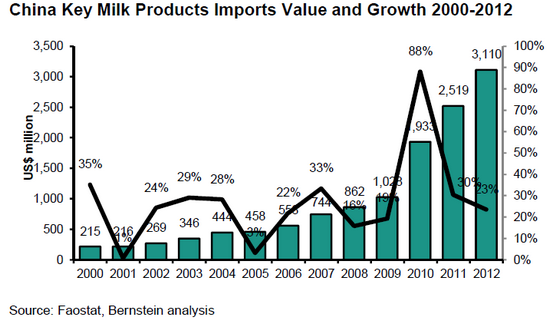
"Driven by urbanisation and the burgeoning middle class, Chinese demand for [milk] has spiked over the last five years, raising prices for [whole milk powder] to record levels. Even so, by volume, the [6] million tons of [milk product] that China imported in [2013] was far from sufficient to bridge the gap between developed market and Chinese consumption on a per capita basis. Accordingly, industry expectation was that the global [dairy] market would remain tight for at least the rest of the decade."
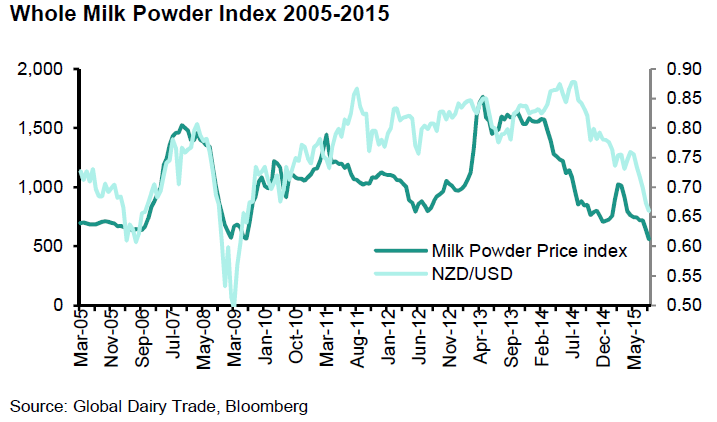
"That didn't happen. Despite rising demand in China, capacity increases globally (it only takes three years to [raise a herd of dairy cattle]) and the relatively simple process of producing [milk powder] resulted in increased supply from a multitude of sources. Prices have collapsed since the beginning of [2014] to the lowest levels since the global financial crisis."
For economies such as New Zealand's, where economic growth and exports are joined at the hip to the fortunes of commodities, the drop in the price of the key export heralds a fall in the value of the currency and a sharp economic slowdown, Parker adds. And as the economy slows interest rates are cut with the Reserve Bank having cut the Official Cash Rate last month with more cuts expected to follow.
"It is a painful lesson for companies and economies. The ability to produce something better and cheaper than anyone else in the world feels like a sustainable, competitive advantage and, strictly speaking, it is. However, when that something is a commodity, being the low cost producer is no guarantee of riches. When demand for that commodity ceases to rise faster than the new sources of supply, and/or when substitutes become available, prices collapse. That's bad news for both high-cost and low-cost producers. And, by definition with commodities, there are too many suppliers to mount a coordinated response."
Thus being the Saudi Arabia of something isn't necessary good news. This, Parker says, is the Pine Tree Paradox. You may be able to grow pine trees faster in New Zealand than anywhere else. But to compensate other countries such as Canada just plant more pine trees so what feels like a competitive advantage isn't one.
"Admittedly, Kiwis are slow learners. Broadly this same dynamic played out in the 1950s with wool (who knew the Korean cease fire would last?), in the 1970s with butter and lamb (who knew the UK would join the EU?) And, to a greater or lesser extent, with pine trees, kiwifruit, wine, peaches and a dozen other agricultural products over the last few decades. The relatively recent collapse in the price of milk powder is simply the continuation of a 70-year old pattern of being structurally long a cyclical trend."
"There is plenty of commentary around to suggest that what happened with milk over the last two years is very different from what happened with other commodities, where prices also tumbled. Like snowflakes, commodities are all unique... except they're all exactly the same."
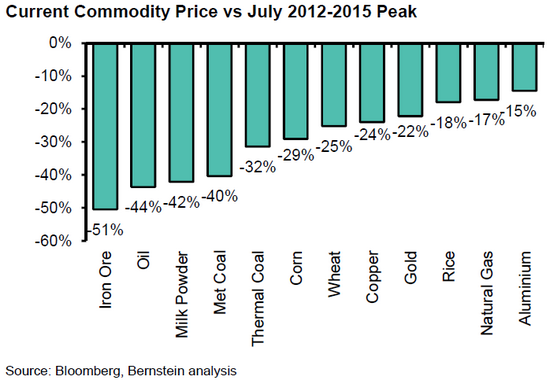
Parker's report goes on to make the case again substituting Australia for New Zealand and coal for cows, noting tongue in cheek that coal and cows couldn't be more different.
"Chinese demand for [power] spiked over the last five years, raising prices for [coal] to record levels. Yet by volume the [300] million tons of [coal] that China imported in [2012] was far from sufficient to bridge the gap between developed market and Chinese [power] consumption on a per capita basis. Accordingly, industry expectation was that the [coal] market would remain tight for at least the rest of the decade."
"That didn't happen. Despite rising [power] demand in China, supply improvements globally (it only takes three years to [build a coal mine or a dam]) and the relatively simple process of producing [electricity] meant increased supply from a multitude of sources. [Coal] prices have collapsed since the beginning of [2012] to the lowest levels since the global financial crisis."
He also makes the point that importing commodities is always the least favoured option given they are bulky and expensive to transport. Ultimately, Parker says with rare exception, commodity prices are likely to stay low for a long time.
"The lesson for most commodity producers is: stop investing. The best option for low cost producers (all those "Saudi Arabia of XXX") in an environment of weak or no demand growth is to cut growth CapEx to zero. There is an immediate improvement in free cash flow along with the ability to pay dividends, reduce debt or buy back stock. Australia doesn't need any more coal mines and New Zealand doesn't need more cows."
"It is always tempting to blame "perfect storms" when things go this badly for any sector. The truth is that the problem, when it comes to commodities, isn't the black swans. It's the camels."
The last point is a reference to Parker being asked by an Indian colleague when they began analysing global milk supply whether they should include camels.
Separately Parker has undertaken major research on data from the Chinese government and Chinese companies looking at how reliable it is. There's more on this in an interview he did with Barron's here.
*This story was first published in our email for paying subscribers early on Wednesday morning. See here for more details and how to subscribe.
We welcome your comments below. If you are not already registered, please register to comment
Remember we welcome robust, respectful and insightful debate. We don't welcome abusive or defamatory comments and will de-register those repeatedly making such comments. Our current comment policy is here.