
By Bernard Hickey
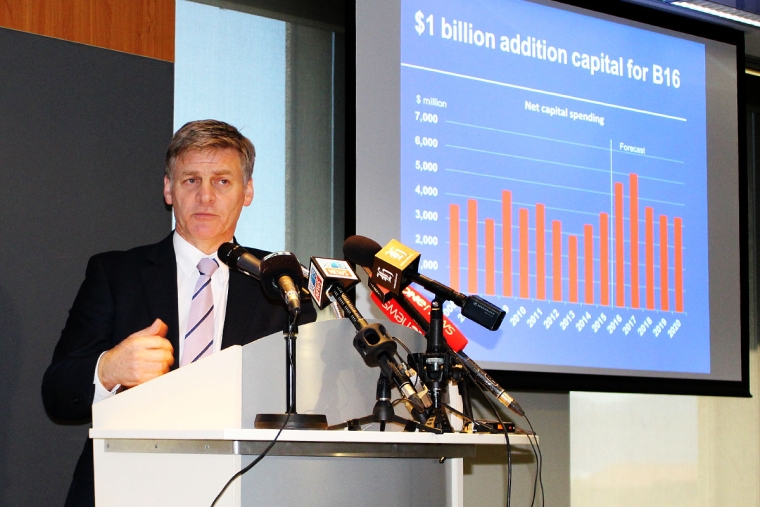
The Government has loosened fiscal policy in its Half Yearly Economic and Fiscal Update (HYEFU) by allowing the Budget to dip back into deficit and by increasing its capital spending allowance by NZ$1 billion in the current year.
Finance Minister Bill English said the Government had taken note of the Reserve Bank's call for more infrastructure spending to help bolster economic growth and inflation, although he stopped short of saying he had deliberately moved to become a 'monetary policy mate'.
He said the increase in capital spending was coincidental to the Reserve Bank's call and was more linked to the flow of capital spending requests coming from within Government, including spending on new schools, transport and the IRD system rebuild.
English's comments came as he and the Treasury released the Half Yearly Economic and Fiscal Update, which includes fresh economic and Budget forecasts.
Treasury reduced its forecast for economic growth in the year to March 2016 to 2.1% from 3.1% in the May Budget, in part due to slower growth by New Zealand's trading partners and partly due to the predicted effects of a significant El Nino event. Treasury increased its unemployment rate forecast for the year to March 2016 to a peak of 6.5% from just 5.1% at the Budget.
The end result was a reduction in Treasury's forecast for the Budget (OBEGAL) balance to a deficit of NZ$400 million in the current 2015/16 year. It had forecast a surplus of NZ$200 million in the May 2015 Budget. OBEGAL stands for Operating Balance Excluding Gains And Losses.
English said the Government had adjusted its targets so as not to strictly target continued surpluses and had loosened its target of reducing net debt to below 20% of GDP by 2020.
"The books are broadly in balance, so in the immediate future we will not distinguish between forecasts of a small negative or small positive OBEGAL," English said.
He said the Government had increased its capital allowance by NZ$1 billion at today's HYEFU given the Future Investment Fund, which was created from the proceeds of the sales of state assets, had been used up.
"Given the pipeline of high quality investment priorities, we consider it is an appropriate time to provide additional funding," he said.
Fiscal impulse
Treasury's measure of whether the Government had loosened or tightened fiscal policy -- which it calls the fiscal impulse -- showed an expansion of fiscal policy worth 1.4% of GDP.
The fiscal impulse was higher than 0.6% forecast fiscal impulse in the May Budget for 2015/16. In May the following three years were expected to contract the economy by a combined 1.9% of GDP. The HYEFU forecast a combined contraction of 1.6% of GDP.
Treasury forecast that the fiscal expansion in 2015/16 would be offset by small contractions in the following two years, followed by a significant contraction in 2018/19 as the effects of economic recovery surges through into higher tax revenues.
Meanwhile, the later return to surplus and the extra capital spending has delayed the Government's return to a net debt to GDP ratio of under 20% by 2021/22, which is one year later than forecast in the May Budget.
The increased debt also meant the Government has delayed the resumption of contributions to the New Zealand Superannuation Fund to 2022/23, two years later than forecast in the May 2015 Budget.
Extra borrowing
The return to a deficit in 2015/16 and the increase in capital spending meant the borrowing programme by the New Zealand Debt Management Office in 2016/17, 2017/18 and 2018/19 would increase by a combined NZ$6 billion over those three years. The borrowing programme for 2015/16 would remain unchanged at NZ$8 billion.
(Updated with picture, details on borrowing)
We welcome your comments below. If you are not already registered, please register to comment
Remember we welcome robust, respectful and insightful debate. We don't welcome abusive or defamatory comments and will de-register those repeatedly making such comments. Our current comment policy is here.