
By Bernard Hickey
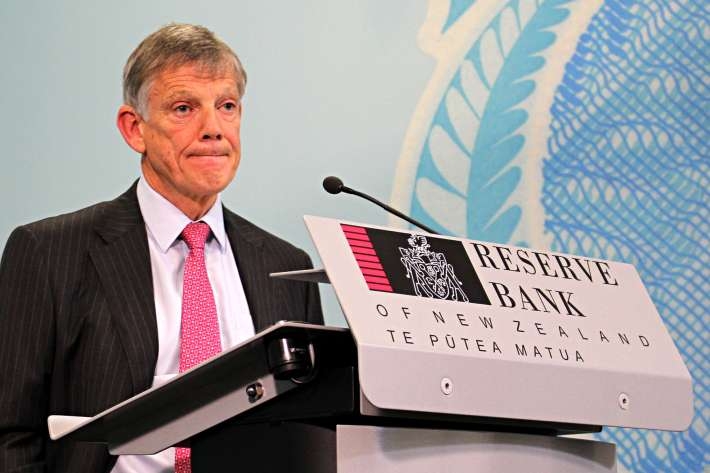
Reserve Bank Governor Graeme Wheeler has fired a shot across the bows of any banks thinking of pocketing today's surprise rate cut, saying he expected all of the 25 basis point reduction to be passed on to floating rate borrowers and that most of it would be passed on to fixed rate borrowers.
Some banks have suggested that a rise in funding costs for foreign funding might offset some of the impact of any Official Cash Rate, raising the prospect that banks may not pass on all of the rate cut to borrowers to either protect or grow their net interest margins.
Wheeler was asked whether banks should pass all of it on by Labour MP Stuart Nash during the Governor's appearance before the Finance and Expenditure Select Committee.
"I'd expect the floating rates to come down by 25 basis points," Wheeler told the select committee.
Earlier, Reserve Bank Head of Macro-Financial Bernard Hodgetts told the committee that the effects of the rise in foreign funding costs was 'relatively mild' for banks at the moment, given they were currently funding only a small share of new lending from overseas borrowing because of strong local deposit growth.
"Banks are only raising a relatively small share of their funding from overseas at this point in time. They're continuing to see very strong deposit growth. Most of the credit expansion that's going on has been funded through deposits," Hodgetts said.
"If the upturn in international funding costs was to persist, it would start to have more of an impact on banks' funding costs. But at the moment the effect has been relatively mild," he said.
He said he expected the bulk of falls in interest rates to be passed on to borrowers.
Asked by Nash if banks may use the rate cut to bolster their profit margins in the wake of share price falls in Australia, Hodgetts said: "I would expect to see the bulk of it passed on and there's already this morning we see some examples of this," he said.
Wheeler then followed up. "Certainly you'd expect the floating rates to come down 25 basis points, and the fixed will depend on a lot of factors, but one would expect that most of that would be passed on," Wheeler said.
Fixed mortgage rates tend to be more closely aligned to wholesale 'swap' rates. One year swap rates fell 19 basis points today, while two year swaps rates fell 18 basis points and the five year rates fell 43 basis points. See more here from David Chaston.
As of mid-afternoon, only Co-operative Bank had cut its floating rate. See more here from Gareth Vaughan.
'Landlords venturing out from Auckland'
Green Finance Spokeswoman Julie Anne Genter then asked Wheeler if the Reserve Bank's introduction in November of tighter controls on lending to Auckland rental property investors had simply pushed them out to regional markets, which in turn suggested a capital gains tax would be more effective.
In reply, Wheeler pointed to a rise in the portion of Auckland home purchases by investors from 33% to 41% in the two years before the LVR controls were put in place. He said that portion had since fallen to 38% after the introduction of the new controls.
"But have investors basically said: 'look, property price appreciation may be going to slow in Auckland and is there scope for further capital gains elsewhere and higher rental returns?' Has that driven part of the Hamilton market and the Tauranga market? Yes I think it has," Wheeler said.
36 Comments
DEFLATION , DEFLATION, DEFLATION .......... Of course Wheeler wants the floating rate cut to be passed on , for 3 REASONS .
1) We need to stimulate spending because of the deflationary environment
and
2) The floating rates on mortgages needs to fall to help dairy farmers
and
3) We need a weaker Kiwi $ to help our exporters
I am saving more money in the bank every month than since the day I started work , because the price of everything has come down , and keeps falling .
I am not making any buying decisions , simply because the price of all consumer goods are falling
Diesel has almost halved , our food bill has fallen . and with electronics , the prices are dropping so fast now , I will just wait until I think they are really cheap .
Unfortunately, the mortgage rate means nothing to me as I am debt free
.
you are a bad bad boatman saving money, you are supposed to spend it all then use your equity to load up on debt to buy rental houses.
surprised you are happy to have it our banks and have not looked into your options even though IRD has cut gold from the equation now
Ummmmm IRD have not done anything other than put forward a draft proposal for opinion. They don't write NZ tax law or any laws. At this present time they have no case unless they also apply their cgt idea on every single home and property that people invest in hoping/ relying on capital gain to make such an bad investment logical.
Consumer goods are so cheap there's not really much that I want. It's been that way for some time. Now that deflationary effects are everywhere I've saved a fortune on the little consumer spending that I do. I also benefited a lot when the NZD was high last year.
Wheeler has shit his pants for a statement like that to be made. Now I'm just waiting for the year to year inflation rate to be announced as it will confirm deflation.
WOW! Wheeler sure does have a sad clown face these days. Maybe the banks will give him a break and save his job that he was supposed to do years ago.
Rage: The most disgraceful interest rates are those charged by banks on credit cards.
These rates have hardly moved in years and I find it unforgivable that banks can get away with 19% and more interest rates even for regular customers.
I have large sums of cash on deposit with my bank for which they pay me peanuts, but if I used my credit card they had no shame in charging these extortionist rates.
Hence i have cut up all my credit cards, except one, and suggest the rest of you do the same.
same here only have one which i pay off straight away whenever i use it so they can not charge me anything other than a bank fee every six months
Solution. Don't live on credit.
You need credit cards for travelling, hotels etc. You earn points too and can get travel insurance - although I don't quite trust the insurance and generally buy it from my Insurance company. You can set it up to be paid off automatically so it is not too hard to manage.
I travel to the U.S. every year and haven't had a credit card since 2005. Somehow we get by just fine
What about booking online, buying anything online? Credit card is so convenient. You can disable them by smartphone or turn features on or off. Fraudulent use is well protected. There is no good reason to not have one.
Debit card Zach. It's not a 'credit' card but is accepted just like one with all the benefits. We have PayPal accounts also.
Debit card.
And of course all people with deposits with banks will get their interest rates on savings cut too.
Thanks Graeme for looking after the investors and banks so well. With the lowest residential mortgage rates already in the past 50 years - they need more incentive to speculate in housing it seems and that you have accomplished.
Good points. Wheeler has not provided any direction as to where investment would produce the outcomes he needs, so buy more existing houses - bugger employment, and export growth.
Banks sure look after number 1, like casinos. Unsecure credit is just that. Why dont you just get a debit card to access you cash stash?
Done that, but not a cent paid in interest on any credit balance.
You miss my point.
Customers of banks who have deposits or do business with their bank should have a concessionary rates charged on their credit cards.
While I am at it, the rates charged on overdrafts are also outrageous.
15% is common.
Those with bad credit, or who belong to the great unwashed are another matter.
thats because banks see the indebted as customers and not those of us that have money in them we are a problem, have noticed over the years how it has changed from being a good customer who was welcomed to a number because i dont owe them anything
Yes, that's right. You are not a valued customer of any bank unless you owe them money.
You do, 55 days free credit.
Reserve Bank Governor Graeme Wheeler has fired a shot across the bows of any banks thinking of pocketing today's surprise rate cut, saying he expected all of the 25 basis point reduction to be passed on to floating rate borrowers.
And if they don't what will Wheeler do about it? He sure knows the deposit rates will automatically be cut that amount and more. Banks stealing from their state mandated last resort capital underwriters is expected and accepted. Just as cruel to the infirm and elderly as shooting fish in a barrel.
so savers will have less to spend, and the theory is mortgage holders will make up the difference.
what if they dont and put onto paying down their loans or even worse taking on more debt.
The Government needs to realise they need to back RBNZ with regulations rather than letting banks do as they please. It'll be telling to see who doesn't pass on the cut.
Interest rate cuts used to work when people wanted to pay off debts. Now most, through bank marketing, believe it's good to be in debt. Thing is when interest rates are low is the time to pay off debts not increase them. The low interest rates might help spending if those selling their houses go on a spending spree with the proceeds.
Follow that up with deflationary pressure it's a bad time to buy a house and have a large mortgage. If the worst case scenario happens people will end up underwater with their mortgage.
As a 74 year old retiree whose retirement costs and Family Trust savings are invested in a range of energy, communication, IT and property investments, I find it abhorrent that the NZ Banks are reporting huge profits which are repatriated to overseas investors, whose tax contributions deserve close attention. My wife and I started our married life together 49 plus years ago with $262 in the bank after paying all wedding and honeymoon costs ourselves. We worked hard and saved, We paid for 3 children to attend University where they all excelled. We are happy with what we have saved for our retirement, but the banks are not helping those of us on fixed incomes. I did work for 50 years and we have paid more than our share of taxes. Present fiscal policies are a real burden which we would be better off without.
At 74, and I am not too far behind, you actually fall out of the bracket that Governments care about. Not enough money to be influential, too much to be dependant, not in employment. It could be worse, you could be pakeha?
Governments have forgotten who they are supposed to represent and because of that ordinary folk like you, me and many of the commentators in these threads are essentially ignored and pushed to the side.
Those producing in the EU are just getting started
New farm loans link repayments to milk price
http://www.independent.ie/business/farming/new-farm-loans-link-repaymen…?
And would you believe. ..
The loans will be unsecured but will be made as priority deductions.
Well the RBNZ did not surprise Ergophobia this morning (see comment here: http://www.interest.co.nz/bonds/80054/economists-opposing-camps-about-w… ) This really is now revealed as a huge subsidy for the tired old commodity exporting dairy monopoly and all the associated banksters and parasites.
They must be desperate to do it so blatantly when all the economic indicators are showing stunning growth in NZ, comparatively. No doubt Pollies have been bullying off screen - there are likely to be secret guarantee deals involving the taxpayer dating back to the millennium, with both Labour and Nats fingerprints on them. If they would throw a Billion at SCF - who knows? There may even be the bones of a good book in the timely deaths of Hubbard and Norgate?
Gosh, you mean Fonterra's $8 billion debts plus the dairy farmers $30 odd billion might be a problem? Surely not. I mean, no one saw that coming. (Just in case anyone is in any doubt, I am trying to be sarcastic and humourous here).
Humour for Friday....if you did not laugh, you would truly cry.
Perhaps, Trump will get a haircut at the polls. Has Bush already been scalped. Was it a Brazillian, no show otherwise.. Is America getting the haircut it truly, truly deserves. At what cost. Sanity.?.
Perhaps,China will break, it always does in the end, washed up, just maybe.
Perhaps a new tea service on the credit cards for Mr Key, if he can personally never recall just why he got suckered into buying the breakable version, in the first place.
Is Alzheimers really, really, truly a beneficial trait for a Leading Polly. Forget I asked that, I already have.
Vote for the flag, that is rich. Someone must own a flag making Company, in Asia...guess who?. Smileandwave.co.nz ....that's rich...must register it,
But wait,,,maybe not...just a ploy to waste our hard earned money...Yet Again.
Perhaps, black tea gonna be the norm in China, as milk dries up, like never before?.
Can we cement our relationship with broke China and build a few more ivory Towers, like these people live in. Will Awklanders be sold on the idea.
Is blindingly obvious, not being able to see the truth in the World econmy .
Is stimulation the new savings plan for the bed ridden. Are they being screwed over by Government policy. Will banks bank on it. ..yet again.
Will importing inflation, put the wind up me, or just work in reverse. Something smells like it.
We have to give our Government credit, they will take it anyway they bleedin can.
.
Lets face it the two most important numbers in NZ today are Tourist Arrivals and Net Migration. Auckland house prices are a proxy for both.
Wheeler Shmeeler.
Good luck influencing anything dipping your toe in the rate cut market; banks lend against capital gains, ignoring just how many mortgages could actually be paid if interest rates went back to 7-8%
Just look at Dairying; incomes have dropped, sure a bit below historical averages; it happens and it is a scenario that a half decent sensitivity analysis should have considered at the same time finance was applied for. Banks have completely ignored historical price averages and lent against appreciating land values instead. Cash-flow be dammed!
Oh, and plenty said back in the day, that high input farming was the European model, and not one that suited our situation; wasn't it a discussion paper from/for the Reserve Bank? Was lost in the stampede I guess.
So gone are our forests, gone are our freshwater values, and gone are the futures of many of the highly indebted. Time for a cup of T - Lange style, not the two Johns...
Those Aussie bankers are a clever lot. Our politicians and bureaucrats are uneducated and naive lambs to the slaughter, as are we.
The idea is to capture all surplus cash flows, present and future, as interest payments, thus ensuring the excessive remuneration of the bank executives. By substituting debt for home or business equity the cash flow that would have gone to the owner as taxable income becomes a stream of untaxed interest payments.
Oh and don't tell Mr Wheeler but the Chinese govt has just released a new Tsunami of funds (for venture capitalists...um yeah!) that will ensure the NZ banks get their 'Dairy debt gone bad' back so phew!
Really Bernard. "A surprise cut"!!!! Given the negative or near zero rate of inflation, his mandate (and the obvious hard word from Bill English), this cut was hardly a surprise.
If 70% of mortgage borrowers are on fixed rates (due to high floating rates) then it's going to take a year or two before those borrowers receive any rate reduction.
Those floating are likely to be on the lookout for a lower 1 or 2 year fixed rate.
So, the immediate effect of the OCR cut on borrowers will be minimal.
Overdrafts, business loans, personal loans, credit cards, ...no change
I would think that the immediate effect would be to stop the decline, if there was one, in Auckland house prices. Lower interest rate means someone could borrow an extra 50-100K. Yields will improve as rent is unlikely to reduce.
We welcome your comments below. If you are not already registered, please register to comment
Remember we welcome robust, respectful and insightful debate. We don't welcome abusive or defamatory comments and will de-register those repeatedly making such comments. Our current comment policy is here.