
By Bernard Hickey
Treasury and the Ministry of Business, Innovation and Employment (MBIE) warned the Government in December that a growing influx of students and holiday-makers on temporary work visas could be dragging on productivity and wages because most were working in low productivity and low growth occupations.
They also warned that some employers were using the temporary work visas as an easy way to find cheap workers, rather than finding or paying more for local workers who were also suitably qualified. Their point was reinforced by attempts by the dairy industry to keep dairy farm worker categories on MBIE's Immediate Skill Shortage List.
Treasury and MBIE gave the advice in a December 10 briefing paper to Finance Minister Bill English, Employment Minister Steven Joyce and Immigration Minister Michael Woodhouse after two Cabinet committees said in May last year they wanted to investigate how the Government's migration settings could improve its contribution to the labour market. A full report is expected back this month.
Treasury and MBIE noted the numbers of temporary overseas migrants with work rights had increased significantly recently, "driven mainly by working holiday-makers and international students." They said a significant proportion of permanent and temporary labour migrants worked in lower wage occupations, "and recent trends show a relative decline in the skill level of permanent migrants."
"Migrants are meeting firm demands for labour and skills, but increasingly in low productivity growth industries and lower-wage and-skilled jobs," they said in the briefing paper, which included a chart showing the number of temporary migrants with work visas had risen from around 200,000 per year between 2008/09 and 2012/13, before accelerating up to around 250,000 in 2014/15.
Chefs, aged care workers and dairy farm workers
"As discussed in STR (Cabinet's Strategy Committee) and EGI (Cabinet's Economic Growth and Infrastructure Committee), the evidence available suggests that the contribution of these inflows to labour market is mixed, with recent trends raising some concerns about the impacts that migration could have on the long-term on the Government's Labour Market objectives," they said.
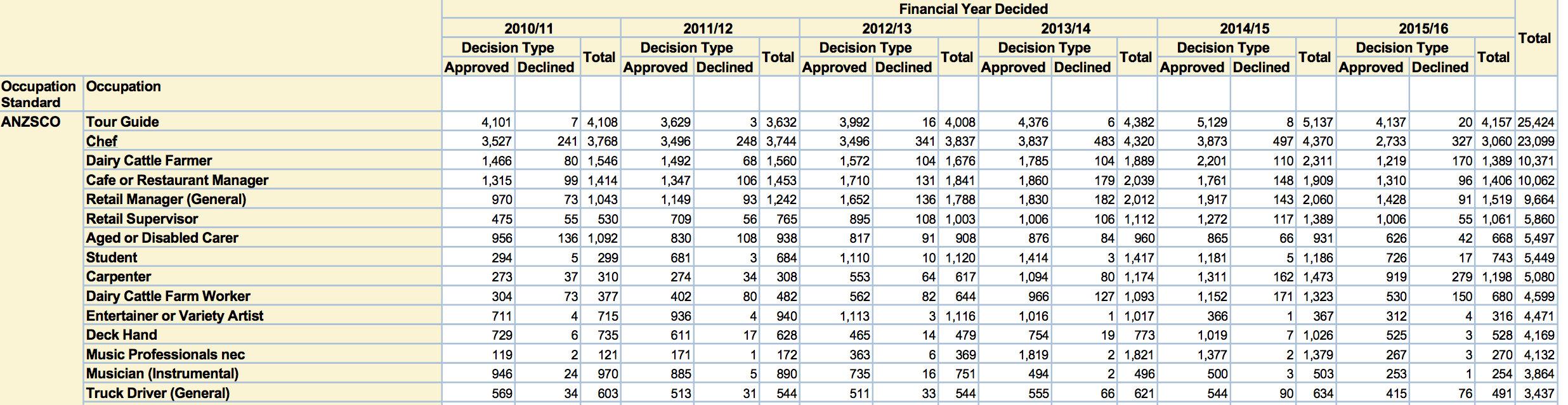
It published a chart showing the top 20 occupations for essential skills visa applicants, including nearly 2,400 visas for Chefs awarded in 2014/15. The next most awarded visas were for Dairy Cattle Farmer, Cafe or Restaurant Manager, Retail Manager (General), Carpenter, Dairy Cattle Farm worker, Retail supervisor, Aged or Disabled Carer, Truck Driver (General), Registered Nurse (Aged Care) and Winery Cellar Hand.
An MBIE list of the occupations approved for work visas is below:
MBIE and Treasury said almost 40% of the applicants for permanent Skilled Migrant Category visas were former international students on temporary work visas..
They said evidence suggested migrants working in highly skilled occupations, particularly Information and Communications Technology, were closely linked to higher productivity growth through increasing wages and innovation.
Foreign students fared worst
"However, there is an increasing use of temporary and permanent labour and non-labour migration in lower wage and/or productivity industries where there is no strong evidence of genuine skill shortages," they said.
They pointed out recent research on Skilled Migrant Category migrants found that skilled migrants from Asia earned less and were less likely to be employed three years after gaining residence in New Zealand than skilled migrants from Europe, and that residents who had previously been students also fared worse.
"Skilled migrants who initially came to study in New Zealand are less likely to be employed and have much lower incomes three years after taking up residence in New Zealand compared with the incomes of migrants who were approved for residence offshore."
Treasury and MBIE went on to point out the difference between a skills shortage, where demand for skills exceeded supply even when wages were persistently high, and a labour shortage. A skills shortage was more common in innovative and productive industries such as ICT or Health.
"In lower skilled and lower wage occupations it is unlikely that firms are experiencing genuine skill shortages," MBIE and Treasury wrote.
"It is more likely that firms find it difficult to meet their labour needs because of a labour shortage. This is a situation in which vacancies remain unfilled either because firms cannot find workers or because of poor wage and employment conditions...and/or because there are just not enough people in the local labour market -- or willing to move to the location (eg lower wage or skilled dairy farm occupations in Southland)," they wrote.
"Filling migrant labour shortages through migrant labour can reduce incentives on firms to employ domestic workers, increase wages to attract domestic workers, and invest in training and/or capital (eg Technology)," they said, noting also that not filling persistent local labour shortages could negatively affect some industries.
"Filling labour shortages through migration can result in wage suppression, low skilled and productivity equilibrium and displacement."
Dairy industry wanted to keep importing labour
Elsewhere, MBIE included advice to Immigration Minister Michael Woodhouse on what skills categories should be retained on or added to its lists of Long Term Skills Shortages and Immediate Skills Shortages (ISSL).
The long-term categories are decided by the Minister, while the Immediate skills shortages categores are decided by MBIE Deputy CEO Nigel Bickle. Once skills are off the lists, employers then have to prove through a labour market skills test that no suitable New Zealanders are available to fill or be trained for the position when applying to bring in a foreign worker. Being on the list makes it much easier to bring in workers on temporary or permanent work visas.
MBIE recommended the retention of telecommuncations engineer and telecommuncations network engineer on the long term list, but declined submissions for airconditioning mechanic and motor mechanic to be added to the list. It recommended adding glazier, metal fabricator, sheetmetal trades worker and surveyor be added to the immediate shortage list.
More controversially, it recommended a range of dairy and beef cattle worker positions be removed from the immediate skills shortages list, "because the qualification and experience requirements for using the ISSL are very low."
"Many migrants have been employed with limited experience, which indicates that the criteria sought by farmers for these positions is low," MBIE said, adding that Dairy NZ and Federated Farmers had made submissions to keep the dairy farm categories on the list, or at least to defer their removal for two to four years, while the Council of Trade Unions had argued they be taken off the list.
The changes for dairy farm workers apply from May 30 this year, which would give time for new work tests to be created with Work and Income. MBIE announced the changes on December 18.
Woodhouse denies wage suppression or skills depression
Immigration Minister Michael Woodhouse said employers did not think the Government was letting in too many lowly skilled people.
"They tell me that the processes for having labour market tested work visa holders is a very onerous one and the requirement is for them to meet the market, and that's what they're doing," Woodhouse told reporters.
Woodhouse said he was satisfied the processes for deciding on which areas had genuine skill shortages, rather than just labour shortages, was robust.
"MBIE didn't say there are too many low skilled workers coming in, and they didn't say that wages are being depressed," he said.
"They said some commentators suggest that's possible. There's no evidence to say that that's happening. We're watching that very closely though and the expectation is that employers need to meet the market."
Woodhouse said MBIE periodically analysed the risk of wage suppression, but "there's no evidence that it's actually happening."
He agreed other bank economists had suggested wage suppression caused by large numbers of lower-skilled short term migrants was happening, but MBIE had yet to find evidence it was happening, although "it's a live issue."
The briefing papers were later referred to an exchange between NZ First Deputy Leader Ron Mark and English.
We welcome your comments below. If you are not already registered, please register to comment
Remember we welcome robust, respectful and insightful debate. We don't welcome abusive or defamatory comments and will de-register those repeatedly making such comments. Our current comment policy is here.