
By Bernard Hickey
The Reserve Bank of New Zealand has cut the Official Cash Rate by 25 basis points to a record-low 2.0% as all economists had expected, but it forecast only one more 25 basis point cut by the middle of next year.
It included scenarios that could include more cuts, but financial markets were disappointed and the currency surged, raising questions about whether the Reserve Bank is sticking to its inflation targeting mandate.
The Reserve Bank forecast in its Monetary Policy Statement that it did not expect CPI inflation to reach the 2% mid-point specified in the Policy Targets Agreement with the Government until the September quarter of 2018, which would imply a sub-target inflation rate for almost seven years. The Bank forecast CPI inflation, which was 0.4% in the June quarter, would not reach the bottom of the bank's 1-3% target range until the December quarter of this year, implying a sub-target-range inflation rate for at least 8 quarters or two years.
Currency markets had priced in a 20% chance of a 50 basis point cut and some economists had expected the Reserve Bank would forecast at least two more cuts as it grapples to get inflation back near the 2% mid-point after more than four years of being under the Reserve Bank's main target.
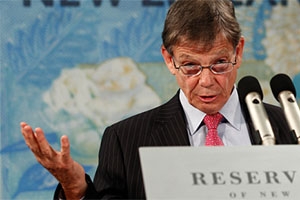
The New Zealand dollar sprinted almost a cent higher to just over 73 USc in the initial minutes after the decision, in which Reserve Bank Governor Graeme Wheeler again said a fall in the currency was needed.
Wheeler said weak global conditions and low interest rates relative to New Zealand were placing upward pressure on the New Zealand dollar.
"The trade-weighted exchange rate is significantly higher than assumed in the June Statement. The high exchange rate is adding further pressure to the export and import-competing sectors and, together with low global inflation, is causing negative inflation in the tradables sector," Wheeler said.
"This makes it difficult for the Bank to meet its inflation objective. A decline in the exchange rate is needed," he said.
"Domestic growth is expected to remain supported by strong inward migration, construction activity, tourism, and accommodative monetary policy. However, low dairy prices are depressing incomes in the dairy sector and reducing farm spending and investment," he said.
"High net immigration is supporting strong growth in labour supply and limiting wage pressure."
Wheeler said that house price inflation remained excessive and had become more broad-based across the regions, "adding to concerns about financial stability," and he noted that the bank was consulting on stronger macro-prudential measures to help risks to the financial system from the rapid escalation in house prices.
'Inflation expected to rise next year'
"Headline inflation is being held below the target band by continuing negative tradables inflation. Annual CPI inflation is expected to weaken in the September quarter, reflecting lower fuel prices and cuts in ACC levies. Annual inflation is expected to rise from the December quarter, reflecting the policy stimulus to date, the strength of the domestic economy, reduced drag from tradables inflation, and rising non-tradables inflation," Wheeler said.
"Although long-term inflation expectations are well-anchored at 2 percent, the sustained weakness in headline inflation risks further declines in inflation expectations," he said.
"Monetary policy will continue to be accommodative. Our current projections and assumptions indicate that further policy easing will be required to ensure that future inflation settles near the middle of the target range. We will continue to watch closely the emerging economic data."
The Reserve Bank's central forecast for the 90 day bill rate included the potential for one more 25 basis point cut to 1.75% some time over the next six months.
Economist reaction
ANZ's Cameron Bagrie:
The OCR was cut but it was not enough to satisfy the market, with the NZD up and rates selling off. Expectations were growing prior that we could see something substantial, but what we got was an entirely balanced and appropriate response in our view. The bill track hints at 1 to 2 more cuts, although alternative scenarios show the risk is for more.
On most levels we agree with the spirit of the RBNZ’s economic assessment. Strong, above-trend growth is eating into capacity, the NZD is likely to remain high, and housing is problematic – although macro-prudential measures “should” assist. Importantly, the RBNZ is assuming that global conditions improve (alleviating pressures on the NZD) and inflation expectations also gradually lift. We are sceptical. It seems inevitable the OCR will head lower still, though not necessarily immediately. We now expect a cut in November and another in early 2017.
·Stepping back, we still assess this action with a degree of trepidation. The NZD is strong for reasons other than just yield, and inflation is low for more reasons than just the strong NZD. Technology-based deflationary headwinds are growing. We’re not convinced more easing is going to alter that. But we also appreciate the RBNZ’s predicament and the challenge presented by the actions of other central banks forcing global yields lower. The RBNZ cannot swim against this tide. More cuts to come.
Against a backdrop of a market toying with the (albeit remote) possibility of a 50bp OCR cut, and market expectations more consistent with two, rather than one, more cut from here, today’s action and revised projections were not as dovish as the market expected. Consequently, we are not surprised that the NZD and interest rates have popped higher. However, if one takes the view that the TWI will hold up, and inflation expectations are at risk of being further undermined by low headline CPI (Q3 CPI is shaping up to be pretty soft, potentially below the RBNZ’s +0.2%q/q pick), the risk profile remains skewed to the downside.
ASB's Nick Tuffley:
The RBNZ cut the OCR by 25bps as widely expected, and in line with our thoughts it lowered its 90-day bank bill outlook to a low of 1.8% by mid-2017 (implying an OCR of 1.75% if not slightly lower). In addition, the RBNZ retained a firm easing bias of “our current projections and assumptions indicate that further policy easing will be required” Financial markets had been salivating for an indication of an even greater degree of easing, and were left underwhelmed.
Although the RBNZ is still concerned about housing risks, it is also now more concerned about the downside inflation risks, particularly if inflation expectations were to fall further. The NZD Trade Weighted Index assumes the NZD will gently depreciate from around 76, and there is a risk that the RBNZ will have to ease to a greater extent if the NZD doesn’t follow that path. As in the recent Economic Assessment, the NZD was called out as making it difficult for the RBNZ to meet its inflation objective and in need of depreciation.
We continue to expect the RBNZ to cut once further, in November, when the RBNZ has received the next set of key economic data, including key long-term inflation expectations, and has comprehensively redone its forecasts. Weakerthan-expected data or persistent NZD strength could conceivably bring the easing forward to September. In addition, the risks remain skewed to a lower OCR than 1.75%, particularly if the NZD persists above the RBNZ’s (new) assumed level or inflation expectations weaken.
Westpac's Michael Gordon:
In June, the RBNZ’s 90-day interest rate track bottomed at 2.1%, and their rhetoric was consistent with a 2% low in the cash rate. Their updated 90-date projection released today was markedly lower, showing the 90-day rate settling at 1.75%. We expect a further 25bp cut in the OCR in November, which will take it to a low of 1.75%. While there is the possibility of an earlier cut at the 22 September OCR review, we think this is less likely given continued relatively firm GDP growth and only limited new information before the September meeting. Further ahead, much of the need for additional cuts comes down to the NZ dollar – we expect that it will ease by year’s end, but the risk is that it remains high.
First NZ's Chris Green
Significantly the Bank also presents a scenario in which the TWI is assumed to remain around its current level, resulting in their 90-day bank bill profile troughing at 0.9%. While the Bank again reiterated that “a decline in the exchange rate is needed” the presentation of an unchanged TWI scenario and the resulting decline in their projected 90-day bank bill profile underlines that additional monetary easing will be required if the NZD continues to remain elevated. Interestingly the other scenario showing a decline in inflation expectations also results in a lower projected OCR profile than presented in their central scenario.
Looking ahead, given the backdrop of the RBNZ projecting an additional 90-day rate reduction, together with the maintenance of an explicit easing bias, we expect the Bank to look to undertake at least one further 25bps reduction in the OCR.
At this point, we pencil in a 25bps cut at their 9 November August MPS, taking the OCR to a historic low of 1.75%. However, the dovish tone to the August MPS increases the risk of an earlier and additional 25bps cut at their 28 September OCR Review, which together with an anticipated November MPS cut would take the OCR to a lower trough of 1.50%.
Kiwibank's Zoe Wallis:
The RBNZ's closely watched 90-day track was reduced by 37bps relative to the June MPS - implying at least one more OCR cut and about a 50% chance of an additional cut to take the OCR down to 1.50%. We maintain our call for additional rate cuts in November and February, although acknowledge there is small risk that the RBNZ could choose to move at its next meeting in September. In addition, the RBNZ included two alternative scenarios in today's MPS - both to the downside.
One of these was the same scenario included in the June MPS, whereby the NZ TWI remains elevated around current levels even as the RBNZ continues to cut the OCR - in this case, the OCR could be cut as low as 0.75% by 2018. The other scenario highlights the risk that with inflation tracking lower for longer, inflation expectations decline further; requiring a greater extent of monetary policy easing and suggesting the OCR would need to be cut down to 1% to generate sufficient inflation pressure in the economy. Given the currency reaction we have seen this morning we agree that the risks remain skewed to the downside.
Political reaction
Labour Finance Spokesman Grant Robertson said the Government needed to get serious about supporting the productive sector and help the Reserve Bank by addressing the Auckland housing crisis.
“With the dollar surging immediately after the OCR announcement it’s clear that monetary policy is having limited positive impact for exporters. The Government cannot outsource managing the economy to the Reserve Bank, it needs to take concrete steps to ensure hard-pressed exporters can compete internationally," Robertson said.
“Bill English needs to take responsibility for the decision by some trading banks to pass on only a fraction of the cut. This is another example of government failure leaving someone else to dictate public policy. The Government has failed to fix the housing crisis in terms of either supply or demand, and some banks have decided to take matters into their own hands," he said.
“National needs to stop sitting on its hands over housing. Today’s announcement won’t build anymore houses but will be another shot in the arm for speculators. It’s essential that National takes on Labour’s comprehensive housing plan to build 100,000 affordable homes, crack down on speculators and close loopholes like negative gearing."
Robertson said the immediate rise in the currency and the banks' decisions not to pass all the cut raised further questions about the limitations of monetary policy.
“More and more traditional approaches seem to be broken. There is an urgent need to review monetary policy, including the Policy Targets Agreement which is now effectively being ignored by the Reserve Bank, given the heroic assumptions that underpin their attempt to meet it in ‘the long term’," he said.
(Updated with more detail, reaction, political reaction)
We welcome your comments below. If you are not already registered, please register to comment
Remember we welcome robust, respectful and insightful debate. We don't welcome abusive or defamatory comments and will de-register those repeatedly making such comments. Our current comment policy is here.