
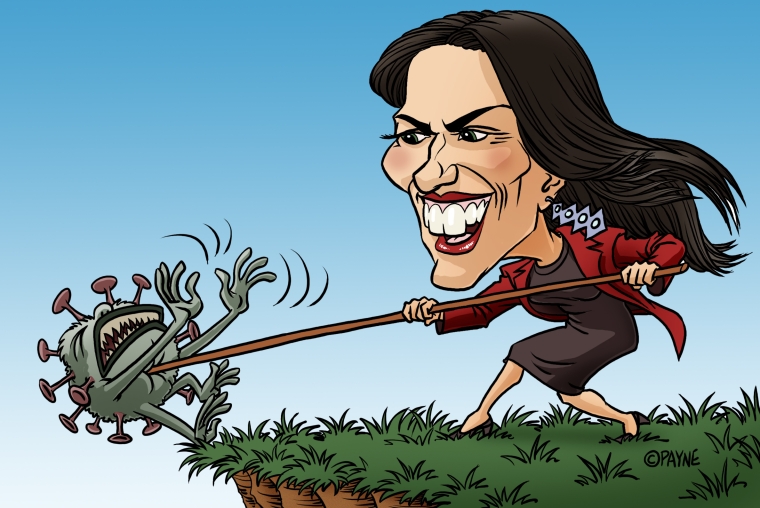
By Chris Trotter*
Minorities – intelligent or otherwise – have very little to do with living democracies. They do, however, have a great deal to do with dead ones, and with elections that are light on policy.
19 September 2020 may go down in history as the “Policy-Lite Election”. Certainly, both of the major parties are offering a pretty skinny profile for their opponents to aim at. In Labour’s case this is a deliberate strategy. With National it looks to be a case of: “Oh My God! – We forgot to do the policy!”
The Prime Minister’s pledge to go on governing right up until election day – and, presumably beyond – plays directly to her so far extremely successful Politics-In-A-Time-Of-Covid schtick.
And why not? Very few people are clamouring for anything more than a steady hand on the tiller as the nation navigates the treacherous waters of a global pandemic. That New Zealand is currently basking in international acclaim for its handling of the Covid-19 crisis suggests to most voters that the only “election policy” that makes any real sense is the one in which Jacinda Ardern promises to keep on doing what she has been doing since the virus struck.
The metaphor Labour’s strategists are offering to voters casts Ardern as a tight-rope walker. With New Zealand’s future strapped to her back, the Prime Minister is concentrating all her energy and skill on simply making it across to the other side. Unsurprisingly, the overwhelming majority of New Zealanders are willing her on. All the attention they have to spare is focused on the high-wire act taking place above them. Very few are paying the slightest heed to National’s hapless jugglers on the ground.
As political metaphors go, it’s a good one – made even stronger by the steadily worsening international weather. Across the Tasman the virus is cutting a swathe through the state of Victoria. Further afield the picture is even worse. The United States seems incapable of pulling itself together. The United Kingdom is a mess. While lightning flashes and thunder rolls and rain beats down upon the roof, Kiwis thank their lucky stars for the weather-tightness of their far-flung island home.
National’s only hope – though it absolutely must not express it – is that the community transmission of Covid-19 will resume. If that were to happen, and if responsibility for the renewed outbreak could be plausibly sheeted home to the Government, then the resulting public outcry would change the electoral calculus dramatically. In terms of Labour’s metaphor, the Prime Minister would be in danger of falling off her tight-rope.
Recent statements from both the health Minister, Chris Hipkins, and the Director-General of Health, Ashley Bloomfield, suggest that this worst-case scenario – along with its dire electoral implications – has already prompted the Government to begin preparing the population for what is increasingly presented as the inevitable resumption of community transmission. Metaphorically speaking, Labour is hurriedly erecting a safety net under Jacinda’s tight-rope.
These preparations have not gone unnoticed by Gerry Brownlee. In a media statement on Wednesday, National’s campaign chairperson called upon the Government to “come clean”:
“We have had three-months of no community transmission,” thundered the Deputy Leader of the Opposition, “then inexplicably, the Director-General of Health Ashley Bloomfield tells the nation today that a second wave was a likely prospect. As well, Health Minister Chris Hipkins tells the House in Question Time that tomorrow [6 August] he will tell Kiwis the conditions in which they will be expected to wear masks in the event of the country moving back into Level Two. It doesn’t add up. Why announce this now when there are few cases? What do these guys know that they are not telling us?”
No recent statement from the Opposition better captures the frustration, bordering on despair, currently being experienced by the National Party. Unable to seize the initiative, the party’s leaders can only rail against an opponent in possession of all the cards that matter. National is reduced to responding to events which it can neither accurately predict nor, in any meaningful sense, control. And, as any political campaigner will tell you, responding (like explaining) is losing.
There is only one way out of the Opposition’s predicament. Unfortunately, it is via a path the National Party is singularly ill-equipped to follow: the release of policies strong enough to re-direct the narrative away from the Prime Minister’s handling of the Covid-19 crisis.
What National needs is the equivalent of the Beveridge Report. Released by Britain’s coalition government in the midst of World War II, this report reviewed the official response to the Great Depression, found it wanting, and called for the creation of what would later be known as the Welfare State.
Though the report’s author, William Beveridge, was a Liberal, it was the British Labour Party which seized the policy initiative. It’s leader, Clement Attlee, swung his party in behind Beveridge’s proposition that: “[A] revolutionary moment in the world’s history is a time for revolutions, not for patching.” In sharp contrast, Britain’s wartime leader, Winston Churchill, warned against imposing the burden of “great new expenditure on the State without any relation to the circumstances which might prevail at the time”. Crucially, Churchill’s Conservative Party refused to endorse Beveridge’s proposal for a national health service.
The rest, as they say, is history. Churchill went into the general election of 1945 confident that the British people would reward him – and his party – for the inspirational leadership he had demonstrated during his country’s “finest hour” and throughout the war. Attlee went into the same election promising to slay the five “giants” which, according to Beveridge, stood athwart the road to reconstruction: Want, Disease, Ignorance, Squalor and Idleness. Labour won the election by a landslide.
The New Zealand National Party’s problem in 2020 is that it not only possesses no William Beveridge within its ranks, but that it is also bereft of inspirational (or even interesting) policy of any kind. For reasons no one has yet adequately explained, National’s website offers virtually no guidance as to how the alternative government proposes to tackle the challenges posed by the Covid-19 crisis. A party in which all roads lead to, well, roads, is not taking its political responsibilities seriously.
Why are the nation’s two largest political parties no longer up to the task of fulfilling one of their principal functions? It was once an axiom of representative government that the primary responsibility for contributing the ideas and programmes advanced by political parties rested with their members. The larger the parties, the more comprehensive and unconstrained its policy debates, the more likely it was that their respective manifestoes would accurately reflect the aspirations of society’s key sectional interests.
A fuller description of the elimination of the most robust democratic features of our political parties must wait for another occasion. Suffice to say that the professionalisation of the policy-making process and the ascendancy of public relations considerations over the often contentious and embarrassing displays associated with passionate political debate have undermined the critical constitutional functions of the mass political party.
What began in a Labour Party traumatised by the rancorous divisions opened up by Rogernomics, was completed by a National Party traumatised by the crushing defeat of 2002. Neither of our major parties are any longer willing to leave the creation of policy to amateurs. The days when a local schoolteacher and a local parson could meet at the home of the local doctor, and over his dining-room table draft the plan that would eventually become the New Zealand welfare state, are long gone.
It was the father of public relations, Edward Bernays, who, in 1928, wrote: “Democracy is administered by the intelligent minority who know how to regiment and guide the masses.” It wasn’t true then, and it isn’t true now. Minorities – intelligent or otherwise – have very little to do with living democracies. They do, however, have a great deal to do with dead ones, and with elections that are light on policy.
*Chris Trotter has been writing and commenting professionally about New Zealand politics for more than 30 years. He writes a weekly column for interest.co.nz. His work may also be found at http://bowalleyroad.blogspot.com.
We welcome your comments below. If you are not already registered, please register to comment
Remember we welcome robust, respectful and insightful debate. We don't welcome abusive or defamatory comments and will de-register those repeatedly making such comments. Our current comment policy is here.