


By Roger J Kerr
The (OCR Official Cash Rate) review this Thursday by the RBNZ will not shed much light on the likely timing of interest rate increases from the current “super loose” monetary policy settings. The RBNZ will highlight the booming export prices, how rural NZ is still repaying debt to the banks and not yet spending and the economy being disrupted this year by the earthquake.
Whilst the RBNZ may be comfortable with current core inflationary pressures being “subdued” (outside food and energy), they will be very uncomfortable about forecasting the annual inflation rate being closer to 3.00% than 2.00% in 2012. Such an inflation forecast would normally force them to be tightening monetary policy today; however they cannot do that for obvious reasons, therefore their inflation forecast will not be near to 3.00%.
As discussed in this column last week, there are many compelling reasons why future inflation in NZ is going to be well above current complacent forecasts. I heard a bank economist on the radio this morning (the non-commercial station that runs on taxpayer’s generosity, not commercial ratings!) say that current and future inflation was “subdued”. What planet do they live on? Obviously they do not get out much.
My reading of price-setting behaviour by business firms over the next 12 months is that they will be seeking to recoup current compressed profit margins (due to increased input costs) with selling price increases as end demand lifts over the next 12 months. Add in higher wage claims after several years of zero increases for many workers and you have an environment of supply-side price pressures that the RBNZ and complacent bank economists cannot ignore.
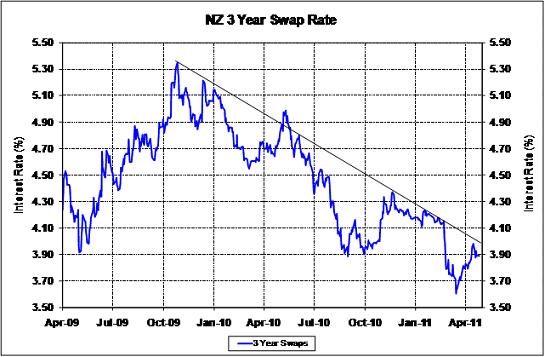
How local investors and borrowers see the short-term interest rates moving in the future in response to inflation and thus monetary policy responses is in many respects captured in the three-year swap interest rate.
Since the rebound up to 5.30% in late 2009, the three-year swap rates has broadly remained below a downtrend line (see chart). A move back above 4.00% would break above that downtrend line, and this appears far more likely than staying below it going forward. Given the 2012 inflation forecast of 3.00% it is very difficult to see the three-year swap rate being too much below 5.00% in 12 month’s time.
--------------------
* Roger J Kerr runs Asia Pacific Risk Management. He specialises in fixed interest securities and is a commentator on economics and markets. More commentary and useful information on fixed interest investing can be found at rogeradvice.com
No chart with that title exists.
We welcome your comments below. If you are not already registered, please register to comment
Remember we welcome robust, respectful and insightful debate. We don't welcome abusive or defamatory comments and will de-register those repeatedly making such comments. Our current comment policy is here.