

 By Roger J Kerr
One could argue about why the RBNZ suddenly decided to concentrate on the inflation risks stemming from strong migration flows and lower than expected two and three year fixed rate mortgage interest rates on the residential property market.
The housing market was already showing signs of leveling off through the winter months as the number of days to sell has reversed from lower to higher.
However, whether they should be tightening monetary policy when the majority of the inflation pressures are coming from a single source, construction costs, is more of a fundamental argument.
There is no question that the resources pressures, thus price pressures in the building industry come largely from the unique situation of the Christchurch earthquakes re-build.
To what degree the RBNZ should be making an exception for a special circumstance is a moot point. In the past, the RBNZ have chosen to exclude one-off price increases for GST increases, rising global oil prices and Government policy changes from their inflation considerations, as long as the price increases did not transfer into wider second-round inflationary increases.
Should a special case be made for the Christchurch rebuild and therefore some of the first-round construction price increases be excluded?
If it can be shown that general wages and prices are not materially increasing across the economy as a result of the unique Christchurch situation, the RBNZ have a responsibility to consider an exception and adjust their inflation forecasts and monetary policy settings accordingly.
I am not advocating that the RBNZ should abandon their planned path to normalise short-term interest rates. Having warned some 18 months ago about the inflation risks associated with an economy expanding by 4% in 2014, I am not about to change my mind about rising interest rates.
However, given that the high exchange rate already has monetary conditions very tight in the economy, is there a risk that an extraordinary one-off event (Christchurch rebuild) causes monetary policy to become overly tight and the collateral damage to the export sector do not justify the means?
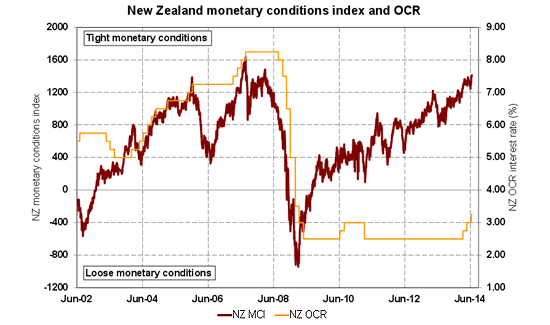
Under the old (now discredited by some) Monetary Conditions Index (MCI) measure of combining the exchange rate and interest rates together, current monetary policy settings are at the extreme tight end (refer chart below).
At 1400, the MCI Index is as high (extreme tight) as the peak in 2007 when overly tight monetary conditions (plus a drought) sent the economy into recession.
Expect to see two and three year swap rates push higher over coming weeks as more mortgage borrowers tap the attractive fixed rates on special offer and the currency comes back off its highs.
Longer term swaps rates will also be pushing up as the US bond market starts to recognise rising inflation (which Fed boss Janet Yellen is dangerously dismissing) as the one-off price decreases in the US over the last 12 months drop out of the annual figures.
-----------------------------------------------------------
To subscribe to our daily Currency Rate Sheet email, enter your email address here.
Daily swap rates
Select chart tabs
Roger J Kerr is a partner at PwC. He specialises in fixed interest securities and is a commentator on economics and markets. More commentary and useful information on fixed interest investing can be found at rogeradvice.com
We welcome your comments below. If you are not already registered, please register to comment
Remember we welcome robust, respectful and insightful debate. We don't welcome abusive or defamatory comments and will de-register those repeatedly making such comments. Our current comment policy is here.