
*By Cameron Preston
Two years ago I suggested that the insurance industry might be about to hit ‘the wall’ as they approached the halfway mark in their Canterbury Earthquake settlements.
In any endurance event those that hit ‘the wall’ either haven’t prepared, or haven’t planned to go the whole distance.
They either come out of the blocks burning the limited energy and goodwill the body will allow over the short to medium term too quickly, not factoring in the whole distance, or they simply have not thought about the second half of the race.
On 10 May Treasury quietly announced Southern Response Earthquake Services Limited (the earthquake challenged rump of the bailed out AMI Insurance retained by the Crown) has just added a further $185 million to its estimate of liabilities to 31 March 2016:
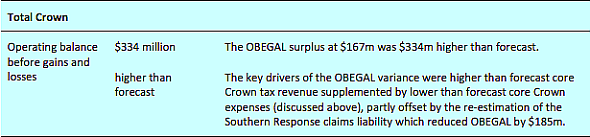
Put this on top of the $325 million jump in 2015 and the $500mln+ promised in 2011 and 2013, and suddenly more than the promised $1 billion in Crown Support is required.
This development is expected to be officially announced in this Thursday’s Budget and makes AMI Insurance the biggest taxpayer bailout in New Zealand history.
Tower Insurance this week announced that a $2.9 million increase in its Canterbury quake ‘net’ provision in the 6 months to 31 March 2016.
However what is carefully hidden away is the fact that Tower’s ‘gross’ provision (what it has and will need to pay customers) for the Canterbury Earthquakes has actually increased by more than $30 million in just 6 months, from $792mln to $822mln:
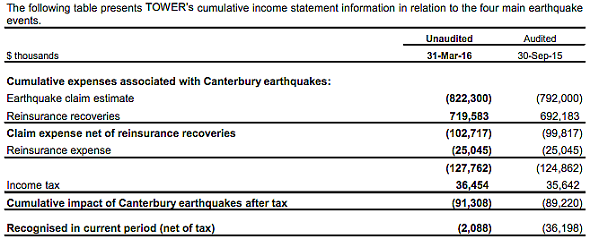
Cushioning this blow (and cushioning is very important in any endurance event) was a $27mln increase in its reinsurance, which is the last of its emergency purchase of $50mln “Adverse Development Cover” (ADC) in 2015.
ADC is a special type of reinsurance akin to extending your insurance cover for a collision after you have already had that collision. As a result ADC is very expensive and I doubt anyone will be rushing to extend another $50mln of ADC to Tower again anytime soon.
IAG is another insurer who has hit the wall. Warren Buffett offered help last year.
Buffett provided both ADC and a capital injection. But this came at an eye watering price for IAG (and their customers and shareholders) as the Buffett deal doubled their reinsurance costs from A$143mln to A$340mln and diluted existing shareholdings. Most of the lost profit and earnings will go to Buffett – he has a shrewd eye for value investing when it matters.
The narrative is the same for all insurers with an exposure to the Canterbury Earthquakes, including Vero, AA Insurance, Medical Assurance Society, and Farmers Mutual.
While they all knew they would run out of reinsurance steam at some point in the race, most didn’t believe they would hit the wall this early.
While most are reporting reaching the 70-75% mark, really once you exclude the easy downhill Red Zone settlements gifted by land decisions at the start of the race, they are only at the 60% mark in the race proper.
The private insurers, via their support team the Insurance Council of New Zealand, continue to use New Zealand’s public insurer, the Earthquake Commission (EQC) as an easy and convenient excuse.
EQC appears to have run the course in the wrong direction, only now starting to settle land claims and address foundation damage. Just when it thought it was near the end of its race, it has to start again.
So while none of the competitors can be accused of setting any record shattering paces before they hit the ‘wall’, and while they have been regularly taking on energy as the race progressed, in the form of higher premiums and expensive ADC paid by all their existing customers, the reinsurance energy and goodwill has all but gone.
Anyone that has ever run a marathon will tell you the real secret is training, it’s too late on race day.
The insurance industry, including EQC, was fat, unfit and ill prepared when the starter gun went off for this race of their lives, contrary to the slick marketing that told their customers they were ready to go the distance in the event of the unthinkable.
Once you hit the wall, the easiest thing to do is give up and walk the rest of the way. Unless of course there are people waiting at the finish line shouting for you to start running again, no matter the pain.
---------------------------------------------------------------------------------------------------------------------
*Cameron Preston is a Christchurch chartered accountant and homeowner who has longstanding unresolved quake insurance claims.
We welcome your comments below. If you are not already registered, please register to comment
Remember we welcome robust, respectful and insightful debate. We don't welcome abusive or defamatory comments and will de-register those repeatedly making such comments. Our current comment policy is here.