
Happy New Year and welcome to our first Top 10 for 2017. It's from interest.co.nz's own Gareth Vaughan.
As always, we welcome your additions in the comment stream below or via email to david.chaston@interest.co.nz.
And if you're interested in contributing the occasional Top 10 yourself, contact gareth.vaughan@interest.co.nz.
See all previous Top 10s here.
You'd almost have to be in outer space or living in a remote, isolated cave to not be aware that Donald Trump will imminently be inaugurated as the 45th President of the United States. Against this backdrop, today's Top 10 focuses on Trump and his idiosyncratic style, which is set to make his presidency unlike any that has preceded it.
1) 'A random blowhard on a bar stool.' Writing for The Daily Beast, Pulitzer Prize winning US investigative journalist and registered Republican David Cay Johnston takes a look at what to expect from President Trump. Johnston has investigated and reported on Trump and his business activities for nearly 30 years. He featured in this interest.co.nz article and video interview last year. I thoroughly recommend his book The Making of Donald Trump, and his articles on Trump's tax history, including this one.
America enters a perilous era with Trump's inauguration, Johnston writes. Americans must respond "smartly" to a President with an "insatiable lust for money, power, and public adoration."
Based on my almost three decades of Trump watching, here is some of what to expect in the days ahead:
First, a rapid fire set of actions designed to dazzle supporters and overwhelm opponents who cannot focus on every executive order and fast-track bill in Congress.
Second, expect Trump to also use national security to crack down on dissent. Protests must be peaceful or they will play in Trump’s authoritarian hands.
Next, expect Trump to curtail public access to government information, perhaps including removing reporters from the White House. Similarly, unwelcome Freedom of Information Act requests will be slow-walked and the already inadequate budget for processing such requests will likely be slashed in the name of reducing burdens on taxpayers.
Johnston also points to Trump's recent interview with The Times, noting one answer had nothing to do with the question and was "the kind of nonsense expected from a random blowhard on a bar stool." Erratic behaviour is to be expected.
...expect Trump’s behavior to become more erratic, as I have long warned, once the pressures of being president weigh on his immature, narcissistic personality.
Be wary. Be watchful. But most of all don't be dumb and play into Trump’s hands.
2) Combating Trump. Johnston is also launching a news service. Touted as a new kind of news organization for the Trump era, David Cay Johnston's DCReport says;
Others quote what Trump Tweets.
We report on what the Trump Administration does.
David is proposing a new kind of nonprofit, citizen-centered news organization, David Cay Johnston’s DCReport, featuring journalism that scrupulously and meticulously scours the public record to report what’s really going on inside your Congressional committee rooms, your executive branch departments, your regulatory agencies and, yes, your White House. This is citizen-focused journalism that will value policies over politics and will focus on the results of government actions, not just the rhetoric of politicians.
...even the best mainstream news organizations rarely cover what is happening within the government until it is far too late for citizens to do anything about it. Mainstream news focuses on controversies - think of the campaign coverage of Clinton’s emails or Trump’s boasts about sexual assault. Rarely does the mainstream press report on the day-to-day mechanics of government, where laws get made, regulations are forged and backroom deals are struck - where government actually happens.
3) The ‘Wettergate’ delusion. Meanwhile, over at The Boston Globe, Niall Ferguson has a warning for the "legion of liberal journalists, bloggers, tweeters, and actors" railing against Trump: He's not going to be impeached in a hurry, and what if he actually succeeds?
What the liberal media would most like is for Trump’s presidency to go directly from his inaugural address next Friday to Watergate, ideally within 24 hours, except that this time the scandal won’t be called Watergate, but — assuming the Russians have video of Trump ordering tarts to urinate on his Moscow hotel room bed — Wettergate.
This, however, won't happen, Ferguson says.
First, Trump’s party has control of both houses of Congress, something that Nixon did not have despite his landslide victory in the 1972 election. A House Democrat may well propose an impeachment resolution. But there are multiple hurdles the resolution would have to clear before it even came to a vote in the House, including the House’s Judiciary Committee. Two-thirds of the Senate would need to vote to oust Trump.
Second, the news media are far less respected today than they were back in 1972. That was the year Gallup first asked the question: “In general, how much trust and confidence do you have in the mass media … when it comes to reporting the news fully, accurately, and fairly?” Back then, 68 percent said a fair amount or a great deal. Last September, in the most recent survey, it was 32 percent. In 1972, only 5 percent of voters answered “none at all.” Now it is 27 percent.
Perhaps new organizations such as David Cay Johnston's DCReport can help reverse the US public's declining respect for their country's media...
Ferguson also makes the point that, helped by having both Congress and the Senate under Republican Party control, Trump has the opportunity to score some early wins.
Finally, there is the distinct possibility that many voters do not care half as much about what Trump has been up to in bedrooms as they do about whether or not he can deliver on his election pledges. Instead of wishfully thinking about what could go wrong for Trump, liberal hacks need to consider the (for them) nightmare scenario that things may go right for him.
Voters do not expect economic miracles, but they may get higher growth if Trump and Congress can quickly deliver on tax reform and deregulation, and avoid an all-out trade war with China.
They may also get peace in the Middle East if Trump can turn his bromance with Putin into a concrete plan to end the war in Syria. And they are almost certain to see much more effective action against Islamic State and its non-violent sympathizers than we have seen under Obama.
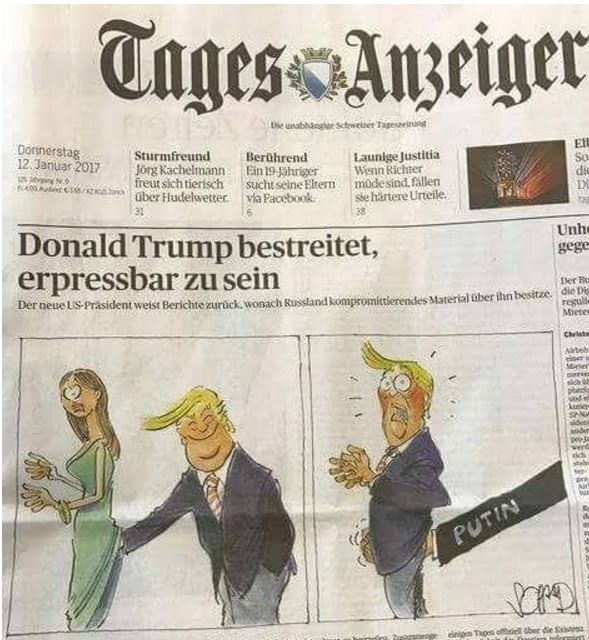
4) The Trump News Network (Twitter).
Trump's controversial tweeting is copping plenty of criticism, but it's clearly working for him. His direct and simple tweets cut to the chase and are easy for anyone to understand. They also both bypass the media and set its agenda. BBC radio takes an indepth look at Trump's tweeting in Trump Tweet by Tweet here.
Trump also attacks people who court his wrath via Twitter. One of these targets has been Megyn Kelly, the former Fox News anchor who recently moved to NBC. She's quoted in the BBC programme saying:
"I have been under armed guard for 16 months, and my children have been under armed guard. And it's not an appropriate price to pay for hard hitting journalism."
Where will Trump’s Zeus-like thunderbolts strike next?
In this Bloomberg piece Noah Smith criticizes Trump's tweeting about public companies, calling it a "policy of rule by personal intimidation" that amounts to "a hidden partial nationalization of America’s large companies and even of companies in foreign countries that do a lot of business in the US."
So far, Trump has focused his ire on companies that transfer jobs out of the U.S. (with little attention to whether they create different jobs in the U.S. to compensate). But what will he demand that businesses do tomorrow? Keep prices low in order to mask the negative effects of a trade war? Stop doing business with countries whose leaders have tweeted or said disapproving things about Trump? Stop putting advertisements in media outlets that publish stories criticizing the president? Cut off ties with businesses owned by rich people who have given money to Democrats? The possibilities are boundless.
The effect on the U.S. economy, however, is unlikely to be salutary. Yes, some companies will avoid offshoring due to fear of Trump. In some cases, this will result in workers getting a larger share of the pie, and owners getting less. In other cases, the companies won’t be able to keep up in competitive global markets, and will have to downsize - American jobs won’t be offshored, they will just vanish.
But an even bigger effect will simply be higher uncertainty. Since no one will know where Trump’s Zeus-like thunderbolts will strike next, investing for the future will become a fraught proposition. Businesses that under Barack Obama or George W. Bush or Bill Clinton would have been able to plan for the next five or 10 years will find themselves paralyzed by the chance that Trump might cast his baleful gaze on them next week.
From a global economic perspective, one of the key dynamics of the Trump presidency is going to be the US-China relationship. Prior to entering the White House there has been plenty of tough rhetoric from Trump on China. He has labelled the country, which has been the key engineroom of global economic growth over recent years, a currency manipulator and threatened 45% tariffs.
Bloomberg looks at what the Trump presidency might mean for China via a discussion here between Beijing University professor Michael Pettis, and Bloomberg Intelligence economist Tom Orlik. Bloomberg notes President Xi Jinping is at the annual Davos World Economic Forum talkfest for the first time in "a sign of how concerned China is about a possible retreat from globalization."
How badly could Trump's threatened 45% tariff hurt China?
The South China Morning Post probes this question, noting Trump has named Peter Navarro, the author of Death by China, as director of the National Trade Council, and Robert Lighthizer, another China critic, as US trade representative.
Kevin Lai, research head for Asia excluding Japan with Daiwa Capital Markets, wrote in a research note that punitive tariffs of 45 per cent would lead to an 87 per cent fall in China’s exports to the US, while HSBC economists led by Qu Hongbin predicted they would result in a halving of Chinese shipments to the US.
The US is China’s biggest export market, accounting for 18 per cent of total exports, and China’s overall exports would be expected to shrink at least 9 per cent if Trump carried through with his tariff threat. There would also be significant suffering due to the collapse of businesses and job losses, with Lai estimating that China’s gross domestic product could be trimmed by 4.8 per cent.
Should a fully fledged trade war between the world's two biggest economies materialise, things could get ugly for small countries like New Zealand caught in the crossfire.
6) 'You're supposed to spend money on your own people.'
Also in attendance at the Davos talkfest, which is taking place in Switzerland this week, is Alibaba founder Jack Ma. The wealthy entrepreneur recently met Trump amid talk of Alibaba helping create up to one million jobs in the US.
Ma had some stinging criticism for those overseeing US public policy for the past 30 years.
The past 30 years America had 13 wars spending $14.2 trillion. The money's going there. What if they spent part of that money on building up the infrastructure, helping the white collars and blue collars [workers]? No matter how good the strategy is, you're supposed to spent money on your own people.
7) "Buy-to-let is dead." UK landlords swapping houses for shops.
In a break from Planet Trump, The Telegraph reports that Britain's legions of "buy-to-let" residential property investors are dumping houses and switching to shops, restaurants and offices instead.
Why?
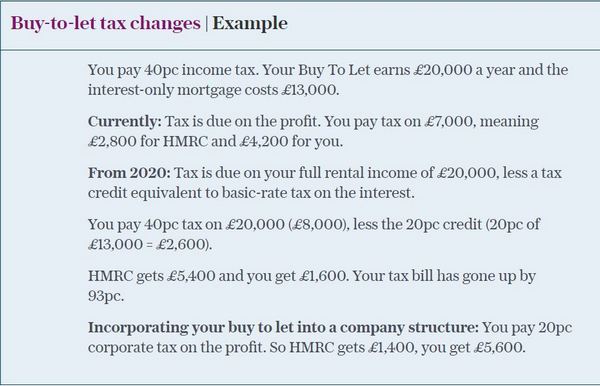
There are now less than three months until mortgaged buy-to-let properties become subject to a new, tougher tax regime which will see thousands of landlords in danger of falling into loss-making territory.
More than 100,000 landlords bought properties within limited companies last year - but many are now concerned that the Government might move to make these subject to tougher taxes too.
George Walker, commercial auction partner at Allsop, said the auction house has seen three times the number of buy-to-let converts dipping in to commercial property since the tax changes were announced.
"We're getting a lot of investors into our market because of the changes to buy-to-let. Once they have bought one, they can't believe the simplicity and want to do it again," he said.
The table below comes from The Telegraph.
Here in New Zealand the Labour Party says if in government it would: "Shut down the ‘negative gearing’ tax breaks that allow investors to write off their losses on rental properties against other taxable activity."
8) An eminent economist and a hare-brained plan.
Indian Prime Minister Narendra Modi's move to cancel his country’s 500 and 1,000 rupee bank notes in November was a fascinating move and is being watched closely around the world. Writing in The South China Morning Post, Tom Holland is sceptical about the official reason for the move and has his own theories. Officially the move - in a cash driven economy - was to combat black money, corruption and crime.
Holland notes sceptics in India argue the real purpose of Modi's move was to wipe out the black money cash campaign funds accumulated by his political opponents ahead of key February state elections.
Internationally Holland is concerned about prominent policymakers, bankers and economists supporting Modi’s desire to create a cashless economy. Governments have tried to inflate away public debt through money printing. But this hasn't worked. And now he's worried about government's scraping bank notes in order to impose negative interest rates that deliberately diminish the value of their citizens’ savings. This, he argues, reneges on trust between people and government.
As the former IMF economist Kenneth Rogoff explained last year in his book The Curse Of Cash, “phasing out paper currency is arguably the simplest and most elegant approach to clearing the path for central banks to invoke unfettered negative interest rate policies”. In other words, he wants to impose an expiry date on money. In a cashless world you either spend your money now, or risk losing it.
Only an eminent economist could come up with such a hare-brained plan which so fundamentally misunderstands the nature of money. An economist will tell you that money is a means of exchange, a unit of account and a store of value. Yes, it is all those, but above all it represents trust: the faith that your debtor will pay. Banknotes are the physical embodiment of that trust.
If officials attempt to scrap banknotes in order to impose negative interest rates that deliberately diminish the value of their citizens’ savings, they will be reneging on the fundamental compact of trust between people and government. Of course, it can be argued that governments have been breaching that trust ever since Roman emperors began clipping their coinage. Nevertheless, withdrawing banknotes would make the betrayal explicit.
9) "This country will be showered with jobs."
Back to Trump. He's certainly showing that he has a thin skin with his tweets complaining about Alec Baldwin taking the Mickey out of him on Saturday Night Live. Given he's now a very, very high profile public figure, the lampooning's not going away. Trump will just have to get used to it.
10) Mark Hamill lampoons Trump too.
Baldwin's not the only actor finding a soft target in Trump. Mark Hamill, best known as Luke Skywalker in Star Wars, has joined the fun. Here's Hamill as The Trumpster, a super villain alter ego who reads Trump tweets in the voice of The Joker. Hamill voices The Joker in animated versions of comics featuring the famous villain.
We welcome your comments below. If you are not already registered, please register to comment
Remember we welcome robust, respectful and insightful debate. We don't welcome abusive or defamatory comments and will de-register those repeatedly making such comments. Our current comment policy is here.