

Kiwi consumers "are feeling rubbish" but this is not likely to result in an outright fall in spending levels, according to ANZ economists.
In an NZ Insight publication, ANZ economist Finn Robinson and chief economist Sharon Zollner have done a detailed examination of the slumping consumer confidence.
The economists say consumers are miserable – and it’s not just Covid.
"Newspapers lately are full of one tale of woe after another about our malaise on all fronts."
Historically, they say there’s been a very strong correlation between household consumption spending and consumer confidence.
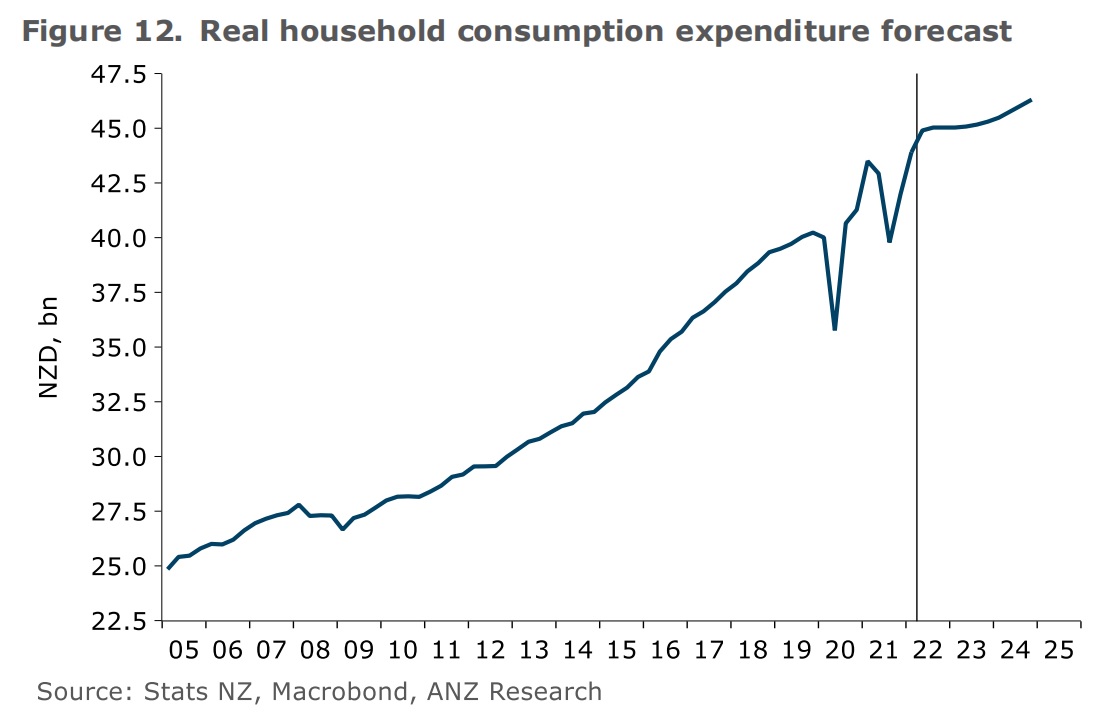
"Taking this historical correlation literally, one might expect household spending to fall rapidly over 2022
"But that’s not our forecast – or the Reserve Bank’s for that matter."
They say there are a few key reasons. The drop in consumer confidence is likely a result of the surging cost of living and the monetary policy tightening (from the RBNZ) it has triggered. But the economists say they expect wage growth will catch up.
"So while consumers are likely to pull back on spending, rising wages should still provide a solid baseline. We do expect a significant slowdown in household consumption spending growth, but not an outright fall in spending levels (although we wouldn’t rule that out as a possibility, particularly if the correction in the housing market were to accelerate)."
They say a key difference between now and the pre-Covid decade is the level of savings that households have accumulated.
"Prior to Covid, New Zealand had a very low (often negative) household savings rate. But since 2020, Kiwi households have had a significantly higher savings rate – and households in other countries even more so. Australia in particular has seen a massive buildup of pandemic savings – and we expect that will provide a fairly sizeable offset as the RBA [Reserve Bank of Australia] hikes rates across the ditch.
"In New Zealand, our accumulated savings should help as well, although it’s a smaller buffer than in some other countries, and interest rates have risen faster here. But every little bit helps."
The economists say there are clearly headwinds to consumer spending and demand over the next year or two.
"Consumers are miserable and don’t expect things to get better, inflation is hurting, interest rates are rising, and asset prices are falling.
"But at the same time, the labour market has never been tighter, and household balance sheets have made it through Covid in pretty good shape.
"So while we expect consumption growth to slow to a crawl from the second half of this year, we don’t think spending will fall to the recessionary levels implied by the level of consumer pessimism."
Robinson and Zollner say the softening in demand from consumers is one key reason why they think the RBNZ will return to "more normal" 25 basis point hikes after the August Monetary Policy Statement, and "only" lift the OCR to 3.5%. (The RBNZ's currently forecasting a peak in the OCR of just under 4% by the middle of next year.)
"We think they’ll be surprised by just how quickly demand starts to ease as the impact of OCR hikes flows through the economy – and weaker consumer confidence is just one symptom of monetary policy working.
"We’re forecasting two more 50bp hikes in July and August, and 25s in October and November, bringing the OCR to 3.5%. But beyond that, a seriously stretched consumer and a construction sector that’s likely to be in decline over 2023 should give the RBNZ the confidence that they’ve broken the back of inflation, and can give growth a chance," the economists say.
But they do say uncertainty "could hardly be higher".
"Inflation is still the name of the game. And while it is our expectation that evidence of softening demand will emerge over the second half of this year, the RBNZ can’t afford to give inflation any room to breathe.
"Any upside surprises on inflation and the labour market are therefore likely to go straight into a higher OCR path. We think inflation peaked at 7% in Q2 (which is also the RBNZ’s forecast). But with geopolitical tensions continuing to rumble and global food prices surging, risks are to the upside. Central banks will not risk losing their inflation targeting credibility – so don’t expect the RBNZ to spare the economy if they don’t see evidence of inflation falling."
And, they say, as part of that inflation battle, in the absence of a miracle recovery on the supply side (eg a huge surge in technological advancement and/or labour from abroad), the RBNZ needs weaker consumption spending.
"So in fact, the question is not, 'to what extent will lower consumer confidence translate into lower spending?' so much as it is 'how high will the OCR need to go to bring about the weakness in consumer spending that the RBNZ believes it needs to see?'
"Retailers face tougher times ahead, regardless."
We welcome your comments below. If you are not already registered, please register to comment
Remember we welcome robust, respectful and insightful debate. We don't welcome abusive or defamatory comments and will de-register those repeatedly making such comments. Our current comment policy is here.