

The housing investors' mortgage pile grew by its largest amount in over three years during August, according to latest Reserve Bank figures.
During August the amount of outstanding mortgages to investors rose by $335 million to $91.837 billion.
Now, that's not a huge increase - certainly not when compared with the $1.266 billion of growth the investor mortgage pile experienced in the super-hot month of March 2021 - but it's further evidence that the long dormant investor grouping may have opened at least half an eye to what's going on in the market.
The $335 million increase in the investor mortgage pile in August is the biggest increase since May 2021 and follows a 215 million rise in July 2024. In fact the amount of outstanding investor mortgages has risen by nearly $1 billion since April of this year, while for the whole of 2023 it grew by just $345 million. In 2022 it increased by $1.4 billion.
The latest investor figures follow on from last week's separately released RBNZ data on mortgages by buyer type, which showed investors gaining a bigger share of mortgage monies advanced in August than first home buyers. It was the first time that had happened for two-and-a-half years. Now, that particular data series includes mortgages that have been swapped between banks - so, not all new. Therefore its a bit dangerous to draw conclusions just based on those figures about increased house buying interest and what borrowing is or it not 'new'.
But the now just released figures that show the existing mortgage pile and how much it has grown by, or not grown, give a rather more definitive picture as to whether certain groupings are buying houses or not.
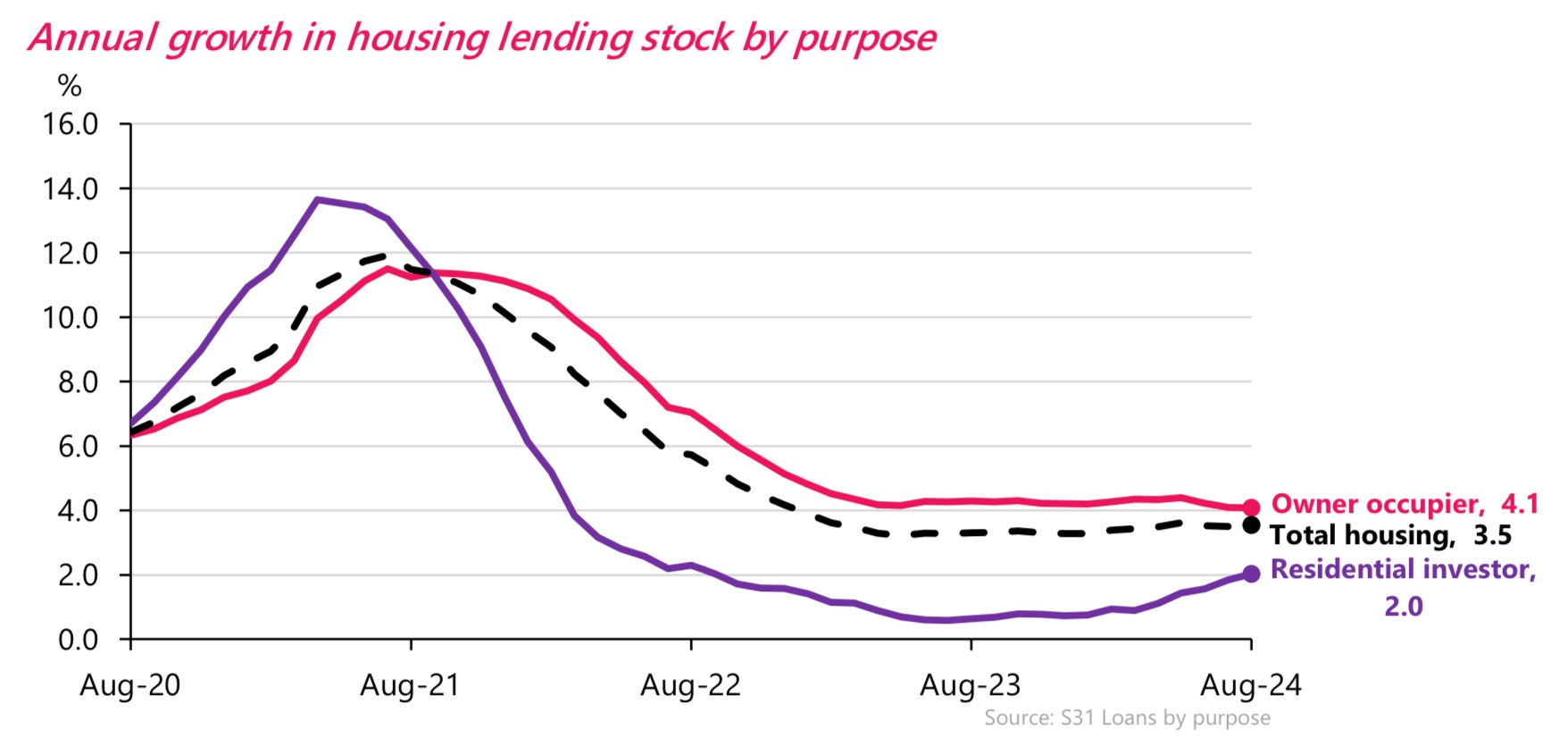
The fact is that the investors have been notable by their absence in the housing market during the past three years after a period of rapid-fire activity that coincided with the pandemic and the RBNZ's (insert your own adjective) decision to temporarily remove loan to value ratio (LVR) limits. Between April 2020 and April 2021 the investor grouping added over $10 billion to their stock of existing mortgages.
Since that feast there's been a famine. In fact, there's actually been more than the odd month in which the investor mortgage pile has actually shrunk.
But of course the investors were hit with reintroduction of tough LVR limits, while on the Government front there were measures such as the removal of interest deductibility for investors and the extension of the timeframe covering the so-called bright-line test (to be read as 'capital gains tax that dare not say its name'). And the housing market went from white-hot to perhaps not bitterly cold, but certainly chilly.
More recently the RBNZ has somewhat relaxed the LVR limits for investors - although it has in tandem introduced new debt to income measures. More crucially, the current Coalition Government has reversed the interest deductibility and bright-line moves.
With interest rates now coming down, it would be surprising if existing and wannabe housing investors didn't at least have another look at the market. The extent to which this 'having a look' crystalises into actual investment will be a key factor for the housing market over the next 12 months. It will definitely be something to watch.
Elsewhere, and perhaps in another sign of stability for the housing market, the RBNZ's bank loans by asset quality figures showed that in August the amount of non-performing housing loans dropped by $26 million to $2.022 billion. This had followed a sudden $141 million jump in non-performing loans in July, taking the overall non-performing total up to an 11-year high and to levels not seen since the aftermath of the Global Financial Crisis.
However, apart from that jump in July, the figures actually appear to have been levelling off in recent months.
Between April 2023 and April 2024 the non-performing housing loan total had risen by nearly $800 million to over $1.9 billion. But since then, apart from the big rise in July, it's been reasonably static.
Now with interest rates on the way down, it will be interesting to see what happens to these figures and whether stressed mortgage holders are able to get themselves back on an even keel.
Of course, the mortgage holders - and many of them will be on fixed term rates - will need to wait till the next reset of their mortgage till they can get the benefit of lower rates.
But the reality is that the Kiwi mortgage holders have been more than ready and waiting for the start of rate reductions. I have previously highlighted the extent to which homeowners have been 'going short' with their fixed terms since the start of this year.
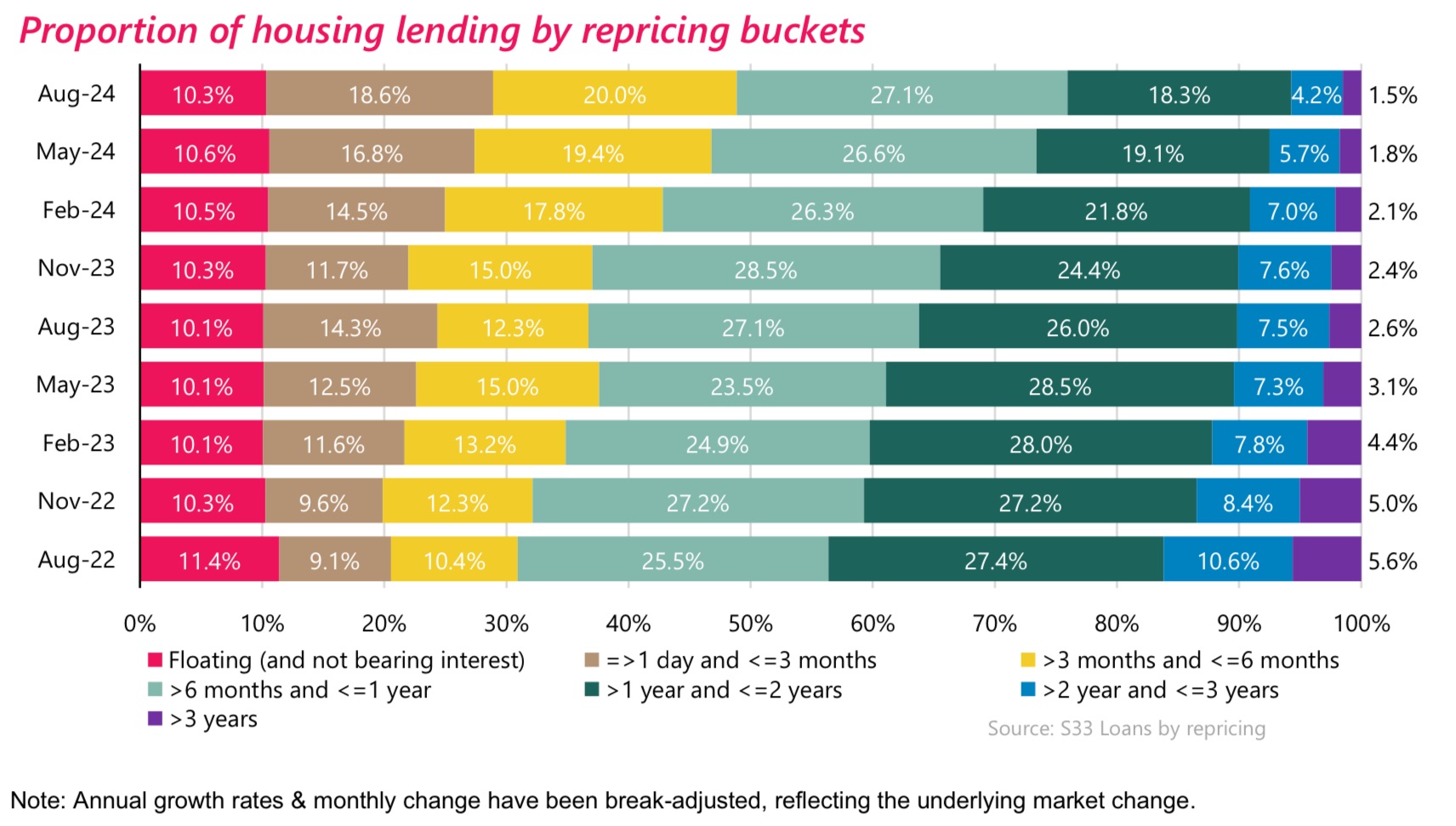
Two years years ago, in August 2022, well over 40% of outstanding mortgage money was on a fixed term of over a year.
But the RBNZ's repricing data shows just how much that has turned around. As of August 2024, a whopping 76% of the total $363 billion mortgage pile was either on floating rates or fixed for durations of a year or less. So, in other words 76% of the mortgage money will be getting lower rates on it within a year. And in fact, if we look at durations of six months and less, they account for just under 50% of all the outstanding mortgage money. (The RBNZ's summary that includes the above graph is here.)
So, relief is on the way for many - quite soon.
What this all does for the housing market over the course of the next 12 months, well, we'll find out. Plenty to see here.
We welcome your comments below. If you are not already registered, please register to comment
Remember we welcome robust, respectful and insightful debate. We don't welcome abusive or defamatory comments and will de-register those repeatedly making such comments. Our current comment policy is here.