

Since the beginning of 2025 the Reserve Bank (RBNZ) has changed the Official Cash Rate (OCR) eight times, with six decreases and two increases.
These have cut the OCR by 150 basis points (bps) overall. But the main banks haven't always passed on the OCR changes to floating mortgage rates in lockstep, and given we are back in a tightening/increasing phase again, it is hard to remember who did what and when.
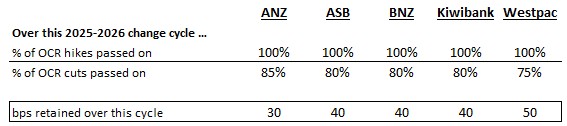
Essentially, the main banks have retained about 40 bps of the 150 bps net OCR change.
While all of them are passing on 100% of the hikes, none of them did the same for the cuts. ANZ retained a net 30 bps over this cycle. ASB, BNZ and Kiwibank retained 40 bps, and Westpac retained 50 bps through this rate-change cycle.
Adjusting rates to customers is one thing, but when they are adjusted can also be important. The longer it takes to pass on a rate hike gives a benefit to clients. Being quicker to pass them on than competitors is a way to extract some margin gains. Similarly, when rates are falling, the longer it takes to pass on the cut is a worse outcome for clients, where as a quicker pass-on is a benefit. After all, the OCR change becomes effective in the market the day after it is announced.

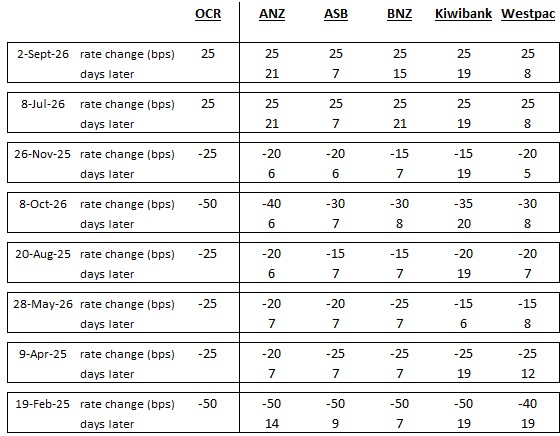
ASB and Kiwibank have passed on the rate hikes faster than their rivals.
Kiwibank and Westpac have passed on the rate cuts slower than their rivals.
Here is the raw data we used to show how the major banks have behaved with floating rate changes after OCR movements in 2025 and 2026.
It should be noted that there is another side to this: how they matched these changes with adjustments to savings account rates. But borrowers probably don't care about that even if savers do. We rarely hear of grumbles from savers about 'slow' pass-on of savings account rates, probably because those rates are so low as not to be top of mind. If a saver is motivated by rates, they will have shifted their balances into a term deposit where there are always much better rates.
We welcome your comments below. If you are not already registered, please register to comment
Remember we welcome robust, respectful and insightful debate. We don't welcome abusive or defamatory comments and will de-register those repeatedly making such comments. Our current comment policy is here.