

Everything that is wrong with the Kiwi property market can be put down to supply - and a lack of it, Kiwibank chief economist Jarrod Kerr says.
"We’re hopeless at building houses. And we refuse to build the infrastructure required to expand," he says.
"We fail to maintain the infrastructure we have. But we insist on adding to the existing (creaking) load."
Kerr's comments come in an Our Take Kiwibank economics publication, which is headed: Kiwi housing: all you need to know for the great BBQ debate this summer.
"If you want to sound like an economist, (but hopefully with a bit more personality), here’s some tips, and crushing one-liners," he says.
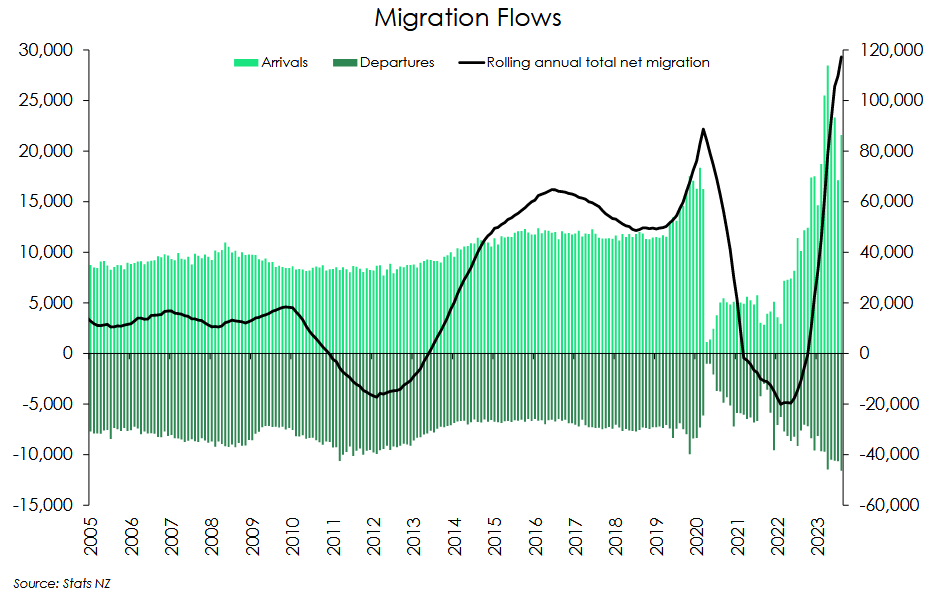
In this century alone, we’ve seen three significant spikes in population growth, Kerr says - and proceeds to outline what happened.
"At the turn of the century, we saw migration boom. The spike in migration led to a spike in demand for properties, both rentals and houses. House prices rose in response.
"Did we increase our spending on infrastructure (not to mention health, education and other services) to handle the flow of migrants? No. But we learnt from this mistake," Kerr says.
He then goes on...
"From 2013 to 2019, we experienced the greatest migration boom in recorded history. In 2018, we estimated the shortage in dwellings blew out to a frightening 100,000. The shortage worsened to 130,000 in 2019. Did we increase our spending on infrastructure (not to mention health, education and other services) to handle the flow of migrants?
"No. But we learnt from this mistake."
And then finally...
"In 2020, we went into Covid fearing the worst. We locked down and closed the borders.
"We saw a net outflow of migrants. We allowed housing supply the chance to catch up. Supply outstripped demand, and our housing shortage improved.
"This was our best chance to eliminate the housing shortage. We did good, for a while.
"But then the borders reopened. And over the last year we have seen a net 120,000 migrants enter Aotearoa in search of a home. That’s the largest increase we’ve seen in one year. Will we increase our spending on infrastructure (not to mention health, education and other services) to handle the flow of migrants? Probably not enough.
"But we will learn from this mistake [insert sarcastic voice]," Kerr says.
He says most policymakers focus on demand because it's the side of the equation they can influence.
"More must be done to increase the supply of land (and all the utilities and services required) for development if we are to respond to surges in population."
He says there are plenty of solutions, including self-fund infrastructure funds and scaled-up builders like Kāinga Ora.
"We just need the political will-power to execute. The troubles with KiwiBuild highlight the difficulty in getting things done, and deepens the fear of trying.
"It’s all about improving the elasticity of supply. Now that sounds like an economist. If you want to sound like a normal human being, say 'improving the ability to boost supply'," Kerr says.
He says that at the moment, at a time when we need the supply of homes to surge, to meet migration demand, we’re seeing a fall in consents.
"Over the last year or so, the decline in housing activity and prices have seen builders scale back. It’s expensive to build in NZ, for a variety of unacceptable reasons. And developers are no longer getting the premium price they need. Pre-sales are also soft.
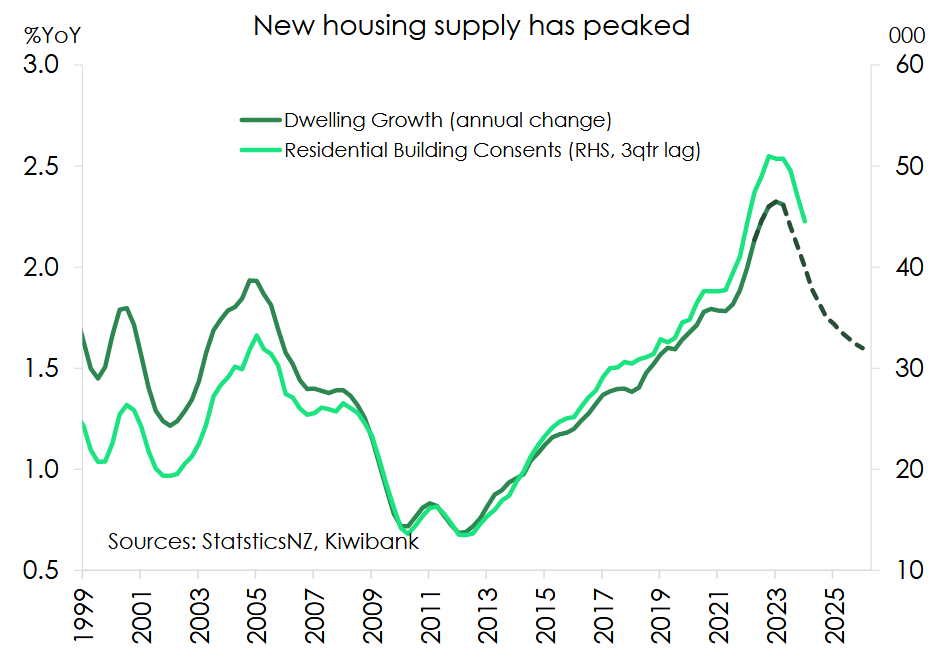
"The good news, we’re getting builders. Our migration stats show us that the largest group of migrants are tradies. So we’re increasing our capacity to build. What we need is a stabilising in house prices – and it’s happening now – to shore up demand and therefore boost supply."
Kerr says in terms of the year ahead for the housing market, the surge in migration will play a big role.
"The demand/supply imbalance will worsen. The surge in migration and the loss of dwellings at high risk of climate change will only exacerbate the housing shortage. The new Government will play a big role. Because the ‘promised’ reintroduction of interest deductibility, shortening the Brightline test timeline, and possible watering down of the CCCFA [Credit Contracts and Consumer Finance Act], will entice investors. Any added infrastructure spend or incentives for new builds will also be welcomed."
Kerr thinks interest rates will fall in 2024.
"But buyer beware: The RBNZ [Reserve Bank] is threatening to hike again. So there may be a lift near-term."
He says the Kiwibank economists' "best guess" is house prices will rise by 5-to-7% next year. "Call it 6% to sound precise."
For anyone who has "suffered" their way through an economics course, "you know we like talking in supply and demand", Kerr says.
"Demand is likely to outstrip supply. That puts upward pressure on price. It’s overly simplistic, (something that is frowned upon in the economics profession), but for every 120,000 people, we need roughly 50,000 new dwellings (with roughly 2.5 people per house). And if we follow the downtrend in people per house to say 2.1, a more ‘desirable’ number, we need more like 60,000.
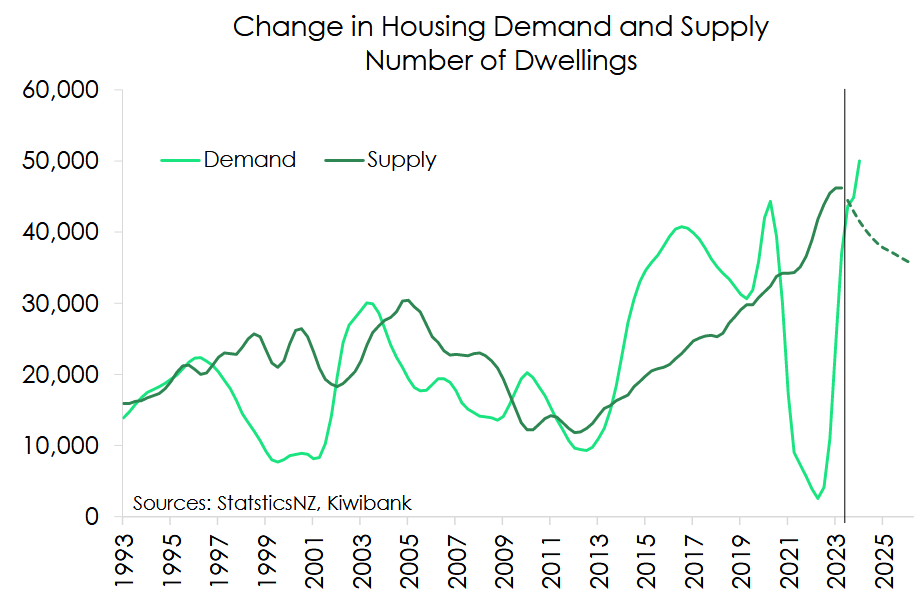
"Regardless of your assumption, 2.5 or 2.1, we need more than we will build.
"We built 46,000 last year, a record effort, but that pace is slowing fast. We expect supply to fall back into the low-to-mid 30,000s. The residential construction boom is cooling quickly. Supply is unlikely to keep up with demand for the foreseeable future. Unless we see some significant policy changes. So that’s a big factor behind our forecast."
Kerr says that interest rates may be another supporting factor for the housing market, eventually.
"We believe the RBNZ will keep the cash rate [OCR] unchanged at 5.5%, well into next year. We’ve pencilled in rate cuts starting in November. We had thought this might come earlier, but the RBNZ is threatening to hike again. The RBNZ has also lifted their forecasts for house prices. And they don’t like the inflation implications that brings (it’s all about migration)."
We welcome your comments below. If you are not already registered, please register to comment
Remember we welcome robust, respectful and insightful debate. We don't welcome abusive or defamatory comments and will de-register those repeatedly making such comments. Our current comment policy is here.