
Successive New Zealand governments have provided homeowners with an implicit guarantee that all policy decisions would protect residential house prices and ensure they only go up.
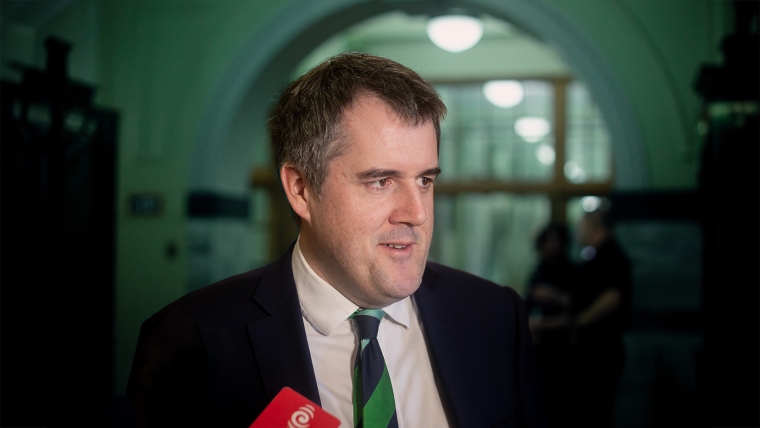
This political promise has collapsed under its own weight over the past two weeks, as Housing Minister Chris Bishop doubled down on his intention to hack down house prices.
The Coalition government has realised the only way to make good progress on housing affordability will be to allow nominal prices to fall, rather than hope for huge income growth.
Now people who are investing in residential property today, and hoping capital gains will make them as rich as their parents, may be betting against policymakers in the Beehive.
Mainstream politicians have traditionally been very hostile to this idea, even when it was suggested by both minor party leaders and conservative economists eight years ago.
And that reflex is still strong. Prime Minister Christopher Luxon wasn’t willing to say he wanted average house prices to fall in real terms when asked, although Bishop later told reporters that everyone in Cabinet was behind his policy goals.
And Labour leader Chris Hipkins said deliberately reducing house prices was not "responsible" and Government policy should only aim to hold prices steady, so that recent home buyers don't lose out.
But since there are always new buyers, Hipkins was effectively saying house prices should only ever go up. This is the implicit promise property investors have been taking to the bank.
Don Brash, a former Reserve Bank Governor and politician, has long advocated for policies that will cause house prices to fall. In a recent blog, he said unimproved houses should almost always sell for less than they cost, just due to wear-and-tear on the physical structure.
“It is surely a serious indictment on policy-makers in central and local government that it is taken as holy writ that houses should almost always be able to be sold for more than they cost,” he said.
Cracking consensus
House prices have periodically fallen in New Zealand. For example, they dropped in the 12 months ended March 2009 and didn’t fully recover for another three years.
But they have risen roughly 150% since then, even once factoring in the recent declines, which are more related to interest rate movements than anything else.
People who were fortunate enough to buy at the turn of century have seen their asset values increase almost 400%, according to the Real Estate Institute of New Zealand’s house price index data.
Since house purchases are massively leveraged, and capital gains are untaxed, rising prices have made a couple of generations very wealthy and some governments very popular.
But the consensus seems to have cracked.
There comes a point when the negative externalities of high house prices, which are shared across society, begin to outweigh the benefits largely concentrated with owners.
For Chris Bishop, that day has come. He believes high housing costs are straining government finances, hamstringing the economy, and fraying the fabric of society.
And he has made it his political mission to do something about it — house prices be damned.
Here for it
If this is still an unpopular position in New Zealand, it hasn’t been obvious in the media.
Matthew Hooton wrote one column criticising Bishop’s comments, although it was largely about immigration, and in the comment section even Act voters, like ‘Christine L’, were saying:
“Bishop is right — anyone who looked at Christchurch after the earthquake, with opening up of land forced on councils, knows that house prices were held down, even while they rocketed through the rest of the country. Supply and demand. Falling house prices are bad for the economy, but young families leaving the country, or mortgaging themselves to the hilt for 30 years, is worse.”
There were similar comments on Interest.co.nz’s story, which first reported Bishop’s comments, such as one which read:
“If he is serious, then good luck to him. If it means that my children inherit a smaller amount, but their children can choose to stay in NZ and buy a house, then I really, really wish him well”.
While there were comments opposing Bishop’s big idea, they were easily outnumbered. This isn’t a scientific measure, of course, but it still says something about the public mood.
Coalition of the Willing
It is worth pointing out that even this swing in favour of more affordable housing appears to be driven by property owners, who are still held close to the heart of NZ politics.
People in their sixties are frustrated that their children are struggling to buy a home and start their own families, and that the kids who manage it are often doing so in a far away city.
Act Party leader David Seymour pointed to this group when defending his support for a set of policies which could result in lower house prices.
“If [a house price] goes up, people who own homes will be happy. If it goes down, people who want to buy homes will be happy.”
“I would say on balance, there will be a lot of people there who are happy with the home they own, but are worried about how the next generation is going to afford one,” he said.
So, the new politics of housing is an alliance between younger people, who are facing the high costs of housing, and older people, who are secure enough to focus on non-financial goals.
This ‘coalition of the willing’ forms a majority in favour of lowering house prices, and they are armed with a long list of social and economic costs caused by the status quo.
Unproductive promises
An essay written by three policy researchers in the United Kingdom in 2021 argued that a shortage of housing in many Western countries was responsible for most big problems.
These include slow economic growth, climate change, poor health, financial instability, economic inequality, and falling fertility.
Bishop has been particularly concerned by the lost productivity that comes with expensive housing and the fiscal cost on the Crown which could be up to $5 billion each year.
“When we stop people building houses, we lock people out of cities. That makes us poorer,” he said, in a speech that outlined the economic and moral case for reform.
“[And] how is it moral for thousands of our fellow citizens to live in motels for months at a time, bouncing from grotty unit to unit, often surrounded by squalor, crime and poverty?”
But there are real questions about whether Bishop will actually be able to deliver on his political mission. Or if homeowners will tolerate it, once it starts to become a reality.
In 2007 John Key also made a serious sounding speech about the “home affordability crisis” and how he planned to fix it if the National Party won the election.
His plan was to relax urban-rural boundaries, make it easier to build townhouses and apartments, build more enabling infrastructure, and reform the Resource Management Act.
This plan was never delivered. House prices went up 9% each year he was Prime Minister and Chris Bishop is giving the same speech 17 years later — almost word-for-word.
Meanwhile, house prices are expected to resume their march to the sea from next year onwards and leave those locked out of the market renting the scorched earth.
*Also see; Would it be possible and/or desirable to engineer a housing market correction?
We welcome your comments below. If you are not already registered, please register to comment
Remember we welcome robust, respectful and insightful debate. We don't welcome abusive or defamatory comments and will de-register those repeatedly making such comments. Our current comment policy is here.