
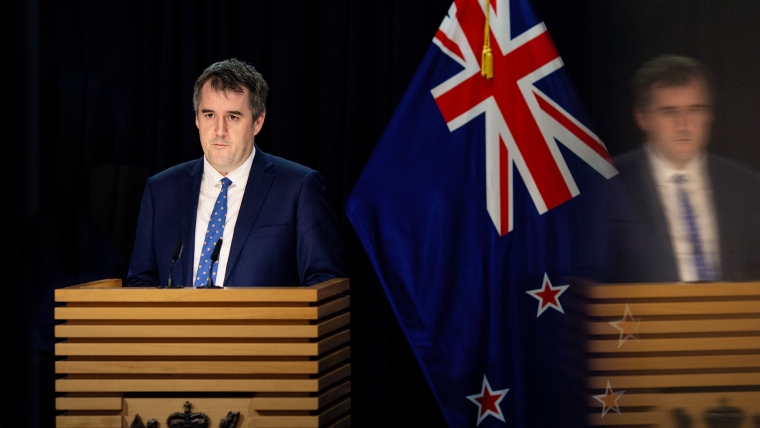
Minister for Housing Chris Bishop says he wants to see average house prices continue to fall even if it makes existing homeowners nervous.
Speaking at a press conference on Monday, the senior coalition government minister told reporters housing was too expensive and prices needed to fall.
This is rare rhetoric for New Zealand politicians who have traditionally been reluctant to suggest real house prices should decline. In 2016 the then-Greens co-leader Metiria Turei caused quite a stir by saying Auckland house prices needed to slowly drop about 50%, bringing them down to three or four times the median household income.
In 2020, then-Prime Minister Jacinda Ardern said she would like to see small increases in house prices, as most people expected the value of their biggest asset to keep rising.
Despite leading a government elected partly on its promise to make housing more affordable, Ardern was only willing to say she wanted “sustained moderation” in house prices.
Bishop blew that language out of the water this week, saying the average house was too expensive and his government was working to make them more affordable.
When asked directly if he thought house prices should fall, the minister answered: yes.
“We want housing to be more affordable for New Zealanders. That is a major work stream for this government — average house prices in NZ are too expensive,” he said.
“The flipside of house prices falling for people who own homes, is that they become more affordable for people who don’t own homes”.
There was an entire generation of people who had been locked out of the housing market because average house prices had been allowed to get too high.
High prices and Reserve Bank loan to value ratio restrictions make it very difficult for new buyers to pull together a deposit to get onto the housing ladder.
He acknowledged that a consequence of aiming for lower average house prices might mean existing home owners feel “a little bit worried”.
“But they also have, in many cases, children who are desperately trying to get on the housing ladder and can’t right now,” Bishop said.
House prices in New Zealand had risen faster than in any other OECD country over the past two decades and his government was not going to let that continue.
“I wake up every day determined to try and improve housing affordability in this country. That is my driving mission in politics,” he said.
Current conditions
Housing unaffordability hit a record in 2021 as ultra-low interest rates and the Covid-19 pandemic pushed prices up to unsustainable levels.
Median prices have since fallen more than 16% from that peak, according to Real Estate Institute of NZ data, but are still roughly 25% above pre-pandemic levels.
Affordability has improved a little as prices have fallen, see interest.co.nz's latest Home Loan Affordability Report here. Mike Jones, the chief economist at BNZ, expects it to “drift sideways” over the next two years.
While he still sees some improvement, his forecasts don’t predict affordability will return to pre-Covid levels unless household income growth continues at 7% while house prices freeze.
Fresh REINZ data, released earlier on Monday, showed the national median house price had fallen to $770,000 in May and was down 1.3% in 12 months.
The REINZ's House Price Index, which adjusts for different kinds of properties sold each month, showed prices across the whole country had declined 2.9% in the past three months.
Jones has forecast house prices will rise just 2% in 2024 before returning to near the long-run average at approximately 5% in 2025.
We welcome your comments below. If you are not already registered, please register to comment
Remember we welcome robust, respectful and insightful debate. We don't welcome abusive or defamatory comments and will de-register those repeatedly making such comments. Our current comment policy is here.