

BNZ economists are conceding that their previous expectations of continued improvement in housing affordability "have been flattened".
Late last year BNZ chief economist Mike Jones had compiled a new housing affordability index and said housing affordability was expected to continue to improve through 2023 as lower house prices (over the first half of 2023) and steady growth in incomes offset higher expected debt servicing costs.
He said then: "Based on our projections, affordability, as proxied by the [housing affordability] index, will have improved back to pre-Covid levels by around the end of 2023. This compares to our house price forecast which, if correct (a big ‘if’), would put house prices still 10-15% above pre-Covid levels by end 2023. Again, this is testament to solid household income growth."
But now, revisiting the situation in his latest Eco Pulse publication, Jones said his expectations have been flattened - "not completely, but based on our projections for income growth, house prices, and mortgage rates, the speed of any improvement over 2024 looks glacial".
"Our housing affordability index is projected to drift roughly sideways from here, as expectations of solid income growth and eventual mortgage rate relief run into higher house price expectations," Jones said.
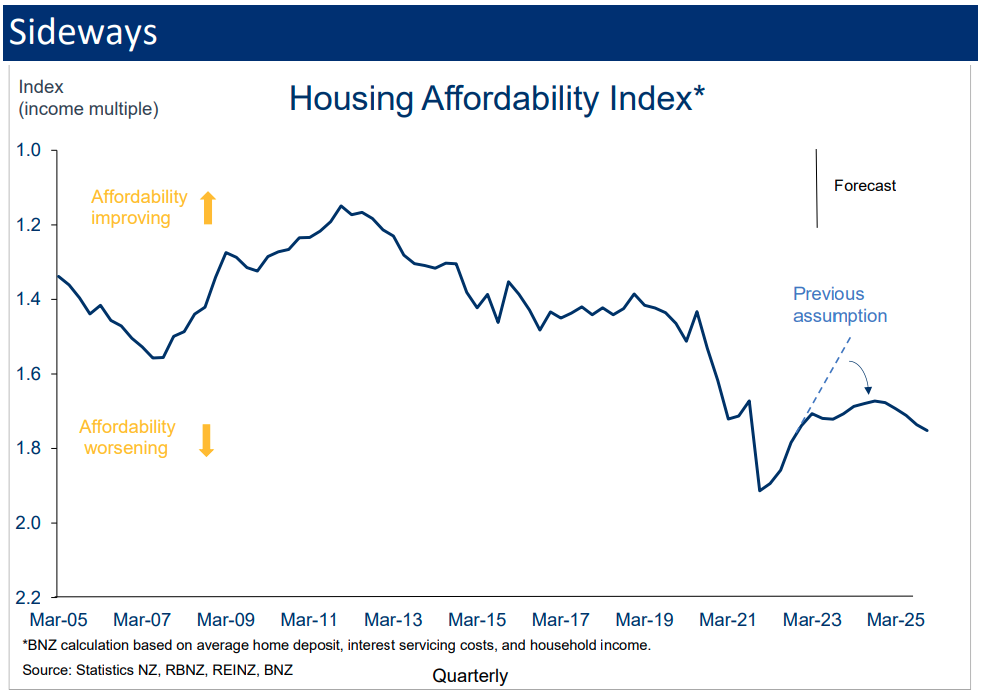
"Firmer house price expectations, and hence higher deposit requirements, have done most of the damage here relative to our last affordability update in December," he said.
"Our expectations of strong, but slowing, household income growth and some mortgage rate relief are enough to hold back the higher house price tide over 2024, but 2025 is a different story and affordability starts to deteriorate again.
"We’re quick to reiterate here that all of this is very sensitive to our forecasts, particularly those for house prices which, as we all know, are very tough to get right."
Jones said the fact that the housing market has turned a corner "is increasingly old news".
He said national house prices stopped falling in March, according to the monthly REINZ House Price Index (seasonally adjusted). Over the past three months that we have data for (May-July) we’ve seen consecutive increases.
"The odds are that this tentative uptrend will be sustained, in some shape or form. When housing momentum turns, it tends to stay turned. Back in early June, we forecast a 3% lift in house prices over the second half of this year, followed by a 7% lift through next year. We’ve seen nothing in the run of play since to throw us off this view."
Jones said "the crux" of his affordabiliity index is that, of the long list of factors affecting housing affordability, there are three core components: the size of the required deposit, the cash required to service a mortgage, and the household incomes used to pay these bills.
"These factors often move at different rates and in different directions. By combining them and adding in some forecasts, we can get a rough steer on the likely future direction of affordability trends. It is just a rough steer – our index only gets at ‘the average’ and the reality is that any particular situation could be different. You can interpret the index as the average cost of a deposit and the first year of debt servicing payments, expressed as a multiple of the average household disposable income.
Jones said by re-examining his affordability index he could draw some conclusions. First, housing affordability has continued to improve (become less bad).
"Our index is up around 10% from ‘peak unaffordability’ in December 2021 (1.7 times average income compared to 1.9 times in December). Most of this reflects the fall in house prices over that time. Strong income growth has helped too, with higher debt servicing costs working in the other direction. Auckland has experienced the largest affordability recovery but unsurprisingly remains the most unaffordable market overall. Canterbury has changed little thanks to an outperforming housing market while Otago has the dubious honour of now matching Wellington in the unaffordability stakes (having surpassed Canterbury in 2017)."
Jones said given the uncertainty around forecasts, "it’s worth looking at a few scenarios. In the chart below, we’ve changed one or two of the forecast variables in each scenario and left all else constant".
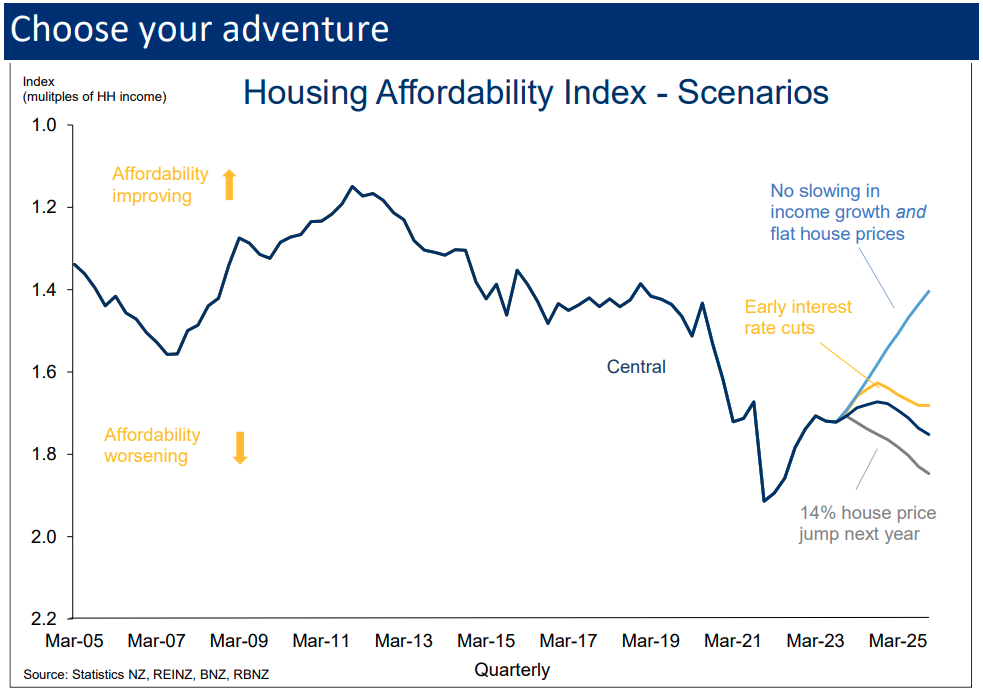
Jones said in the first scenario, a situation in which house prices grow at "double our expectations" through calendar 2024 (+14%), this pulls affordability back down to near the December 2021 lows.
In the second, a scenario in which the Reserve Bank delivers early 2024 interest rate cuts provides a small boost to affordability, relative to BNZ economists' ‘central’ assumption. "But it’s small bikkies in the grand scheme."
Finally, in a possible but "unlikely" ‘goldilocks’ scenario in which household income growth holds at a healthy 7% and house prices flat-line for the next two years, the affordability index "roars back up" to above pre-Covid levels. "It highlights, again, how difficult it is to claw back affordability in the wake of a house price boom," Jones said.
"Stretched affordability will be a key factor limiting the extent of house price gains next year (we forecast a 7% lift). Still-high mortgage rates and a slackening labour market are the other factors expected to keep a lid on things."
We welcome your comments below. If you are not already registered, please register to comment
Remember we welcome robust, respectful and insightful debate. We don't welcome abusive or defamatory comments and will de-register those repeatedly making such comments. Our current comment policy is here.