
By Gareth Vaughan
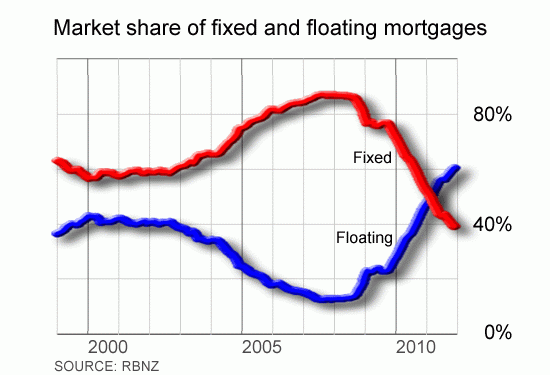
The percentage of home loan borrowers with their mortgage on a floating interest rate has risen above 60% for the first time since the Reserve Bank records began in June 1998.
Borrowers are preferring to stay floating despite warnings from bank economists that the Reserve Bank's Official Cash Rate is likely to increase from later this year, potentially pushing up floating mortgage rates. The shift to floating is also flying in the face of slight reductions in fixed rates to levels in line with floating rates. The move also gives the Reserve Bank more monetary policy traction and, ironically, gives it more headroom to leave rates on hold for longer because it can be more confident it will be able to slow the economy faster when it needs to.
The latest monthly figures from the Reserve Bank show NZ$103.761 billion worth of banks' on-balance sheet residential mortgages were floating as of December, comprising almost 61% of the total NZ$170.750 billion.
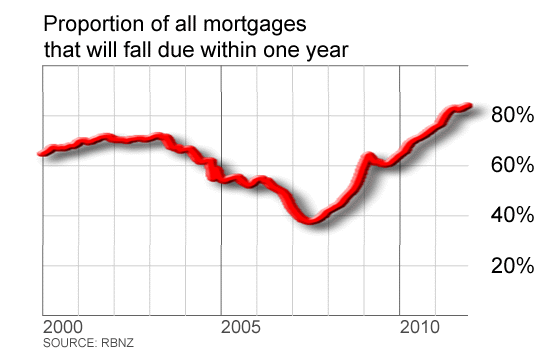
Another NZ$40.232 billion was fixed for less than a year, meaning NZ$143.993 billion, or 84%, worth of on-balance sheet residential mortgages are either floating or up for renewal during 2012.
The total of on-balance sheet fixed-term mortgages stands at NZ$66.742 billion. According to the central bank's figures, the trading banks hold a total of NZ$281 million worth of residential mortgages off-balance sheet.
Banks cutting fixed-term rates
Confirmation home loan borrowers were still favouring floating mortgages over fixed ones as 2011 ended comes on the heels of recent cuts to fixed-term rates by four banks.
Sister banks ANZ and National, SBS Bank, plus ASB and TSB Bank, recently cut advertised fixed-term home loan rates by up to 30 basis points after wholesale 'swap' interest rates fell following official data that showed the consumer price index fell 0.3% in the December quarter and the Reserve Bank left the Official Cash Rate (OCR) at its record 2.5% low amid economists' expectations it may stay there into 2013.
In contrast, the most recent change to floating mortgage rates came from the BNZ on December 1 last year when it raised its Total Money floating, or variable, rate by 15 basis points to 5.74% from 5.59%.
Late on Wednesday Westpac cut its two-year fixed home loan rate by 10 basis points to 5.79%.See all bank advertised mortgage rates here.
More monetary policy power for the RBNZ?
In theory the large proportion of residential mortgages on floating rates strengthens the Reserve Bank's ability to control consumer spending and inflation through OCR moves. Because the OCR's biggest influence is on short-term interest rates, a hike or cut in the OCR quickly flows through to floating interest rates.
A borrower on a floating mortgage is, for example, generally hit by a 25 basis point hike when the Reserve Bank lifts the OCR by the same amount. This means the borrower is forced to spend more on interest payments, giving them less discretionary money to spend elsewhere. See more on this here.
However, some of the big banks are increasingly arguing that the floating mortgage rates they charge customers are "decoupled" from the OCR, especially with the Eurozone sovereign debt crisis driving up the cost for them of raising money in overseas wholesale markets.
For example, BNZ yesterday issued a €500 million worth of three-year covered bonds, secured by New Zealand residential mortgages, to European institutional investors at 113 basis points over the euro mid-swap rate. That's well up on the 62 basis points over swap the same bank paid in a seven-year, €1 billion covered bond issue in November 2010. These figures don't include the cost of converting the money from euros back to New Zealand dollars.
'Decoupled'
BNZ CEO Andrew Thorburn told interest.co.nz last October the OCR and banks' floating mortgage rates had never been coupled and there was the "real possibility" floating rates would be hiked, independent of any OCR move, because of the banks' own rising funding costs. And yesterday Cameron Clyne, the CEO of BNZ's parent National Australia Bank, said NAB may not pass on any official interest rate cut made by the Reserve Bank of Australia next week to customers in full because "there's no correlation to what the Reserve Bank does and the cost of our funds."
Also in Australia, the ANZ Banking Group recently moved to review housing and small business floating interest rates monthly independent of Reserve Bank of Australia OCR reviews. Although New Zealand subsidiary, ANZ New Zealand, hasn't followed its parent's lead, a spokeswoman for the bank told interest.co.nz.
ANZ NZ agrees with its parent's view that interest rate considerations for banks include many factors other than just the Reserve Bank’s OCR.
This push by some of the banks to separate the OCR from the floating interest rates they charge customers comes after a strong year of profits for the big four Australasian banks - ANZ, NAB, ASB's parent Commonwealth Bank of Australia and Westpac. Combined, the big four made a record A$25 billion of annual cash profit in their last financial year, with their New Zealand subsidiaries making a combined net profit after tax of NZ$2.778 billion. That's NZ$78 million, or 3%, higher than their combined profit in the boom year of 2007 when double digit lending growth was the norm compared with more recent anaemic lending growth.
In New Zealand ANZ, ASB, BNZ and Westpac all recorded annual rises in net interest margins, up 11, 40, 14, and 22 basis points, respectively. The Reserve Bank monitors banks' net interest margins on a monthly basis and the results can be viewed here.
We welcome your comments below. If you are not already registered, please register to comment
Remember we welcome robust, respectful and insightful debate. We don't welcome abusive or defamatory comments and will de-register those repeatedly making such comments. Our current comment policy is here.