

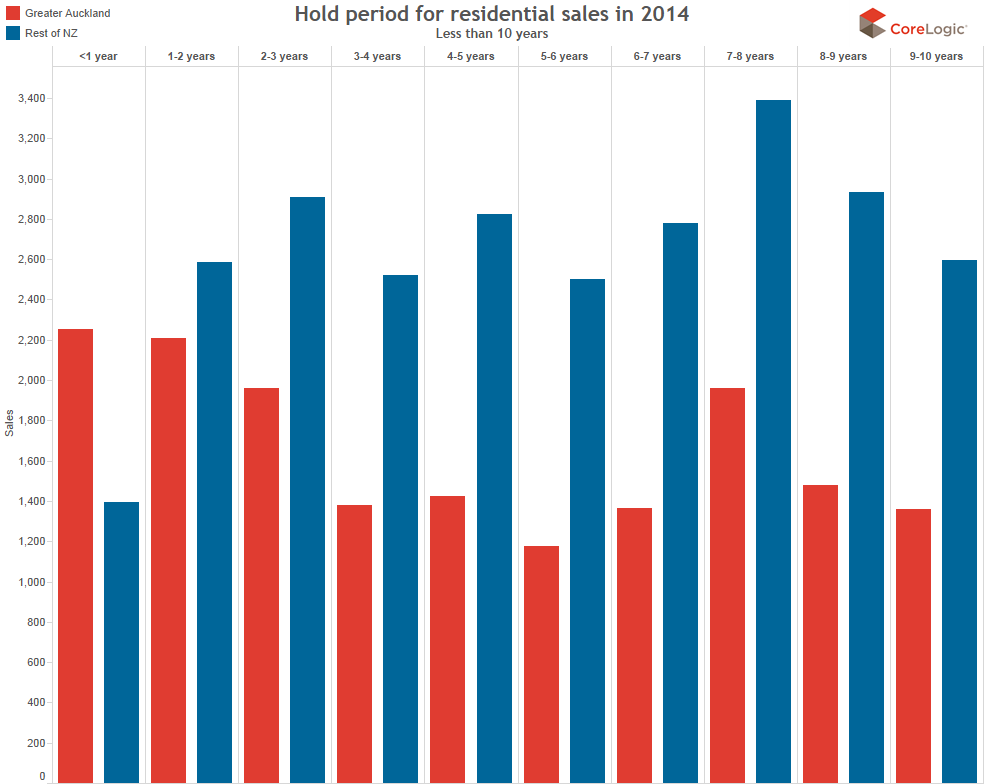
Some 15% of the houses sold in Auckland last year had changed hands less than two years previously, according to research from property information, analytics and services provider CoreLogic.
The figures are significant in the light of the Government's decision to formalise the existing taxation of property gains by introducing a rule that any investment properties sold within two years will attract tax from October 1.
In an article on the CoreLogic website, senior research analyst Nick Goodall has investigated the house sales patterns both in Auckland and nationally.
The research indicated that had the new tax rules applied last year, about 3,400 house sales transactions nationally would have automatically attracted tax.
The research doesn't break down how many of those 3,400 might have been in Auckland, but it does show that Aucklanders have been keen to flick their houses on faster than people in other parts of New Zealand - perhaps not surprisingly given the heated state of the market in the country's largest city.
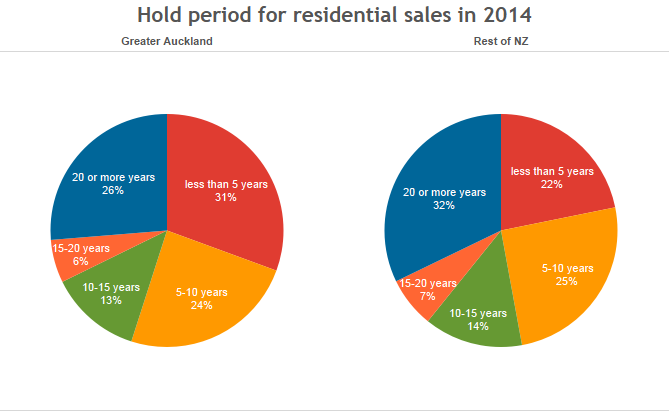
Goodall says there is "a definite difference" in hold period between Auckland and the rest of the country, with almost a third of Auckland houses held for less than five years after being sold.
"If we investigate further into this it’s quite clear there are signs of speculation in the Auckland market – when breaking the hold period into yearly buckets we see Auckland peak at less than 1 year while for the rest of the country it’s most likely properties are sold within 7-8 years.," he said
"So the new measures from both the Reserve Bank and Government certainly seem like sensible approaches to try and address Auckland’s rapid growth, mostly driven by Investors."
Goodall says that of the 86,000 house sales nationally last year, almost 10% (8,400) were held for less than two years.
But in Auckland the percentage was much higher – almost 15% of 31,000 sales (so about 4,500).
Goodall says that some of these properties would be the sellers’ main home so not liable for the tax.
He estimates about 60% of sales ("from our buyer classification data as well as Stats NZ Census owner occupier data") would be "main homes".
"So 40% of 8,400 sales nationwide give us a total of almost 3,400 properties that would be up for the tax," Goodall says.
"Capital gain for those properties shifted in less than 2 years is $230m – taxed at an average rate of 30% is almost $70m per year," he says.
However, he says it also needs to be remembered that not all capital gain will be liable, as costs paid for renovations need to be taken into account "so this number would be scaled down further".
"This is because the renovations undertaken add to the capital of the property. For example if you bought an investment property for $500,000 and spent $50,000 renovating the bathroom and kitchen, then sold it a year later for $600,000 you’d only be liable for capital gains tax on the $50,000 profit.
"And finally, some people will already be obeying the current tax laws which would be included in this amount, so again this figure will be scaled down," Goodall says.
We welcome your comments below. If you are not already registered, please register to comment
Remember we welcome robust, respectful and insightful debate. We don't welcome abusive or defamatory comments and will de-register those repeatedly making such comments. Our current comment policy is here.