
By David Hargreaves
There's been a sharp drop in expectations for house price gains this year in the latest quarterly Reserve Bank Survey of Expectations, an influential survey closely watched by the RBNZ.
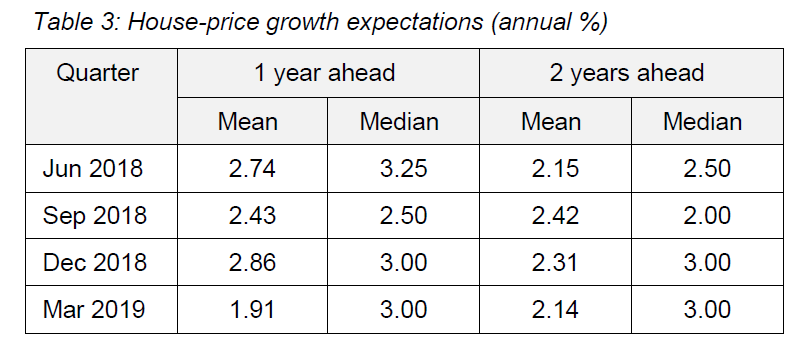
Respondents to the latest survey expect house price gains over the next 12 months on average to be just 1.91%, which is a steep fall from the 2.86% in the same survey only three months ago.
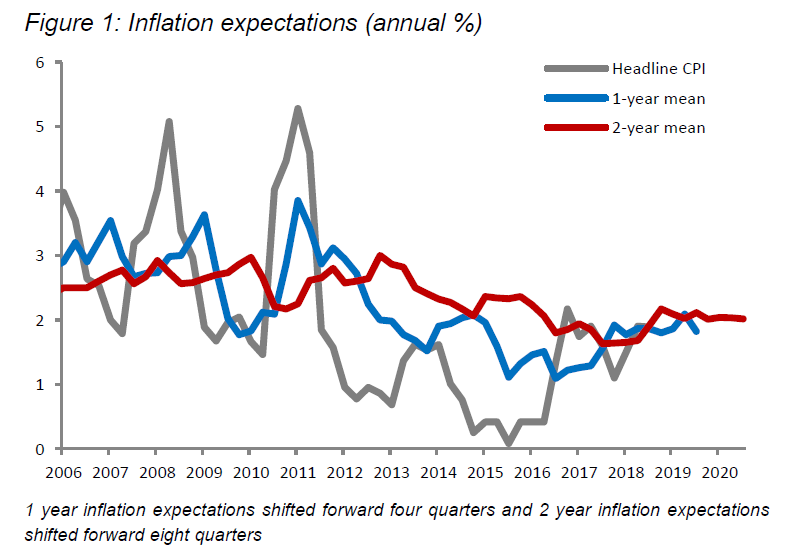
The figure of most interest to the RBNZ in the survey is the expectation for overall inflation in two years' time - and this shows that inflation expectations are very much 'anchored' around the 2% level at the moment - which is the explicit target level for the central bank.
This survey, a New Zealand-wide quarterly survey of business managers and professionals, carries a lot of clout with the RBNZ.
The central bank has been known to make changes to the Official Cash Rate largely based on the outcomes of this survey in the past.
The question about house price expectations is a relatively recent addition in the survey having only been added towards the end of 2017.
For most of last year the expectation of year-out prices sat in a range between 2.3% and 2.9% so the latest drop is a sharp one in the context of recent results.
In terms of expectations for where house prices will be tracking in two years' time, the respondents to the survey see little change.
They are picking annual house price inflation of 2.14% in two years' time, which is down from 2.31% three months ago.
For the RBNZ, which has from the start of this year loosened its limits on high loan to value ratio (LVR) lending, the results of the survey will be encouraging, demonstrating that pricing expectations have levelled with little sign of the overall market taking off again.
If such expectations carry on into this year and are borne out by a flat actual market the RBNZ may later this year be again encouraged to loosen the LVR limits.
The next time it will rule on whether or not to do that would be at its next Financial Stability Report release in May.
That would probably be too soon for a further change.
But given a continuation of flat market conditions the following Financial Stability Report in November could well be a time for further loosening to be announced.
In terms of overall inflation expectations, the latest survey shows that the mean expectation for inflation in two years' time is now 2.02%, down just a touch from 2.03% as of the previous survey.
There has been a much bigger movement in the year-out expectation, which has dropped from 2.09% to 1.82%.
However, this just pretty much reverses a sharp rise in the previous survey and can be explained by the fast rise in petrol prices seen earlier last year follwed by the big drop late in the year.
In terms of overall economic performance, the survey has reflected the recent soft-looking economic data, with expectations for GDP growth over the next 12 months having been trimmed back to 2.38% from 2.44%.
Generally the results of the latest survey would back the general view ahead of the RBNZ's decision on official interest rates (the Official Cash Rate) on Wednesday that the OCR would be kept the same (1.75%) and the outlook for the RBNZ would be for risks being broadly 'balanced' between the possibility of the next movement in the OCR being either up or down.
Most economists still pick the next move will be up - although not for some time - but ANZ economists believe the RBNZ will be forced to drop rates later this year.
We welcome your comments below. If you are not already registered, please register to comment
Remember we welcome robust, respectful and insightful debate. We don't welcome abusive or defamatory comments and will de-register those repeatedly making such comments. Our current comment policy is here.