
Budget 2023 has delivered a surprise $5 billion of new spending in the next year, which could fuel further inflation and trigger a reaction from the Reserve Bank next week.
This is despite talk from the Beehive of a budget that would focus only on the basics and do what it could to dampen down inflation.
Much of this is due to the cyclone rebuild, and was therefore unavoidable, but some extras were included as well. Notably 20-hours of free childcare and cheaper public transport.
ANZ’s economic research team said the ‘No-Frills Budget’ definitely contained frills from a macroeconomic perspective.
The current economic context was not conducive to further fiscal expansion, and yet the Budget added more than $5 billion of extra spending over the next year alone.
“That’s around 1.4% of GDP that the RBNZ wasn’t previously expecting based on the Half-Year Update, and could have implications for the interest rate outlook,” the bank economists said.
A Treasury report from March last year said as a “rule of thumb” additional fiscal stimulus equal to 1% of GDP would push the Official Cash Rate 30 basis points higher.
ANZ economists said it was therefore “odd” that the Treasury hadn’t incorporated a stronger monetary policy response into its economic forecast.
The RBNZ has explicitly warned the Government that any expansionary fiscal policy will be met with higher interest rates.
Trimming the frills
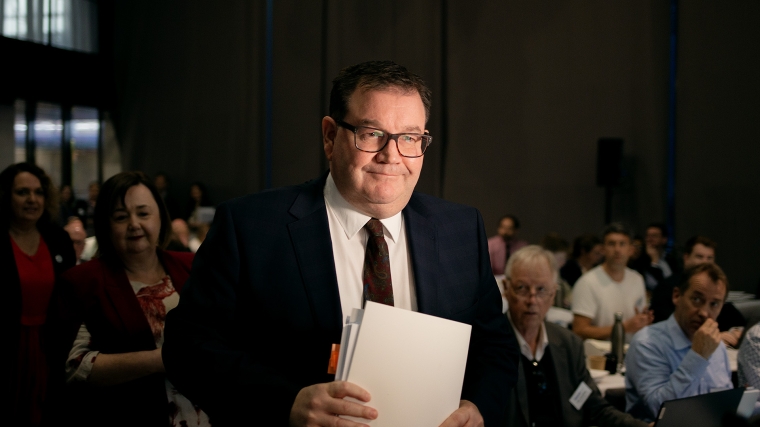
Finance Minister Grant Robertson said in his speech that the budget would target spending to help households with the cost of living, but not exacerbate inflation.
This is true only in the latter years of the Budget 2023 period, which are forecast to be contractionary and are subject to change.
Each annual budget covers the following four years and comes with the opportunity to increase or decrease previously planned spending.
Contractionary settings could never materialise if future governments decide to fund their own priorities, without creating room for them.
Operating spending—or OBEGAL—in the 2023 fiscal year will be a deficit of $7.6 billion and only return to surplus in 2026.
This will contribute to net debt climbing from 18% today to 22% in 2024, before retreating to 18.4% at the end of the forecast period in 2027.
(For readers who prefer the old debt measure, the equivalent numbers are 38.5%, up to 43.1%, and back down to 37.3%.)
Even a surprise tax increase, lifting the trustee rate to 39%, will do little to offset higher spending. It was forecast to bring in a total of $1.1 billion across the next five years.
S&P Global Ratings said the budget projected central government cash deficit for the 2023 fiscal year would be 6.5% of gross domestic product.
“This is a big uptick from the 4.3% deficit penciled in five months ago, and 2.2% a year ago. However, we still anticipate fiscal improvement in the subsequent years as emergency spending programs are rapidly phased out,” it said in a note.
The credit ratings agency said it was not worried about New Zealand’s debt levels, which it said were in the “midrange” of 18 countries with an ‘AA’ rating, but wanted to see stronger fiscal metrics.
Budget 2023 relies on future governments delivering on those better fiscal metrics and not being tempted into repeated deficits.
Cyclone Gabrielle and other infrastructure investment has played a significant role in pushing spending upwards, although operating expenditure has increased as well.
Robertson lifted the 2023 operating allowance to $4.8 billion, down from $5.9 billion last year but still $300 million above the budget policy statement in December.
The cost of the four headline policies in the cost-of-living package comes to $2.6 billion across four years, but only makes up a chunk of the $14.1 billion of new spending.
Robertson said a majority of new spending was consumed by cost pressures, as inflation increases the cost of providing government services as well as boosts tax revenue.
Massive infrastructure programme
In addition to the ongoing operational spending, Budget 2023 provided for $10.7 billion in capital spending and set aside another $6 billion to be spent in a National Resilience Plan.
The capital expenditure in the budget includes $6.7 billion to build public housing, $1.3 billion to build new classrooms, and $197 million to support City Rail Link.
In addition to these projects, a yet-to-be defined National Resilience Plan will be given an initial $6 billion. This will first be spent on reinstating road, rail, and local infrastructure damaged by Cyclone Gabrielle.
The government will also spend $100 million over five years to repurpose the Christchurch rebuild agency, formerly known as Ōtākaro, into an infrastructure delivery organisation.
It will be rebranded as Rau Paenga, or the Central Crown Infrastructure Delivery Agency, and will support less experienced organisations with large, complex projects.
Recession avoided?
Six months ago the Treasury expected the New Zealand economy to contract 0.8% in 2023, but it now expects 1.1% growth without any further increases to the official cash rate.
“While we no longer anticipate a technical recession during 2023, growth remains low and labour market conditions will deteriorate,” the agency said in its economic and fiscal update.
Despite this improvement, it has forecast the Official Cash Rate to be held at its current level (5.25%) throughout 2023, then falling to 3% by 2027.
ANZ recently lifted its Official Cash Rate forecast to 5.75%, but said the budget adds upside risk to even this forecast.
Earlier this week Westpac upped its forecast to predict a peak of 6% and the RBNZ itself has signalled a 5.5% rate, which throws some doubt on Treasury’s numbers.
But if they are to be believed, the Budget will deliver a $4.9 billion boost to nominal GDP over the forecast period.
This will allow the unemployment rate to peak lower than expected at 5.3%, but would likely stay high for longer as interest rates are held at 5.25% longer than previously forecast.
Even though their forecasts include stronger employment and a lower Official Cash Rate than some others, Treasury thought inflation would be back in the target range by December 2024.
The bad news for homeowners is that house prices would fall another 4.6% in this scenario, bringing the total peak-to-trough decline to 21.3%.
The recovery was also expected to be much slower than previously forecast, with house prices still well below 2021 levels at the end of 2027.
We welcome your comments below. If you are not already registered, please register to comment
Remember we welcome robust, respectful and insightful debate. We don't welcome abusive or defamatory comments and will de-register those repeatedly making such comments. Our current comment policy is here.