
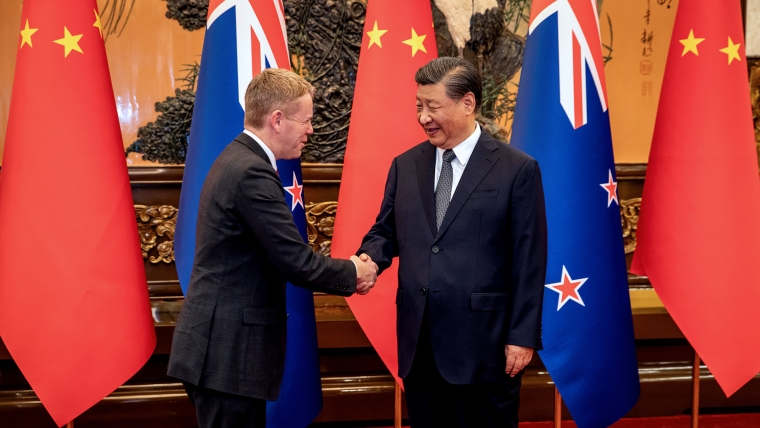
Prime Minister Chris Hipkins has met with Chinese President Xi Jinping in Beijing as he works to shore up New Zealand’s trading relationship with the world’s second largest economy.
Hipkins focused on economics in the meeting on Tuesday, while the Chinese leader took a more personal approach in his opening remarks.
“China always views New Zealand as a friend and a partner,” Xi said. “Amidst the changing international landscape, our relationship has remained robust and strong”.
Hipkins was hesitant to use the same words when later asked by reporters. He described the meeting as being “warm” but said he’d only describe China as a “friend” in certain contexts.
“I would describe the relationship between NZ and China as an incredibly important one. We cooperate and work together on areas where it is in our interests to do that, we disagree from time-to-time and we convey those disagreements”.
Hipkins said it was a partnership, in the sense they shared a free trade agreement, and it was a friendship, in the sense they had regular dialogue and worked together on some issues.
He said China was largely a friend and partner but it could “depend on the context”.
“I don’t think one or two words will ever adequately describe an international relationship”.
Talking trade
As signalled, Hipkins said the trade relationship was the main topic of discussion in the 40 minute meeting. However, the Pacific, the United States, and Ukraine were also discussed.
“There was a particular economic focus to our conversations, that’s an issue of such importance to New Zealand exporters,” he told reporters in Beijing.
Not much time was spent reiterating New Zealand’s discomfort over issues such as human rights abuses in Xinjiang, as China was already aware of these views.
In his opening remarks, Xi said other countries in the region had been following Hipkins' visit “very closely”.
This was likely a reference to China’s hope that other countries will copy New Zealand’s independent foreign policy and not take cues from the United States.
An editorial published in The Global Times, a state-owned media company, said NZ’s approach to diplomacy should set an example for other Western countries.
The article was written by an academic named Qin Sheng, who studies Australia, New Zealand and South Pacific, and was timed to coincide with Hipkins’ arrival in China.
“The meetings between the leaders of China and New Zealand will send an important signal to regional countries and even the world, that only by jointly addressing global threats, abandoning ideological prejudices, and rejecting Cold War thinking can we follow the right path of history,” it said.
Since most media in China is controlled by the Chinese Government, editorials like these are often thought to reflect the views of the country’s leadership to some extent.
The South China Morning Post, an English language newspaper based in Hong-Kong, reported Xi as having said the two countries should see each other as partners, not adversaries.
“[We need to] respect each other, treat each other as equals, be open and accommodating, be harmonious but different,” he said.
One China Policy
Hipkins also met with Zhao Leji, chair of the Standing Committee of the National People's Congress, who thanked Hipkins for visiting China and for 50 years of diplomatic relations.
“It has brought about great benefits to the two peoples and made positive contributions to regional peace, security, and prosperity,” Zhao said, in his opening remarks.
Hipkins welcomed the opportunity for a face-to-face meeting and said New Zealand remained “firmly committed” to its One China Policy.
This policy acknowledges (but doesn’t endorse) the Chinese government’s view that Taiwan is an “inalienable” part of its territory. It has been in place since NZ helped China join the United Nations in the 1970s.
We welcome your comments below. If you are not already registered, please register to comment
Remember we welcome robust, respectful and insightful debate. We don't welcome abusive or defamatory comments and will de-register those repeatedly making such comments. Our current comment policy is here.