
There was good news this week for those who don’t like paying tax: one political party ruled out not just a capital gains tax, but all taxes.
Income tax, corporate tax, goods and services tax, road user charges… you name it, it's gone.
How will the party continue to fund public services without tax revenue, you ask? Well, those (minor) details will be provided “in the coming weeks” it said.
The political party was conspiracy theorist Liz Gunn’s new NZ Loyal Party and it has the luxury of promising a tax-free utopia because there is zero chance it will be asked to follow through.
This is an extreme example of what I like to call “micro-populism”.
Minor parties propose outlandish ideas that are popular with their voter base, but have little-to-no chance of becoming government policy.
Examples include the Act Party’s proposed referendum to redefine treaty principles, the Maori Party’s plan to establish a separate parliament, and now the Green Party’s wealth tax.
A wealth tax is not a particularly outlandish idea compared to the other two examples cited above, both of which would be significant constitutional reforms.
But, for over a decade, there has been consensus that the Labour Party cannot win an election with even a faint whiff of a capital gains tax in its manifesto.
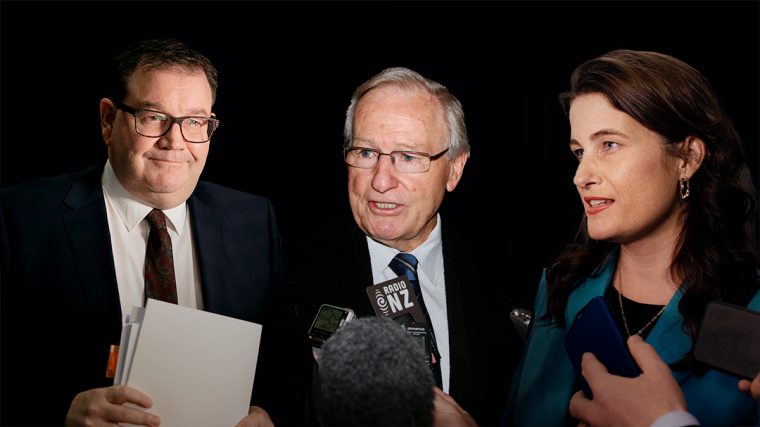
Phil Goff campaigned on it in 2011 and lost. David Cunliffe campaigned on it in 2014 and lost.
Jacinda Ardern was elected in 2017 without ruling it out, but ended up doing so before the next election. And now, Chris Hipkins has followed suit.
The rest of the Green Party’s marquee income policy rests on the extra revenue that would’ve been brought in by its wealth taxes. You can’t do one half without the other.
Herein lies the problem for would-be governing parties this election: there is no money in the bank for shiny new policies. If you don’t raise more cash, you can’t do more stuff.
Something has to be done
In the Budget 2023 process, Treasury told ministers there were “fiscal challenges” that would make it difficult to maintain operating surpluses and meet fiscal objectives.
There was a “strong case” for considering raising revenue to support the $4.5 billion operating allowance and the self-imposed fiscal rules, it said.
In 2021, Treasury wrote a long-term fiscal position briefing document which warned net debt would reach unsustainable levels by 2060 unless governments did something about it.
This was based on historical spending trends (not just Covid-era spending) and factored in demographic change.
The Treasury said there was “no immediate need” to reduce debt, but some combination of lower spending and/or more taxes will be necessary over time.
Some commentators have criticized Labour and National for their lack of policies, but the truth is that there isn’t much room for new initiatives without lifting taxes.
Micro and macro populism
And so, many of the bright ideas are coming from minor parties which will never have to hold the finance portfolio or win over ‘middle New Zealand’ in an election.
The Act Party wants to hack the public sector to facilitate tax cuts across the board. The Green Party wants to tax the wealthy to support low income earners. Te Pati Maori wants to take GST off all food. The Opportunities Party wants a universal basic income.
National and Labour face their own macro-populist issues when it comes to tax policy.
Homeowners still make up 65% of all households, even though ownership rates have been falling for decades. Since voter turnout and ownership rates are higher among older groups, we can assume the voter base has an even higher proportion of homeowners.
These voters are afraid of what a capital gains or wealth tax might mean for their most important asset, even with the ‘family home’ ruled out of the equation.
Farmers, and the rural communities that surround them, are another important demographic that hates the idea of wealth, capital, or land taxes. They often earn thin margins from a very expensive asset and worry about being hit hard by these types of taxes.
Only a small minority of NZ’s population lives rurally, but they hold a lot of political sway due to the importance of exports.
Wage and salary earners already shoulder the bulk of the tax burden and asking them to carry more would be a tough sell. Particularly when some other types of income remain untaxed.
And so, it is very hard to corral a winning coalition that will support tax increases.
The minor parties can craft a micro-populist policy for their 5% to 15% of voters, while the big parties stick their populist heads in the sand.
Dreamwalking
There’s an interview that former prime minister Jim Bolger gave during the 2020 election campaign that I never stop thinking about.
He was being interviewed about Todd Muller’s shock resignation and RNZ’s Kathryn Ryan is pushing him to endorse possible replacements, but Bolger wasn’t interested in that at all.
The only thing he wanted to discuss was “the stark reality” that New Zealand would need higher tax rates in the aftermath of the pandemic.
“All political parties [are doing] a little bit of dream-walking at the moment,” he said.
There had been massive (and essential) spending during the Covid-19 pandemic to protect people and the economy, but nobody was talking about getting budgets back on track.
“We have been drifting along, all comfortable, and the virus has thumped us. We need to respond by acknowledging we have to take some very radical and bold steps”.
While Ryan tried in vain to bring the conversation back to the leadership contest, Bolger said political leaders needed the courage to lift rates and implement a capital gains tax.
“I know some will scream blue murder and I'll get some nasty emails. But that’s the stark reality of what New Zealand has to do,” he said.
Remember, this is a life-long National Party member and a prime minister who oversaw the Mother of All Budgets in the 1990s. He’s not exactly a Marxist.
When Ryan pushed again on who should lead the National Party into the 2020 election, the only thing he’d say was that it needed to be a bold leader.
The way New Zealand was taxing and spending was “totally out of kilter with reality” and needed to be confronted.
“I just hope that there are leaders out there, in all parties, that will step up to that [challenge]”.
Three years later, he must be disappointed.
We welcome your comments below. If you are not already registered, please register to comment
Remember we welcome robust, respectful and insightful debate. We don't welcome abusive or defamatory comments and will de-register those repeatedly making such comments. Our current comment policy is here.