
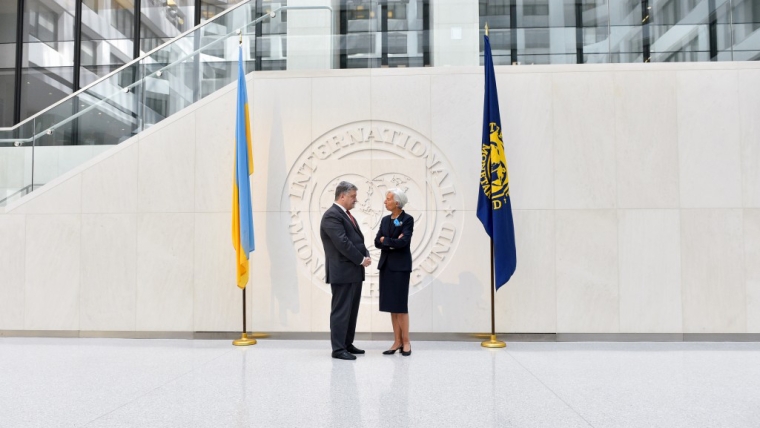
The International Monetary Fund (IMF) says the New Zealand Government needs to trim its spending, or risk prolonging high inflation and prompt another lift in interest rates.
It also implied the Official Cash Rate (OCR) was not high enough to bring inflation into the target range during 2024, and forecast that goal would only be met the following year.
The IMF publishes a report on the New Zealand economy each year, after visiting and meeting with its policymakers.
This year’s staff report said economic growth would remain slow in the near term as monetary policy works to bring down inflation.
However, it said that inflation would stay higher for longer than the Reserve Bank has forecast due to another dose of government spending in Budget 2023.
“Inflation will likely decline but remain above target in 2024, with new discretionary spending adding to pressures,” they wrote.
The external price pressures which first triggered inflation were easing, but non-tradable inflation had become sticky and the outlook was highly uncertain.
It said there was limited scope for the Reserve Bank to consider lowering the OCR, with output and employment gaps likely to stay positive throughout 2024.
IMF staff took a cautious view on the central bank’s current plan to hold the OCR at 5.50% for the foreseeable future. It did not explicitly disagree, but did not endorse it either.
“Should new data confirm that inflation is now on a durable downward path to the target, a pause in the tightening cycle could be warranted,” they said.
“On the other hand, a reignition of demand, including due to insufficient fiscal consolidation, and a stalling of inflation above target would call for further tightening of monetary policy, and there is a need for greater recognition of the fiscal-monetary policy interaction”.
Cut spending now
The report contained veiled criticism of the Government’s Budget 2023 which opted to expand spending despite fast inflation occurring in the already-too-hot economy.
Operating allowances were increased in Budget 2023 to $4.8 billion each year (1.1% of average GDP) with an additional $1.1 billion for fixing cyclone damaged infrastructure.
While Cyclone Gabrielle was often cited as a reason for the higher spending, the IMF said the budget was bigger even with the cyclone spending removed.
There was new spending on early childhood education, free prescriptions, discounted public transport, and energy bill subsidies.
The savings and prioritization announced alongside the budget only covered a “small share” of the new initiatives, and fiscal consolidation was only projected to begin in 2025.
IMF staff said more money should be cut from this year's budget and cost-of-living support should’ve been targeted at low-income households only.
Finance Minister Grant Robertson would’ve been aware of these comments when he announced $4 billion of spending cuts on Monday afternoon.
The IMF report gives the Government and its agencies an opportunity to respond to the report within the document itself.
New Zealand argued that fiscal expansion was needed to respond to the cyclone and the cost-of-living crisis, and cutting spending only in future years was appropriate.
“They agreed with staff on the need for a tighter stance in line with the fiscal rules and explained that the weather events have temporarily delayed fiscal consolidation, but it will be achieved in the forecast period (four years),” the report said.
Frontloaded growth
The IMF said New Zealand’s economy recovered from the pandemic faster than most other advanced economies. It grew 10% since the middle of 2020, fueled by fiscal support.
“But this came at the cost of significant overheating against capacity constraints exacerbated by restrictions on labor movement due to border closures and disruptions in global supply chains,” it said.
Now, the economy will have to pay back that stimulus-driven growth with a policy-induced slowdown. The IMF expects gross domestic product to grow 1% in each of the next two years.
But even this engineered slowdown may not be enough to bring inflation back into the target range. The IMF said policymakers needed to pay more attention to how fiscal and monetary policy interacted.
If government spending doesn’t fall and inflation gets stuck above target, further monetary tightening would be required.
“When inflation first started picking up in the second half of 2021, it was mostly driven by a spike in international food and energy prices and supply chain and shipping disruptions.”
Now, capacity is starting to catch up with demand as commodity prices ease and supply chains are repaired.
“However, non-tradable inflation has taken its place, keeping overall inflation high and sticky,” the report said.
This sticky core inflation means the headline rate won’t drop into the 1% to 3% target range until 2025, according to IMF forecasts. RBNZ has projected it will be in September 2024.
Call for monthly CPI data
To help the central bank make timely decisions, Statistics NZ should reconsider the possibility of compiling monthly inflation data — alongside its current quarterly measure. NZ's the only OCED country that doesn't have quarterly inflation data.
The Reserve Bank told the IMF it needed more real-time information, and the lack of monthly consumer price data was an important gap.
“The lack of a monthly CPI series makes New Zealand an outlier among advanced economies and is holding back a timelier formulation and assessment of monetary policy,” the IMF said.
Stats NZ is examining the possibility of publishing monthly price data but noted a monthly CPI series would require additional resources
We welcome your comments below. If you are not already registered, please register to comment
Remember we welcome robust, respectful and insightful debate. We don't welcome abusive or defamatory comments and will de-register those repeatedly making such comments. Our current comment policy is here.