
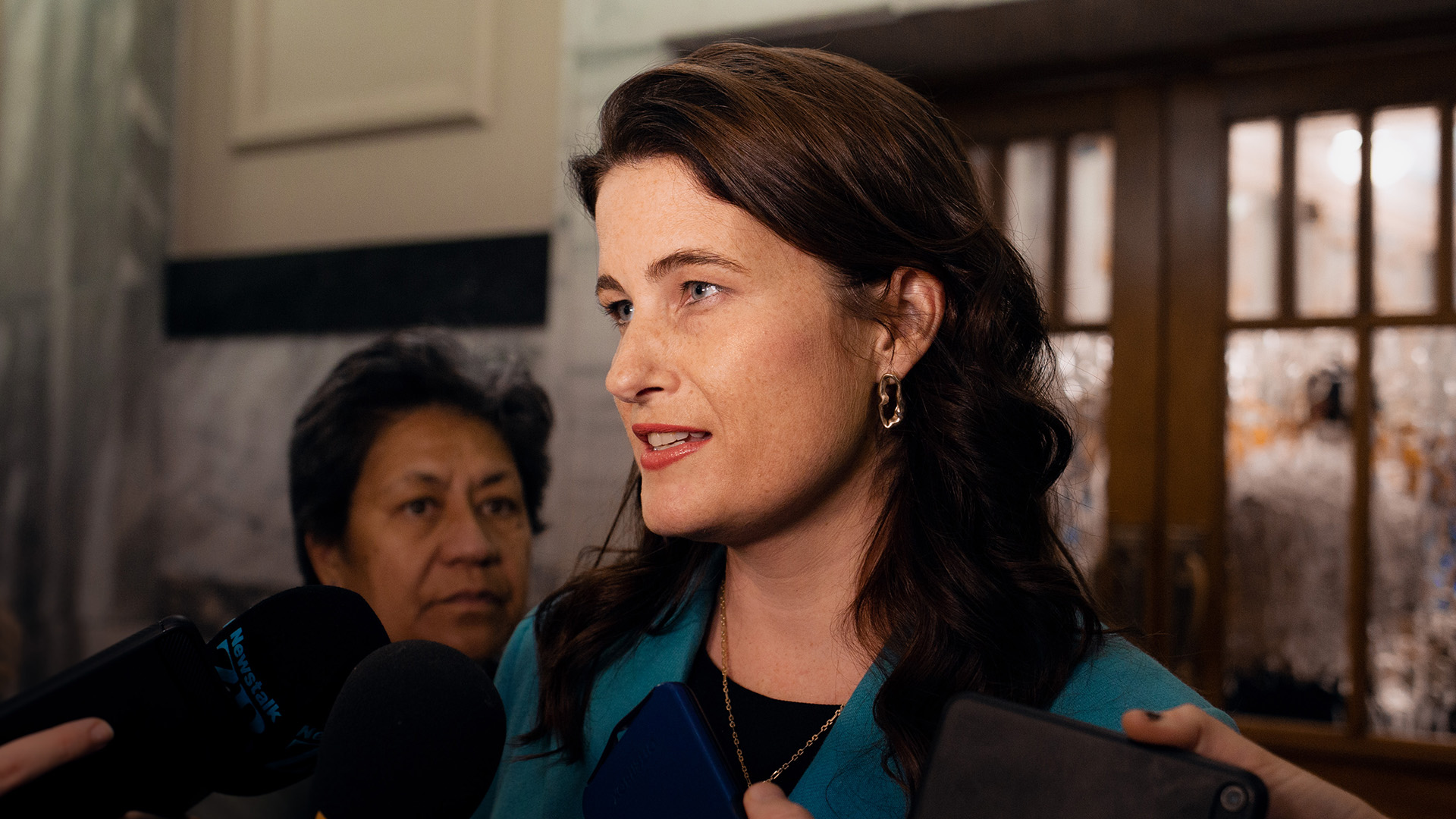
Finance Minister Nicola Willis says she is still working with Treasury on how to fund the income and property tax cuts her party promised to deliver in the May budget.
During the election campaign, the National party pitched its tax policy as being self-funded from a combination of spending cuts and new sources of revenue.
However, its proposal to allow foreign investors to buy residential property and tax them 15% did not survive the coalition negotiations.
The coalition Government has stuck to its commitment to make the tax package fiscally neutral but has not said how it will fill the gap left by the foreign buyers tax.
Willis said she was seeking advice from officials on tax changes for the May budget, in answer to a Parliamentary question on Thursday.
“The details of any specific revenue measures the Government may choose to pursue are yet to be finalised,” she said.
Grant Robertson, Labour’s finance spokesperson, has claimed the National Party does not know how to fund its tax cuts without borrowing money or cutting essential public services.
Willis said the tax reduction package, as promised by the Government in its recent Speech from the Throne, would be self-funding — but couldn’t say exactly how it would be done.
The new Finance Minister will present a “mini-mini-budget” on December 20th, alongside the Treasury's Half-Year Economic and Fiscal Update.
It is expected to include the 6.5% cuts from the public sector baseline funding and any spending in the 100-day plan that cannot wait for the May budget.
More tweaks
Miles Workman, an economist at ANZ, said the mini-budget would be more of a “policy statement than a budget”.
“While there will be a few small tweaks here and there to fiscal settings over the next few months, the big change to fiscal settings will occur from the next fiscal year onwards”.
A full budget process was a “goliath task” and there would not have been enough time to do substantial work since the coalition agreements were signed a couple of weeks ago.
The mini-budget would likely outline the path for fiscal policy and the list of regulatory reforms included in the coalition Government’s 100-day plan.
Workman said the Government will want to forecast an operating surplus for the 2026/27 fiscal year and will adjust policy settings to achieve that target.
“As we’ve noted previously, seven consecutive years in deficit following the pandemic is not appropriate for the economic conditions. Sovereign credit ratings agencies are watching closely, and there is very little room for slippage”.
From S&P Global Ratings New Zealand has a AAA local currency rating and a AA+ foreign currency rating, both with stable outlooks. It has Aaa foreign and local currency ratings from Moody's Investors Service, also with stable outlooks, and AA+ foreign and local currency ratings from Fitch Ratings, again with stable outlooks.
The domestic currency ratings assess the country's capacity to meet obligations denominated in the NZ dollar, which almost all government debt - via government bonds - is issued and repaid in. All these ratings are either the highest, or second highest, credit ratings the ratings agencies have.
Nic Guesnon, an economist at UBS, said he expected to see $11 billion in government spending cuts, but only a $1 billion improvement in the annual operating balance in the next four years.
“While we expect expense projections may be trimmed, revenue is also likely to be lower compared to National's pre-election plan, given the foreign buyer tax is no longer going ahead and interest deductibility changes have been marginally pulled forward”.
National’s fiscal plan said the $10.6 billion of tax relief over the four years to 2027 would be offset by just $2.5 billion of new revenue without the proposed foreign buyer tax.
“So, while the new Government may find ways to raise revenue, we judge it is unlikely they will be able to raise another ~$8 billion in revenue to fully offset their proposed tax relief over the 4 years to 26/27”.
UBS expects core Crown spending will decline from 33.5% of GDP this year, to about 30% in 2027 or 2028.
165 Comments
The only viable option is a John Key GST rise...great start by the team I must say!
i dread this has been her go to right from the beginning, it is a tax that hits those at the bottom and middle the most and is highly favoured by those who can use structures to claw it back ie the top end of town.
most people do not see the great JK tax shift was just a sugar hit that hurt them further down the track
It also means that renters have even less to pay for rent, which will potentailly affect all those landlords. Plus guessing it will be inflationary. IMO they would have more credibility to say that they can't afford the tax cuts anymore due to the coalition deal, which is 100% correct. NZ voted for this by allowing NZ first back in.
no, I think National should create the CGT that the Labour fails to push. in this way National can do it under its terms.
Tax cuts are simply not appropriate in NZ's current circumstances.
They might have worked as a campaign bribe - but that's it.
The government needs to suck it up and govern. Banging on about tax cuts leads us down a road to nowhere.
TTP
IRD/MSM have picked up on $2billion of covid loans to be paid back. That not chump change.
Now there’s a job for the guy who hits people with bed legs..
LOL - That comment really brightened up my Morning.
Presumably the govt borrowed that money, and has to pay it back. Not revenue.
I don't think it's just found it, it's been there all along.
sitting in the books as an asset...about to become bad debts and written off. Another hole on the books appearing.
Too true, many businesses are just walking away and refusing to pay back the loans. It is way to easy to avoid debts as a business, just change the name for $200 and get a spouse to hold the can.
From the article in stuff I couldn't help but relate it to all the other bailouts preformed in the last 15 years or so. It sounds very much like the businesses were on there way out anyway and it prolonged their existence a bit.
The best thing Willis could do would be to look at things like accommodation supplement and wff, they are a never ending and expanding subsidy pit to pour money into. That would easily sort the deficit.
But I guess that's real change so not the sort of change they want.
And I've given them a way to cut the $2 billion+ per annum accommodation supplement costs out;
Do away with ASUP. And a very simple way of saving tax and reducing house prices. The rental market would adjust to what a tenant can afford. At present rents go up and thus so does the amount climbable by the tenant.
Then there is the multiple claims on one property rort.
Slowly abating this supplement would be politically astute. So far this Govt is far from that.
I'm doubtful. The last time five months I advertised a rental I had over 50 applicants in the first day. Some were relying on the accommodation supplement but most werent. I disagreed with the ASUP but removing it now will only increase homelessness and the social housing wait list. Rents won't decrease.
Do you ask each and every applicant if they're claiming an accommodation supplement? I highly doubt you do.
But if it is indeed the case, then it could be implied that you're discriminating.
https://www.tenancy.govt.nz/starting-a-tenancy/tenancy-agreements/discr…
Landlords just hate admitting they are sucking off the taxpayer teat.
Not to mention speculatively profiteering off the back of government largesse in terms of regulating the dysfunctional market - so dysfunctional that subsidies are required..
most landlords are making under 3% gross. Removing the supplement now won't push rents down as they are already on the economic floor. Rents and housing stock will remain the same and those who are reliant on the accommodation supplement will be homeless.
The government would push them down via regulation.
It's what they are employed to do - make laws and regulate markets!
No I don't ask but plenty of people volunteered that information. I'd say about 20% of the applicants said they had the supplement. I certainly wouldn't discriminate either way.
The others didn't volunteer the information - and why would they?
Why would they volunteer that information? "Oh hi, I'm here to look at the property. By the way, I receive an accommodation supplement and I have a $10k term deposit".
Talk about spinning a tale. Probably didn't even get 50 applicants. By the way, I'm Chuck Norris.
Exactly. And I'm Dolly Parton :-).
No skin off my nose if you don't believe me Churck and Dolly. Many people volunteered that they have accommodation supplement and that WINZ would pay me directly. I think they volunteered the info as it made them appear more reliable in terms of payment.
Just calling out the fiction that's all. WINZ require a bank statement as proof of bank account when applying for AS. I suppose many people are getting bank statements off their landlords?
Maybe you're talking about people on Jobseeker benefits who have the option of setting up a redirection of benefit payments to go along with the portion that WINZ top up (the rent above the 25% income cap).
Yes, I suspect he/she is - see below.
I think you/they are mistaken in referring to WINZ rental assistance funding as the Accommodation Supplement. They are two different things, but nonetheless both subsidies to landlords..
1689.
Increasing the ability to pay pushes up rents for everyone.
I've heard through the grapevine over 60% of renters rely on assistance paying rent. That's forked.
Yes - they're called Zombie businesses because the Covid bailout just pushed their failure date out a bit. We've been expecting this one for a while.
Nothing in the MSM yet about the extra billion dollars signed up by 3-10 Waters before during & after the election, along with over 400 policy staff.
The ChCh press yesterday had a small article about another short term funded $8B hole in Labours programs.
We’ve pledged to give working families a few more dollars each week then we’ll take those back and more with increased gst. That’s fiscal responsibility, enabling the great unwashed to support the new coalition through its cost of living crisis.
When you look a landlord in the eye, and they are smiling at you because they have their dignity back, you know that it was all worth it.
Yes, dignity - you couldn't make this sh#t up.
You can’t put a price on someone’s dignity.
My hope is that national would put tax cuts for landlords behind tax cuts for everyday New Zealanders - and that’s what I understood was in the policy. But ACT has so much regard for landlord dignity they seem to have written in stone the reverse. Hopefully the media can keep them honest.
We are finding out what we already knew, Labour shagged the NZ economy.
i always thought GR was a terrible finance minister and the worst we ever had even outdoing RR but looks like we have replaced him with someone that wants to prove me wrong and take on that tittle.
I don't think GR is inherently a bad Finance minister. He seams to understand the underlying rule of economics namely that there is no free lunch. I would consider him one of the better Labour MP's. His problem was he was running the books for an organistation that could nicely be described as "populist & idealist" Apparently GR was pro a CGT before cold water was poured on it by Ardern & Chippy. Grant seams to realise that NZ's over dependence on income taxes is crippling the productive sector of the economy. Which it is.
Nicola seams to think money grows on trees.
Yes, the resistance to a CGT lost them the election.
I'd agree on that one. I'm not a cgt fan, however shutting the door left them nothing of significance to distinguish and campaign on. You would have thought Hopkins would learned from Jacintas mistake there.
Grant had ample opportunities to push back and advise against much that was funded by labours idealism yet he was complicit in this. He also lied to the nation blaming external factors and never acknowledging internal RBNZ and government decisions and their impact on the economy. Evil is allowed to flourish when good men do nothing
Robertson's problem was he thought he was the smartest guy in the room. And he certainly thought money grew on trees.
At the very least it's looking like they kept things running through covid using ponzi scheme techniques via IRD business support packages and wage subsidies.
As a working musician, I am so glad I took the covid money when it was handed out. I declare all of my earnings, pay my ACC levy, and have a day job that pays a lot of PAYE.
When my music income dropped something like 80% for the financial year, I played the game by the rules. I hope that URD seizes assets off those who cheated.
her tax plan never added up, she could save a billion not winding back the interest deductions that favour a small cohort of society and use that for starters
Seems to be the obvious decision - leave interest deductibility where it is but perhaps don't progress to 100%. Those Mom and Pop investors will all benefit from the income tax cuts, right?
Any investors without other income may need to do some actual work to compensate, I guess.
she could save a billion not winding back the interest deductions that favour a small cohort of society
Except they were the ones that donated the most to National for their election campaign, so it's not going to happen.
It's alright Nicola, we all knew it was a bare faced bribe, with no actual cash to back it up. You got voted in not because of any expectation of integrity, but because the swing voters wanted to punish someone. Just be honest and say we lied, and stop wasting taxpayer money seaching under the mattress and behind the couch.
There's also an element of voting for what's less bad. The country's between a rock and a hard place with no easy solutions. I doubt that National can fix everything but they will do less damage.
The only election slogan Nats really needed is "Vote Nat. We're not Labour".
It got my vote.
You get what you deserve, I voted for the clown show, I feel like I'm getting my moneys worth already.
Yeah, I get the feeling a lot of NZF party votes came from folks who found Luxon boring and so saw a Peters comeback as at least adding some spice to an otherwise dull political environment :-).
We are kind of suckers for the amusement factor of a kingmaker.
A case of jokers to the left, clowns to the right. Ditto to the show
The DWT bump from dividends being declared on or before 31 March 2024 before the 39% trust tax rate kicks in will help.
Well she said she will quit if they don’t get the tax cuts through so I guess she’s desperate 😂
Firstly, it is already blatantly obvious how National will close the funding gap. They will speak gravely about the state of the Govt books before gleefully declaring that hard-working new Ministers have already found all manner of wasteful spending in the frontline as well as the back office! Then they will expand the reach of that 6.5%(?) Govt spending cut to include spending in areas they said they weren't going to get into - with Ministers charged with reporting back on their pain-free savings before the May 24 budget. Meanwhile the goons at the Taxpayers Union will pump out supportive social media campaigns on public service largesse - public servant X, who identifies as 'they', once upgraded his hire car to a BMW etc etc.
Now, about this idiotic quote: “seven consecutive years in deficit following the pandemic is not appropriate for the economic conditions. Sovereign credit ratings agencies are watching closely, and there is very little room for slippage”.
For the millionth time - aiming for surplus during an economic slowdown while running a persistent current account deficit is a guaranteed enduring recession. It is basic bloody maths! This is exactly what the UK tried in 2010 - they attempted to reduce Govt debt from 70% of GDP by cutting Govt spending back. What happened? Tax revenue collapsed (of course) and they ended up in the classic austerity doomloop. The UK *never* got Govt debt back below 70% of GDP. Don't get me started on the credit agencies.
Jfoe,
"Don't get me started on the credit agencies". Fair enough, we know the part they played in the GFC-all these Triple A rated loans that were worthless, But, the fact is that their ratings still matter, still affect the rate at which we can borrow.
If the NZ Govt, which unusually has a positive net financial worth, runs a budget deficit for a few more years (or ever) nobody will care apart from politicians who have sold budget surpluses to the public as something to be cherished rather than feared. Most countries with trade deficits never run surpluses, and, when they do, they tend to go into recession. The famous Clinton surpluses of 1999 and 2000 plunged the US into recession and cost the democrats the next election.
Ghouls
"hard-working new Ministers have found already found all manner of wasteful spending in the frontline as well as the back office"
I think one needs to be careful between opex and capex. I've no doubt there has been wasteful frontline as well as backoffice spending by Labour from an opex perspective.
The cut-back in capex is where care needs to be taken as capex work invariably involves the private sector and spend.
There is wasteful spending everywhere I look. I have a television in my spare room I never use. My neighbours have four cars. It costs ten times more to sell a house in NZ than it does in the UK. Govt keep building roads and stupid junctions inducing demand for people to drive to their bullshit jobs and waste money parking on land that should be housing. Harvey Norman employ too many staff and they hassle me when I go in there to buy another television I don't need...
More seriously, I agree that capital expenditure in things we actually need is critical. But, opex involves the private sector too (staff, suppliers, etc). A sudden reduction in Govt spending of any type at a time when consumer spending is plummeting and we are almost certainly in recession, is the most dumb idea.
No doubt much like under the last National govt, when they say they are cutting back office workers, all it will do is transfer the back office work to the front line staff. The result - seeing more nurses, teachers, court staff etc sitting behind computers and spending less time on the front.
Whilst there is no doubt some waste in govt spending, tinkering around the edges will actually do nothing and just run down the services the govt does provide. This National led govt wont want to do anything that is politically hard, so I just expect a whole lot of words to come out of this process, but very little meaningful action.
"Whilst there is no doubt some waste in govt spending, tinkering around the edges will actually do nothing and just run down the services the govt does provide."
This is the plan though. Run public services into the ground so the private sector can come in and make a profit for ... the rich pricks that have money to invest which allows them to make even more money which then means they don't need to wait in the public services queue with everyone else and wait their turn they get to use their extra wealth to get better access to all the public services that are now private.
Who wins? Rich pricks. Who loses? Everyone else. Who funds National and Act? Rich pricks.
It's not hard.
OF COURSE this is the case. But we have a finance minister most people in this site voted in who is basically clueless and thinks that managing her families finances makes her suitable to run a countries finances, thinking they are the same thing.
You get what you vote for.
I am seeing a collapse in tax take next year of epic proportions, many people I know are losing jobs and/or reducing their spending hugely. The budget next year will be a huge event IMO, massive austerity budget cos Nikki thinks we have to balance the books somehow because if we don't, a mystery bank will repossess the family jewels. So austerity it is and more clueless "Why didn't that work??" statements from Nikki next year as she scrambles to try and read an economic text book. Replicating the UKs issues will follow.
The plan for the next year is to blame it all on the previous govt
Is this going to be National's kiwibuild moment?
Tax cuts not going to happen that idea was just a cynical con job.
We don't need a tax cuts we need the place sorted out with some action cutting waste and get NZ productive again.
A good start would be getting everyone working 8-5pm 5 days a week from there work place.
Council worker still only expected to go to the office 2 days a week and you can tell by their performance they are at the extreme end of bad and it goes right through the public service to you get to the PM over the last 15 years.
This is the challenge for this bunch over the next 3 years
How is wasting resources getting workers to the office 3 days more a week a good idea. Why would they actually do any more work in a crowded office than at home? Everyone knows Most key tappers wether in public or private don't do anything that's actually productive . Those that are productive will produce no matter where they're working.
ARRR they are unproductive working from home walking the dog doing washing or any other thing that distracts them.
The whole Kiwi work ethic has gone and we need this to come back to be winners again.
Actually studies show people are far more distracted in offices. There is only 1 dog that you mention at home in your example. Whereas there are usually over ten of them in an office and they talk back, all wanting attention for the mindless drivel coming out. Each one competing for attention at any given time so it becomes much harder to focus. In addition as more than 1/5 employees suffer bullying and office politics that impact on their performance it because a real cost to business to force people with anti social behaviours into the same space as those who are impacted by them.
Hence many employers have set up quiet office zones, soundproofing for meeting rooms, encouraged the use of headphones so people can focus on work better, reduced shared break times and reduced meeting length so people are less likely to delay return to work or taking extra long coffee trips to talk about Steve's clubs, and mindless drivel about clothing etc. We do have worksafe requirements about reducing the bullying and harassment in workspaces but very little actually gets done so the impacts to productivity across NZ are huge. With the larger companies experiencing the most negative outcomes from it.
Offices are the distractions of a home multiplied by 100. The only time this is not the case is if there are very autistic children who need 24/7 care or abusive spouses in a home. Then the office is more relaxing and easier to focus in. In most other cases it is the offices which are viewed as being worse to a significant degree. Think on that people literally consider an office to have as negative impact on their work performance and productivity as an abusive spouse or a 24/7 support worker role in addition to a day job.
Pacifica...that sounds more like a case for better office layouts and ergonomics to allow people to do their work.
As we say in our business when folk roll out the benefits of WFH..it's only a rort if you are not involved.
Actually the benefits are far more for businesses who use WFH. You still have your meetings as before but the start and end times are more time boxed. You still have chat groups but the information can be stored on a harddrive so critical details are not lost. You still have power, equipment, and basic amenities but the employee pays for most of them (including the heating bills). Also I cannot understate how damaging bullying and harassing staff behaviour can impact projects. I have seen millions of dollars go down the drain (including in government depts) just from harmful behaviour.
When it comes time for project work in collaborative settings the tech is there and in most cases free. But there are added benefits for employers where staff have changing life circumstances like reducing the risk of the hit by the bus effect (where one employee is forced to leave due to injury or illness or moving towns and they take with them all the critical information necessary to run the business functions) as employees would not be forced to leave the job simply because they cannot physically get access to the office. In addition staff are less affected and less drowsy as the effects of transport are incredibly damaging to employee performance with many losing up to 3 weeks a year just from poor or cancelled transport. In fact transport is know to affect employees performance far more than sudden shifts to daylight savings (another known function that messes so much that there is a known uptake in accidents and employee faults around this period).
Staff still can have social time but the benefits of controlled and determined employee interactions means there are less distractions for employees focusing on critical work and staff get to choose the periods which are best for those interactions. This means the interactions can be more meaningful and better placed around tasks.
Do not let the excuse of poor management and not being able to handle basic tech apps stand in the way of massive savings (the power and office rent savings alone in Auckland are massive). If your manager cannot get 10x returns from WFH then it is a massive lack of management skill. It is trivial to manage employees in WFH as everything is still committed to shared repositories. It actually becomes easier to track what employees are doing as before. You literally do not need bums on seats to measure productivity and if that was your measure it is easy to see why you are failing so badly. Work output should be the measure of productivity and in that case it is always things like the ticket closure rates, client engagements, project time estimates versus actual, sales, etc.
And it is a great way to kill a city....
If you think a city is made up of coffee grounds scrapped off the floor and fly strewn reheated pasties then sure. But a city is a functional space of different residences, and companies. Just because most companies can operate now without bricks and mortar with soft skills like financial, engineering and tech design that can be done remotely does not change that. Perhaps you need to move with the times and go to where the customers are. The residences are actually becoming more densely populated and in general companies do better when they do not have huge rent costs driving them into debt.
Very good points made, pacifica.
I have a son who was a park ranger for a regional council. He was promoted to the position from having previously been a maintenance worker - i.e., on the tools getting real work done. His new role required an element of computer work - reporting and planning. He chose to do the latter, after work in the evenings at home, as he always prioritised face-to-face public contact and physical improvements to the environment above the admin. If he was in the office (particularly for meetings), he could only think of the work in the environment and with the public that was not getting done!
Not worked for Auckland council at all and most government departments.
We need to stop living in dream world a get back to reality.
I code for a living and I am so much more productive working from home. I find the office incredibly distracting, and I struggle to really get stuck into work. I need quiet to think, and all the noise, socialising, bright lights... Yes, I think going into the office every now and then is important to maintain your social relationships with colleagues, but in terms of productivity, personally for me it's terrible.
Folk bang on about the mental health issues with lockdowns and kids working from home.We are social animals.
I personally know of someone starting at a new company,working from home,struggled and eventually left due to isolation and difficulty learning and getting support remotely for her role.So much of learning and growth is organic and happens by osmosis,over hearing conversations,being invited to listen into some thing not associated with your role.I work in a company that has operational and WFH roles...steadily there is becoming more of a disconnect with the folk working from home....short term for a crisis for sure,but over time it is hard to have a 'culture' and team spirit when people rarely see each other...just my opinion.
Everything you mention above is actually a distraction to productivity. Stopping work to listen to conversations and avoiding real training time to just randomly chat; impacting the work of not just one employee but 2+ is really bad management practice. Focusing on the social activities in an office instead of the work impacts productivity in a big way and the inclusion of people who do real social damage to other staff with bullying and harassment in that mix (which is known to occur for between 1/5 to 1/4 employees) is a critical risk that will cause a real breakdown in performance and project success. It is far more damaging to employee health and wellbeing to enforce office time instead of a mix with WFH or just pure WFH. In addition since most large companies are international over 90% of staff are literally not in the local office anyway.
You have families and friends for social gatherings and time. Do not confuse your office with a day care for adults or a party.
What is this magic improvement in productivity...how is it measured?
If Bob used to process 10 transactions at work and now processes 20 WFH ,that is measureable.This increased productivity should allow the company to lay off staff and do the same work with less people.In my experience,neither happens,same amount of output most of the time.The efficiencies come for the staff memeber being able to drop the kids off and get a gym class in at midday and finish work by lunch time on a Friday.The poor operational guy who wants an instant answer and who used to see some one personally,now has to email,or make a teams call which may or may not be answered.
And seriously,you must ahve worked at some crap places to have all these issues...and guess what,welcome to life,you have to learn to get on with all sorts of folk.
So I am guessing using your arguement we should be closing schools & Unis,too much time wasting ,bullying and socialising.
Did you hear of the magical invention called a phone or in many cases now VOIP. I hear you can get in contact with people almost immediately and contact them wherever they are. Most companies function this way internationally for more than 6 decades now.
Companies have been using phones to contact employees for decades now. How do you think services still run while the office is closed. Most critical operations have staff doing this new fangled thing called being ON CALL In fact that IS THE OPERATIONS GUY ON CALL.
Geez it is like you were born two centuries ago. Graham Bell is calling you and telling you the world has moved on.
Actually in most cases companies with critical systems don't want employees in during key periods causing faults through changes that are badly managed. Hence shutdown periods and limits to change rollouts to fixed periods. Having employees rolling out changes all the time or uploading is actually not desirable in critical systems. It is why we have operations teams at all. You want to control or limit change rollouts to fixed blocks while employees can continuous work on tasks around those fixed blocks. So the rollout periods are not doubled but the work that goes through them is. The QA time is reduced massively when changes can be through controlled rollouts that have defined limits. (E.g. design may have x product assets produced, reporting may have analyst or production reports, sales may have customer engagements, production & services may have producible output, tasks or time estimates for functionality, and QA is time QA is always time, operations is the less time spent fixing up Steve's Fups the better).
Note edits: examples of why we normally keep the same rollout periods, example of productivity measures, and an apology to the Steve's out there. I have been in multiple offices, managed and run some as well and it is usually one or two people who rush and fail to test their stuff first (even with support placed around them) but they are sadly essential in their roles. I just picked Steve as a name but there have been numerous. There are also a lot of failures in services due to unexpected issues. One office had the site go down because someone at the secure data center literally pulled out and dumped the server. The wrong number was on the note they wrote at a meeting and they did not have a record of the meeting to double check.
Geez it is like you think all eftpos transactions go down when staff stop all work commits and go home. Here is a clue Paymark and eftpos can operate 24/7 without employees working 24/7 in the office. Ask me how. Go on I dare you to be that clueless to not know how Paymark manages eftpos transactions during the weeks of December -January during shutdown, the busiest retail period where the demand on the services and fixing faults is at the highest.
* Worldline. ;)
:) yeah but it is just as bad as DPS going to Windcave. Neither makes you think of secure payment transaction systems. One sounds like a worldwide charity org and the other a surf shop beach wear brand. Whoever was doing the branding is taking a lot of pay for using a random name generator ;)
I'm beginning to think we probably know each other, heh. Opinions on Windcave withheld...
Indeed. I think everyone who had some time around tech ops has a shared experience so we all can nod and say 'been there'.
Engineering though has an easier emotional time somewhat. In the health sector losing a client, service or staff member can be quite literally losing them and the fallout is harsh (staff can be just as or sometimes more susceptible to death due to the field, bullying, burnout and risks). In building & manufacturing though it is easier than both and oddly enough there is far less bullying and harassment to contain and manage. I guess you don't want to bother the person with the saw or forklift moving materials, or distract the one wiring up equipment. The speak up campaigns are more visible in trades than in health sector also,.. oddly. Even the AI robots on the line are treated better than humans in the health sector.
I have never been in property sales and don't care much to be in politics. I don't like lying upfront to people and while the politicians & real estate agents may fight and throw insults for show they very much have to craft a public image & work to a sense of current fashions / zeitgeist while effecting very little change in outcome.
And yet construction has the highest suicide rate.
Crikey, Ill stop the friday BBQ stat.
Needs to be a balance. At least two days in the office
I like the hybrid model and work in it now. 2 days in the office, 3 days WFH.
But man, when I am in the office, I can barely get anything done. So many people stopping to chat about random bull dust. So many people its distracting, which is why I used to put headphones on to get any work done. When WFH, holy cow, I am 3-5x more productive, smashing work out so much faster. BUT - you have to have the work ethic and self discipline, plus a carrot/stick encouraging workplace to do this, and that is lacking with a lot of workplaces, particularly government.
But yes, I do have more of a social life when in the office, which is nice too. Seeing people face to face is quite good, but it definitely does not make tech workers more productive. Our tech office almost doubled productivity overnight when we went full WFH over COVID lockdowns, objectively measured by story point fulfilment. It would have been triple but some people were lazing about, many of them were let go. Now we have a team of pretty hard core workers that nobody touches cos they are delivering massively.
WFH definitely works, but only if its embraced by workplaces/workers, the work that needs to be done is mostly known and just needs to be executed, requires workers to have a good work ethic and workplaces to monitor and respond to those that abuse the privilege.
Why? What is the good argument for coming in to the office, in the instance of jobs that can easily, and obviously, be done remotely?
Agreed B&W...and those 2 days in the office are spent catching up with co-workers,hanginging around the water cooler and lunching.
Pity the owners of cafes ,lunch bars etc who never know how many people are going to be in town on any day.
I think you're making two very different points. Allowing WFH does result in increased productivity. It can hamper team culture and social connections at work. Some people don't really want social connections at work and would prefer to be able to have improved social connections at home e.g. being able to have breakfast dinner with your kids, lunch with a spouse, walking kids to school and interacting with local parents.
The impact on local city economies is a completely different point and irrelevant to productivity. There was some evidence that local centres prospered with more WFH as people popped into their local cafe for lunch or a break. So yes, the city centre might lose business but local centres might pick that up.
‘Some people don’t really want docial connections at work’
But a work team DOES need some social connection. You don’t need to be best mates, but there really does need to be some minimum level of connection on a human level for a team to function well.
What I have witnessed is that when people hardly ever come in to the office, or maybe one day a week, it really does impact on work productivity (as a team, rather than on an individual basis). Lots of really important ideas and connections also come out of the informal and spontaneous discussions you get in an office. It’s a bit like the quote from Krugman about bookstores.
But as you say those personal connections and responsibilities are really important too.
Hence the need for balance. 2 or 3 days in the office, 2 or 3 days WFH. Neither 5 days WFH, nor 5 days in the office.
Agree, it depends on the role and person. In my case I'm pricing comprehensive quotations off large construction drawings and several hundred page specifications. I don't need distractions, my output is not reliant on "team collaboration". A perk that comes with it is I can walk my child to school most days. The time I would normally spend commuting is spent working which is a gain for the company.
Interesting to see comments arguing against, it's really up to the employer/employee to decide. Or are we going to legislate "back to the office" because some people are jealous?
Actually most studies show people are far more distracted in offices. There is only 1 dog that you mention at home in your example. Whereas there are usually over ten of them in an office and they talk back, all wanting attention. Each one competing for attention at any given time so it becomes much harder to focus. In addition as more than 1/5 employees suffer bullying and office politics that impact on their performance it because a real cost to business to force people with anti social behaviours into the same space as those who are impacted by them.
I'm mostly distracted by the comments section on interest.co.nz
Stop it! I have work I should be doing.
I've worked remotely as a permanent employee in an IT role for over 15 years. I have not visited my office since pre-Covid days (I'm not even 100% sure where it is, but it's in a different region), and have never met most of my team IRL. My terms of employment now specifically list my home as my place of employment. I have consistently good performance reviews, and have been promoted multiple times.
Bad workers are bad regardless of location.
I just finished a contract on a national project with stakeholder across the country. I was working closely with a colleague who I had never met before and we both lived in different cities. We have only met in person 2 times. It was one of the most successful working relationships I have ever had. This role relied heavily on building strong relationships and trust and it was all done remotely.
This isn't an issue. I would expect that an incoming government will want to have a clear and complete view of the current financial state and the future expenditure requirements of the government before deciding anything about altering revenue.
You have forgotten the reversal of the App-Tax or GST on Airbnb and Uber etc.
All I see are tax cuts that favor their MP's and donors.
No. National are now keeping the GST.
https://www.1news.co.nz/2023/12/04/govt-says-itll-now-keep-the-app-tax-….
Lol. National's promises on GST are not worth the paper they are written on.
That being said, I do support this tax and glad to see that National has woken up to realise there is no political benefit to fighting it.
How to fund tax cuts? oh this an easy one: Don't.
If they truly cared about the state of the lower income masses then they would reduce GST which incidentally reduces the costs of bare essentials needed to live as well as those less thought of immediately like critical medicine and medical services (e.g. for cancer), housing & rates costs for those on fixed incomes, insurance would be more affordable for the uninsured reducing the govt risk profile, power in all forms would be more affordable so you can not only run health equipment & heating at home but in the case of power cuts continue to run it safely with generators etc etc.
Essentially reducing GST is something that benefits the poorest the most as they have most of their income spent on essential needs where GST plays a large part. In contrast those most well off have more of their income going towards investment (the essential needs costs make up a much smaller proportion of the larger income) which GST has very little impact. However it also is good for business as goods, trades and services would see an uptake in sales which increases the productivity and reduces the wasted products, effort, space & time lost.
By focusing only on limited forms "tax cuts" for a limited group that misses targeting those on the lowest incomes and misses much of the population who don't have children under 18 it essentially means in real terms most people and most families, (especially those who would have needed the tax cuts the most to stay alive), will see none of them. Hence if it misses targeting those who need it the most and is only a sweetener for those who need tax cuts the least then it is the most fruitless aimless and pointless policy that only serves to benefit those most well off but misses the majority in its intention. A lot of wasted effort for people who would never change their opinion of the party regardless. The only intention of "tax cuts" was only ever to ensure the next election and any tax cuts now cannot do that when it misses most of the people they want to change their vote.
I say let's give these guys a fair shake of the stick rather than gossip about maybe's.
This are not tax cuts, they are changes to the tax thresholds that should have happened to adjust for inflation.
Many economies have this done yearly to stop fiscal drag, to ensure we pay the same fair tax.
Labour conveniently ignored this with their appetite for their tax grabbing addiction.
National played the same game back in 2017. Tax thresholds haven't been adjusted for over a decade
Superannuation will be trimmed.
Accomodation supplement, WFF hmm not sure
GST maybe
Theyll be looking at user pays and sin taxes. May as well tax sugar and ultra processeed food.
For a lot of households those 'tax cuts' will be a drop in bucket compared to the additional costs they have to pay to service credit/mortgage obligations at current interest rates. Add incredibly lose migration settings (even looser than last year), and I suspect most people will be worse off as infrastructure and public services get pushed beyond breaking point. Meanwhile landlords and business owners have a lot to celebrate, more demand for rentals/houses and cheap compliant labour. A delightful combo leading to persistently high inflation (with aggregate demand increasing faster than downward pressure on wages, and tax cuts adding to the inflationary pressure). What a wild three years we're on for.
Yes, indeed. If the tax cuts prove to be funded through further borrowing - the rating agencies will be there with downgrades. These just increase our cost of borrowing - likely lower the value of our currency - and all that translates to a higher cost-of-living.
My top 5 stupid ideas to raise govt revenue, that are only a little bit more stupid than whatever will be proposed:
1) sell the remainder of Mercury, Meridian, Genesis, and air nz.
2) toll the harbour bridge, cook strait, and other transport corridors.
3) buy a fleet of tesla cybertrucks for minister vehicles to save on fuel.
4) increase GST to 20%. Leave fruit and vegetables at 15% for bipartisan support.
5) introduce an Aussie Style stamp duty on house purchases.
How about:
Increase Maori entity tax to be equvalent to other businesses.
Stamp duty is a wildly distortionary tax and hampers the free flow of labor. So no. Just no.
6) CGT (and the NACTF would be able to do it on terms that their benefactors are okay with. And leaves enough loopholes that few at the top will not have to pay it.)
How about, suspend NZ on Air grants for a couple of terms of government.
4 to 6 rounds of decimation of public servants who have communication or marketing, plus variations, in their job description.
Just have one commissioner of everything, and disestablish the rest.
Etc
Yawn.
Isn't it great since the election? No Labour and maori politicians waffling on about tax increases and how they were going to gouge the 'rich'.
Whoever they are. We gather more than enough tax in this country, but it's been squandered on boondoggles and Labour Government failures..
We wants it. We needs it. Must have the precious. They stole it from us. Sneaky little Hobbitses. Wicked. Tricksy. False.
- wingman
So let me get this straight...
Despite information being available in the budget and PERFU, National ran some unrevealed math to fund their tax cuts.
Reputable economists criticize the plan, saying that it didn't add up. National deny this.
And now this is Labour's fault?
... This doesn't exactly show much financial literacy from National.
Fringe benefit tax on double cab utes.
Show us the spreadsheet!
The biggest drunken sailor in the Govt ship is Kainga Ora. I have personally witnessed their profligate spending, and some of the business decisions they have made are beyond comprehension for a public service organisation. Things like buying finished developments in the most expensive suburbs of towns, or building on land they hold in expensive areas when they could have sold it and bought somewhere else for half the price and got the building done effectively for free. It almost seems like they believe that drug addicts and gang members deserve to live in ritzy houses in posh areas, as a means to punish those already living there for being successful. Running a public service based on woke ideology instead of making practical and economical decisions is why this country is as broke as it is.
That thing needs a serious cleanout, and I would estimate there is billions of dollars that can be saved from that organisation alone.
Oh, and giving Govt subsidies to foreign immigrants to buy houses. That can stop immediately as well.
Things like buying finished developments in the most expensive suburbs of towns
I believe they do this specifically so they don't need to get RMA approval from neighbours to signoff building multi storey state housing builds. Sneaky, well yes, the neighbours will think so without doubt. Illegal, not at all. Necessary, arguably yes, but I still agree with your sentiment on KO throwing money at things and often getting more lacklustre results than intended.
They do. But that is not the object of my comment. Instead of buying a development in the most expensive suburb in town as they recently did in Hamilton, they could have bought a development in the cheapest area of town. These deals are stitched up before the developer even starts building, because none of the properties are ever sold OTP to private buyers and who does that? Happy for them to buy whole developments, its the price they pay for them (double or triple the cost of buying in a cheaper area).
An additional issue with this is that it leaves the cheap parts of town, well, cheap. Injecting economic activity into these areas ultimately is one of the best things you can do to stop people ending up needing KO housing in the first place.
Anecdote time!
A good friend of mine worked in KO until recently. They were getting paid $120K to do.... well I'm not exactly sure what. Consulting with neighbours about building developments that had already been consented. Talk about a job with no obvious outcome. You could have cut the number of people by about 50% without noticing a change in the number of houses getting built.
An obvious department where you save quite a few million.
For sure. I could share an anecdote too - both in this named version and the last named version of the organisation.
My friend, although very well paid, quit as she couldn't take the bs that went along with the taxpayer largesse :-).
Here's a smattering of profligate Labour Government spending...and you're paying for it...it's a f disgrace. Your hard-earned tax dollars at work folks.
The abandoned Income Insurance Scheme
Billions on maoris, 1 billion in one budget alone, thanks to Comrade Ardern
$250m on the absurd gun buyback
$50m on Pike River
The rejected TVNZ/RNZ merger
$51m on the Harbour Bridge Cycleway which never happened
$51m on 3 Waters
The Light Rail fail
Millions on bike lanes no one uses
And last but not least, 14,000 more govt. bureaucrats
To be fair, I really am sick of the backwards and forwards we do across almost everything. Labour do something, nats undo it, nats do something, labour undo it. It's very sisyphean. Te Pukenga is an example, nats are dismantling it on principle but what an absolute waste of money. A good chunk of actions in their 100 day plan is to stop or reverse things.
Who ever heard of a Te Pukenga?
The morons need too allot names that reflect the institution or business involved.
Labour. Systematically destroying our international education export sector one Maori name (and curriculum) at a time.
Actually it is really a good thing to stop a hemorrhage. Letting it bleed out would kill the tertiary sector altogether. TP was a literal waste from day one of hundreds of millions of dollars and all we got from it was stripping the assets and courses resulting in less students, less income and more management salary. If you thought that was going to be a good or better result then what we had you are really sadly mistaken and have never seen the financials of the clusterF circleJ of TP.
Strange you missed the training tech and polytech merger TP which was always going to lose hundreds of millions of dollars flushed down the drain the second they hired Stephen Town and then continued much the same way they started by hemorrhaging cash with much poorer delivery of courses, less accessible services and increasing management numbers and pay to become so top heavy, & unproductive without the student incomes to pay for it.
I don't know how it could be any more of a waste than restoring interest deductibility for existing landlords. Yes, I know it's a business, apparently, so they should be entitled to deducting costs. But all of the negative externalities flowing from landlording aren't being accounted for either (families not being able to afford houses, inflated house prices and rents, loss of social connectedness, truancy, etc). We should have home ownership targets if anything. And before anyone says, the problem is supply not landlords. I think the past year or so has showed us that prices will come down if you reduce a significant chunk of demand for housing generated by landlords.
The Labour Government, in another one of their failed policies assured us all that rents would come down, but unsurprisingly they went up, which my dog could have told them.
So then rents will fall again with reinstatement.
"But all of the negative externalities flowing from landlording aren't being accounted for either (families not being able to afford houses, inflated house prices and rents, loss of social connectedness, truancy, etc)."
It'll be music to your eyes then that the first two negative externalities have absolutely nothing to do with landlords, and everything to do with artifical planning constraints, central government tax settings, and local & central government failure to provide infrastructure.
As for social connectedness and truancy, yeah that can be a problem, though again that's not caused by landlords.
You're mistaken if you think demand for housing generated by landlords coming down has reduced pricing, look at the new borrowing statistics: https://www.rbnz.govt.nz/statistics/series/lending-and-monetary/new-res…
Over the April 2014 - October 2023 period, Investors accounted for 23% of total new lending. Hardly driving the market. This value is much larger in the earlier period too, over the past five years it's only 18%.
Owner Occupiers are 80%. All series fell at the same rates with interest rates tightening. Reduced demand overall, but especially for owner-occupiers, has led prices lower. 7% hurts, doesn't matter if you're an investor or owner-occupier...
Tag, your it... who's next.
https://www.bloomberg.com/news/articles/2023-09-14/nz-s-willis-would-re…
Just when I thought that our current batch off politicians are all idiots, they repeal the stop smoking legislation to make up for their poor tax planning. Actively promoting the uptake of smoking in the coming generations is a work of genius!
It will generate tax revenues almost immediately, while the health costs to society will take years to manifest. It also mitigates against having too many old people sitting around being a drain on society while soaking up their national super payments. It will also make the health system more efficient as we will need a large cohort of experienced health workers dealing with only smoking related illnesses, instead of those inefficient ones who can work on just about anything.
Sarcasm intended, in case you were wondering.
You do realise that the new Smokefree laws would have done absolutely nothing to stop people currently smoking from smoking, right? So the same tax revenue would flow regardless of whether the laws are implemented or not. Children vape these days, so they were never likely to take up smoking cigarettes, whether they legally can or not, just as they arent choosing to smoke cigarettes today. The idea that a rush of kids are going to take up smoking when they havent already taken up smoking is just Leftist rubbish.
The best way of achieving additional tax revenue would be tax the heck out of vapes. Just about every teen aged 13+ I know currently vapes. Thats the true scourge. Who knows what future lung diseases they will develop.
Moving the starting age for smoking progressively higher would have, over a decade or two, effectively eliminated smoking from society while at the same time not affecting those who had already taken it up. Long-term thinking seems to be extremely rare in NZ politics lately, but there it was. Remember when it was ok to drink and drive? That took decades to shift public opinion on. It still happens, but not nearly to the same extent. Sadly, we have become progressively more cr&p at driving so our road toll stays up.
As for vapes, yes, I agree that they are going to cause us problems, long term.
Yes, I've been pushing that issue of raising the age of purchase for years, ever since Treasury told the government that the excise taxes collected exceeded the cost to the health system of smoking related diseases. Mention it here back in 2019, e.g.,
I’m not a fan of time-bound slogans introduced by politicians wanting to ‘save’ someone or something. The Smokefree 2025 campaign, for example, is so lucrative that government surpluses have come to rely on this punitive tax.
In 2011, when the time-bound target was adopted, had the government chosen to raise the purchase age of tobacco products by one year every year, you would need to be 26+ years old this year to legally purchase these products, and 32+ years old in 2025.
Meh. I mean sounds like something you shouldn't change tbh.
Net benefit for the state while also maintaining respect for individual liberty? No brainer? Just keep it at a high level of tax and legal?
Absolutely if all one cares about is revenue to the government coffers at the expense of those taking up a highly addictive legal substance.
There is no OTHER reason for canning the new age of of purchase restrictions..
Oh, and ps - if they are of this "ilk" in thinking, then I want my individual liberty to smoke weed.
Legislation that means a 31-year-old in 2025 cannot legally purchase tobacco products whilst a 32 year old can, is frankly ridiculous and doomed to failure. It is quite laughable.
Luxon has his chance to enact rather than repeal with vaping ..
“Vapes were introduced as a means for people to step out of cigarettes, and to manage their addiction down.
“Instead, we've ended up creating a whole new series of addictions to nicotine that I think we’ll regret very strongly,” he said.
Luxon said he and National’s health spokesperson Shane Reti would go “back to the drawing board”.
“We're very happy to look at this from a blank piece of paper and include anything and everything up to banning vapes.”
They'll just tax them.
I noted that Winston's policy included banning single-use vapes - meaning those sold at service stations. Which makes perfect sense if you are in cahoots with the tobacco industry.
As I've said before - everything they are doing is aimed at growing more nicotine addicts.
Unfortunately I think you're right. Interesting article the other day about Gen Z quitting vaping for social justice reasons - child labour and slave like conditions in Congo mines. Although one response on Tik Tok was “Back to cigs it is; free Congo”, not quite a win win.
It's absolutely despicable.
Only the lead parts played are Winstone Peters and Nicotine Willis leading the pack of yellow-coloured Minions.
But smoking dope which causes lung cancer is OK?
You don't have to smoke it. And even if you do, the typical user smokes significantly less than a typical tobacco smoker.
Brownies are best!
Not really and with weed the trend is to mix tobacco and weed for the anxiety relief instead of actual anxiety relief treatment which is free instead of weed.
Cannabis' most medicinal use is for pain relief, I think.
But I wouldn't recommend self-medicating for anything - see a Doctor, they can prescribe it too these days;
If you want to use the "self medicating" argument (also step 1 in AA in learning how to recognize you have a negative addiction) then we have this term for natural products and liquids that are effective and produced to treat all sorts of medical ills. We call it "medicine" and it has a rigorous production, testing approval, and prescription methods for good reasons. Try taking a smidgen of time to learn about them. Because there are some real shockers of harm & mass poisonings about, especially in the "its natural" crowd. We even have pain management clinics, clinics dedicated to pain management alone, available for free. Life is pain, anyone saying different is lying and trying to sell you something.
If young people wanted to smoke they would simply buy them on the black market. Probably from the same people who they currently buy their dope from, because more young people smoke dope than smoke cigarettes. The youth smoking rate was currently 1.3% in 2021 (and is probably even lower now considering the widespread availability of vapes), while the rate of marijuana use amongst teens is almost triple that at 3%. This whole "OMG kids will start smoking" hysteria is just that, hysteria. The actual facts show the opposite is true.
The cigarette black market in Australia is worth billions of dollars now, and is mostly run by Asian gangs. I guess its lucky we don't have a nationwide network of Asian proprietors of convenience stores, liquor outlets and dairies to sell illegal cigarettes from .... oh wait....
You have stumbled upon another obvious revenue raiser - give the people what they want and legalise and tax the dope. Better, safer product, money to government rather than gangs, lots of positives. Neutralise some of the left-wing opposition.
It is coming to something when the US is making our drug laws look old fashioned.
My teenage grand daughter disagrees with you. So much so that she's asked me to drive her to the protest on Parliament grounds on the 13th December. Should be interesting.
She suggested we make a sign stating: "Black lungs matter".
Out of the mouths of babes, eh?
https://asms.org.nz/event/our-future-up-in-smoke/
I bet she doesnt even know anyone who smokes cigarettes. Since only 1.3% of youths smoke. https://www.health.govt.nz/news-media/media-releases/daily-youth-smokin…
This is why we shouldnt let children vote - they are too easily swayed by hysteria and woke ideology and have no knowledge of the actual facts. But I hope she also supports never legalising marijuana as well though, because "mental health matters" too and we don't want future generations developing schizophrenia or psychosis or depression or simply becoming unemployable and dependent on a benefit for life.
She'd be better off campaigning for banning vaping, considering 10% of teens vape. And thats bad for your lungs as well. https://www.hopkinsmedicine.org/health/wellness-and-prevention/what-doe…
I bet she doesnt even know anyone who smokes cigarettes.
Both her parents used to smoke but are vaping now. All her grandparents still smoke cigarettes. One of her elder brother vapes, as do many of her friends at school.
She wants there to be no smokers around when she has children herself. Smart girl.
We need to give a lot more credit to teenagers than we currently do.
On weed? Well, she really hates alcohol (knows its destructive effects well) - and said she would be happy if alcohol was made illegal, that weed would be a less harmful substitute than a "drunk high", as she calls it. More of her friends get drunk than vape or smoke weed..
Is she equally keen for social media to be banned too, bearing in mind the negative influence it has overall on today's youth? I am sure she would be a responsible user of social media herself, but for the greater good, one must make sacrifices.
Trust me from someone with a medical condition severely affected by smoking (so much so that all family members including extended family had to quit just to come near me as a baby on a breathing machine for years) it is not cigarette smoke that will kill me and it is not cigarette smoke that makes it dangerous to go outside and causing asthma attacks that nearly do kill me.
If you applied one ounce of effort to something tens times more dangerous and deadly to humans it is to stop burning wood, rubbish and refuse for heating in households where the smoke in the neighbourhood outside you literally cannot escape and it will come into homes no matter how air tight they seem. I could live with a partner who smokes and have zero trouble, (they could manage it and have quit only for the cost & improvements in taste and smell) but put me in a space with a log fire anywhere in the neighbourhood and I am on my knees gasping for air. During my school years those days I would be frequently in the ER.
Weed smoke is equally as deadly if not more than cigarettes to those who are vulnerable due to the nature of it (we are those with the higher death rates from smoking and it does not matter how much you try to pander to those who smoke it we still suffer the outcomes of your blind ideology). I cannot even enter a room or a space with someone who has smoked weed without having asthma issues and I cannot even smell it to the lack of being able to breathe through the nose so it is not a psychosomatic response, (it is something I usually find out after the fact I have got to the point I have to have emergency meds).
Trust me losing the ability to breathe at nights while asleep and losing the ability to breathe because the smoke is so bad does kill. It is primarily the heating & wood smoke that puts NZ in the category for the worst air quality in Australasia coming from often small south island towns and areas where the idea of electric heating is a rare thing.
It is also why countries that use burning for heating and cooking have even worse rates of asthma, COPD, black lungs as you put it and worse air quality. While there is the risk of cancer we also have far more risk from the non organic PFAS which are non degradable and now in essentially all our bloodstreams from our cooking, & water resistant products now their use is far higher since the 1970s. You are literally giving the worst killers carte blanche and actively encouraging them in larger amounts for the green or natural branding promoted with them.
Open the housing market to foreigners, that will solve all the problems, Easy! ;)
A GST rise will be the final nail in the coffin for a lot of retail and construction companies. Disposable income is at an all time low.
Many people are too stupid to realise that if you make something illegal, like cigarettes, then criminals will benefit. Just like prohibition.
Booze was illegal so crims like Al Capone made a fortune bootlegging.
We welcome your comments below. If you are not already registered, please register to comment.
Remember we welcome robust, respectful and insightful debate. We don't welcome abusive or defamatory comments and will de-register those repeatedly making such comments. Our current comment policy is here.