
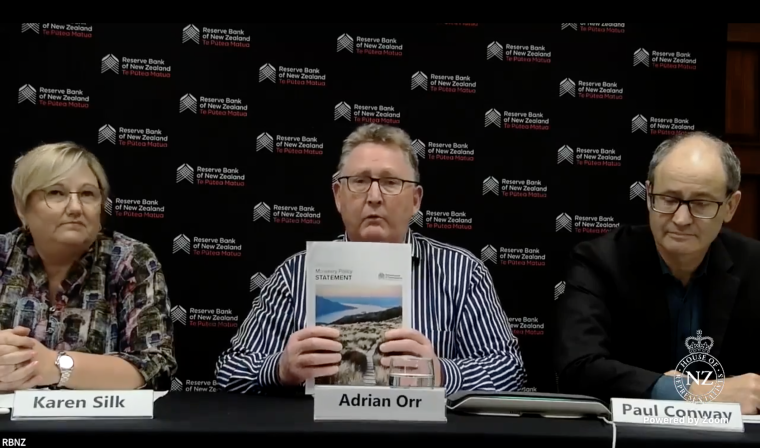
Reserve Bank (RBNZ) Governor Adrian Orr appeared before Parliament’s Finance and Expenditure Committee for the first time since the change in Government on Thursday morning.
The committee is now chaired by National Party MP Stuart Smith and has ex-Finance Minister Grant Robertson as the lead opposition member.
Because these committees are designed as a way for Parliament to scrutinise the Government, senior opposition MPs and backbenchers get to ask most of the questions.
Here are the three most interesting things the politicians and monetary policymakers discussed:
RBNZ is processing the GDP surprise
Governor Orr said the September gross domestic product (GDP) data was “surprisingly subdued” and had “significant” revisions to previous data releases.
“We are busily internalizing that complex situation and we will be back in February with our [next] Monetary Policy Statement”.
Before then, an “enormous amount of data” will be released, including employment and inflation, and baked into the central bank’s thinking.
Orr also said the RBNZ would pay attention to this afternoon’s Half Year Economic and Fiscal Update from Treasury, and the coalition Government’s mini-budget that will accompany it.
Paul Conway, the RBNZ’s chief economist, said that while historical headline GDP had been revised down, consumption and business investment were revised higher.
“You could associate that with an increase in migration,” he said.
When asked about the proposed tax cuts, Conway said they would boost economic demand if they're not fully funded.
“But it depends on how they are funded [and whether] government consumption has also been cut. So, how all of that plays out is exactly what we’ll be looking at”.
Mandate doesn’t change policy
Chlöe Swarbrick, a Green Party MP, asked what “tangible changes” would occur within the central bank as a result of the revised mandate.
Orr said it would create clarity in how the bank communicates its monetary policy, but wouldn’t change any of its work behind the scenes.
“The labour market, and concept of maximum sustainable employment, remain as important as always. Because it is one of the single largest factors in the supply side of the economy and the potential growth rate of the economy.”
“So, all of our work related to the labour market, and how it works … will remain as a continued focus.”
The Governor noted the remit still asks the bank to “have regard” to employment, output, and exchange rates. He also said the dual-mandate’s phrasing had always prioritised inflation.
Later, he said the RBNZ was “very committed” to flexible inflation targeting. The Act Party has proposed setting a specific time limit for getting inflation back to 2%.
“It is economically impossible to target a date and time to achieve consumer price inflation,” Orr told the committee.
“New Zealand tried that decades ago and we ended up with wage and price freezes and carless days and all sorts of things.”
Grant Robertson quipped: “It all comes back to Muldoon in the end”.
OCR should’ve been lifted slightly sooner
Orr said the Monetary Policy Committee did wish it had raised the Official Cash Rate earlier, but only by “one or two quarters, at most”. Increases started in October 2021.
This would have kept the inflation peak under 7% but not significantly, as the war in Ukraine would still have pushed import prices higher.
Underlying core inflation would be the challenge ahead, and much of that price pressure was coming from central and local governments.
“The last five yards of the inflation battle are going to be tough,” he said.
*You can also listen to Adrian Orr on a recent episode of our Of Interest Podcast here.
We welcome your comments below. If you are not already registered, please register to comment
Remember we welcome robust, respectful and insightful debate. We don't welcome abusive or defamatory comments and will de-register those repeatedly making such comments. Our current comment policy is here.