
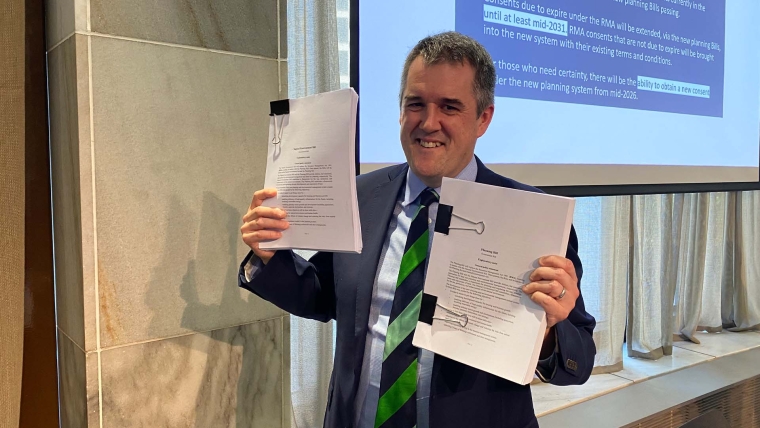
There are aspects of the proposed laws to replace the Resource Management Act (RMA) that will need to be fixed, RMA Reform Minister Chris Bishop acknowledges.
Bishop made the comment at the New Zealand Planning Institute annual conference in Wellington on Friday.
“It’s an 800-page piece of legislation. There are things in the Bills that will not be right now and people have already picked some [things] up. There’s things that need to be fixed, panel beaten - you can call it whatever verb you like,” Bishop said.
“When you draft legislation the first time around, things aren’t right. That’s why it has gone to a Select Committee and it’s going through a very thorough process.”
“Wait and see what comes out of the Select Committee. Let’s not cast judgment on the first draft of the Bills.”
His comments came after he was asked by an audience member what the rationale was for excluding iwi Māori from needing to be consulted in developing the first tranche of national policy direction standards.
Bishop said they were prepared to have a look at that during the Committee. When asked again, he said "that's in the Bills before the Committee" and repeated that they were prepared to have a look at that.
Bishop was part of a panel alongside Labour MP Rachel Brooking, Parliamentary Under-Secretary for RMA Reform and ACT MP Simon Court, New Zealand First MP Andy Foster and Green Party MP Lan Pham.
Asked by MC Miriama Kamo what he meant by saying they could have a look at that, Bishop said: “I’m in a difficult position, right? I’m the [RMA Reform] Minister. Simon was the under-secretary. We’re in the executive.”
Bishop said Pham and Brooking were members of the Environment Select Committee, which was currently considering the Bills.
Pham said she was glad to hear Bishop say he would look at it and consider it, “because it’s extremely serious when it comes to a functional RM (Resource Management) system”.
Brooking said Bishop was right - he was the RMA Reform Minister and was not in the Select Committee room.
“But of course, if he’s interested in changing things, then he can talk to his colleagues and they might pay more attention to it,” Brooking said. “That’s a difficult relationship with how Select Committees work.”
Court said they were listening. “We’ve got our ears pricked up but we also have to wait for a process to deliver."
Replacing the RMA
The Government has long been outspoken about its plans to overhaul the RMA, having called it "broken" and a "handbrake on growth and opportunity".
In December, to further their sweeping reforms, the Government released details of a new planning system that intends to replace the RMA, introducing a Planning Bill and a Natural Environment Bill.
These Bills are currently before the Select Committee.
If the Bills are passed, direction under the new Planning Act would cover urban development, infrastructure and natural hazards while the Natural Environment Act will cover freshwater, indigenous biodiversity and coastal policy. Both pieces of legislation would replace the RMA.
We welcome your comments below. If you are not already registered, please register to comment
Remember we welcome robust, respectful and insightful debate. We don't welcome abusive or defamatory comments and will de-register those repeatedly making such comments. Our current comment policy is here.