
Over the last couple of days news coming out of China has indicated that some sort of normality is starting to become re-established.
Numbers of new infections are down, and workers are returning to the logistic industries (ports and transport etc). The South China Morning Post has reported that February’s rail movements are up +4.5% on last year despite manufacturing and services hitting an all-time low. GDP for the first quarter of 2020 is likely to be a negative for the first time since the early 1970s’ and the ill-fated cultural revolution.
So, the question for New Zealand exporters is whether the ability to move freight around, namely meat and dairy products in this case, trumps rising unemployment and factories remaining closed, and so the consumer's ability to purchase imported food.
China has relaxed its fiscal policies and lowered interest rates to try to help stimulate to economy however, pundits are picking the Government will not go as far as they did in 2008 when over US$500 bln was ploughed into the economy which resulted in local governments mired in “massive debts”. So, thoughts that the splashing out of Government to drive the remaing years GDP should be kept to modest levels.
The predictions are now that the negative impacts on the China economy will persist until the end of the year. The domestic agricultural sector was already being hammered by African Swine Fever, and Covid 19 has depleted its work force right through the chain and food prices have become greatly inflated as a result. In January alone it is reported to have risen by +15.2% for Food and Tobacco. This may provide some early hope/opportunities for New Zealand food exporters.
Given New Zealand’s falling dollar against most other currencies, the yuan included going from over 4.7 in December to be sitting at 4.35 now. In the same period as above the Kiwi dollar has gone from over 67.2 USc to being around 62.5 USc currently (showing a slight rebound from 62.2 USc). If the Reserve Bank lowers the OCR that should provide more downward pressure on the Kiwi dollar. Already the largest major exporter of food into China, this low exchange rate should make us an attractive source of protein, almost regardless of their internal economy.
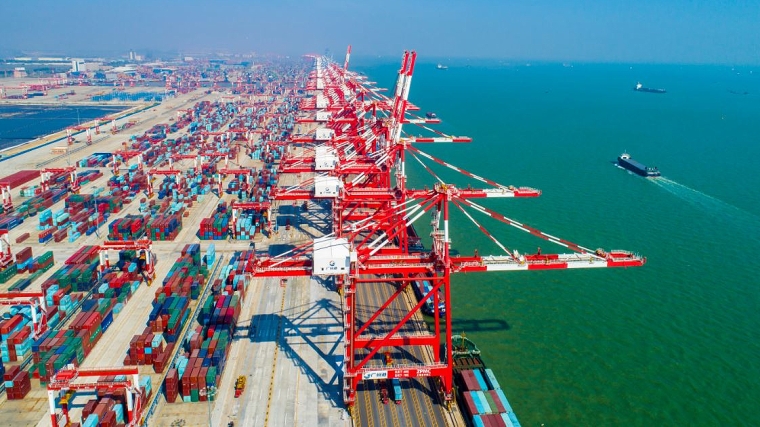
Trying to find sound evidence that produce, of any type, are flowing from the ports now is proving difficult. The most clear picture has come from the New York Times which reported that the ports are still jammed up with all sorts products, ranging from iron ore to any other of numerous products including food; “Shanghai, Ningbo and Xingang — were clogged with refrigerated containers full of imported vegetables, fruit and frozen meat.” The issue appears to be not the cranes unloading the ships but trucks ability to clear them away to the hinterland.
As of last week, only 60% of Chinas’ trucks were reported as ‘working’ resulting in the build-up at the ports. To help prevent spoilage Maersk is charging a US$1,000 fee on electricity for food containers to encourage shipping companies to keep their ships away from the port until trucks can be found to move the containers inland. It has to be hoped from a New Zealand perspective that food is given priority over other ‘bulk’ goods. This may mean that New Zealand will gain an economic advantage over other countries, at least temporarily.
At the same time that our most important trading partner is showing the potential for some life soon our most major secondary markets, notably the EU (including the UK ) and the USA are now heading down the pathway to where China was two months ago.
We are already seeing consumer habits changing with people not eating out and habits becoming more conservative. The result is we have to hope the revitalisation in China occurs at least as fast as the shut down in Europe and the USA occurs. There is likely to be a world recession occur through this year, the degree of it will depend upon the timing of the Covid-19 impacts on the major economies. Having all our major markets ‘closed’ at the same time (compounded by the drought) is the perfect storm we really don’t want. We can only hope that our secondary markets ability to contain the spread is successful to buy time for the development of a vaccine and also to buy time for the Chinese economy to start to re-open. The all gone-wrong-option looks pretty bleak for all concerned.
The ability of our Government to buffer against the effects is likely to be limited. The Reserve Bank can lower the dollar (not a government decision to make) and while the government coffers are looking healthy for the present the ability to be able to make positive impacts upon the export sectors is going to be difficult. Their actions are more likely to be, as we are already seeing, providing short time employment packages and more WINZ funding for those losing jobs and income. Hopefully the farming fraternity can ride through it, be it with some tolerances from the banks.
The option of doing nothing with the current 70% of the population that China says seem to contract the virus and the 2.2% death rate that accompanies this "could" result in 115 million deaths worldwide and for New Zealand if we follow the same stats, up to 69,000 deaths "could" occur. To put this into perspective we currently have around 33,000 deaths per year. A 200% increase is something we don’t want to contemplate.
We welcome your comments below. If you are not already registered, please register to comment
Remember we welcome robust, respectful and insightful debate. We don't welcome abusive or defamatory comments and will de-register those repeatedly making such comments. Our current comment policy is here.