
In recent weeks I have been exploring opportunities for market diversification, given increasing concerns that New Zealand has become too dependant on China. I started by looking at China itself, with the key finding being that growth of two-way trade between New Zealand and China is a consequence of natural alignment for each other’s products, also facilitated by the 2008 Free Trade Agreement between the countries.
Next, I focused on other North-East Asian markets and specifically on Japan, South Korea and Taiwan. The challenges with all of those include that their populations are either declining or about to decline. Also, their economic growth had either stalled or nearly stalled even before COVID-19 came along. That means that new trade requires elbowing out existing products rather than meeting new economic demand from consumers.
I then turned to the ASEAN countries of South East Asia, which are geographically our nearest Asian neighbours. Many of them continued to show strong economic growth, at least until COVID-19 arrived, but they have per capita incomes much lower than China.
There are opportunities in ASEAN, but there are also lots of constraints. I see Vietnam as a particular opportunity with an emerging middle class, but alas, its per capita GDP of US$2700 at market exchange rates (IMF, 2019) is still only 27% that of China (US$10,100) and only 7% that of New Zealand (US$40,600).
It is important to remember that countries importing goods from New Zealand have to purchase them at market-exchange rates. Purchasing power comparisons for developing countries are very different using these market exchange rates compared to internal purchasing power parity (PPP) calculations used to assess living standards. New Zealand goods are very expensive for anyone living off a Third World salary!
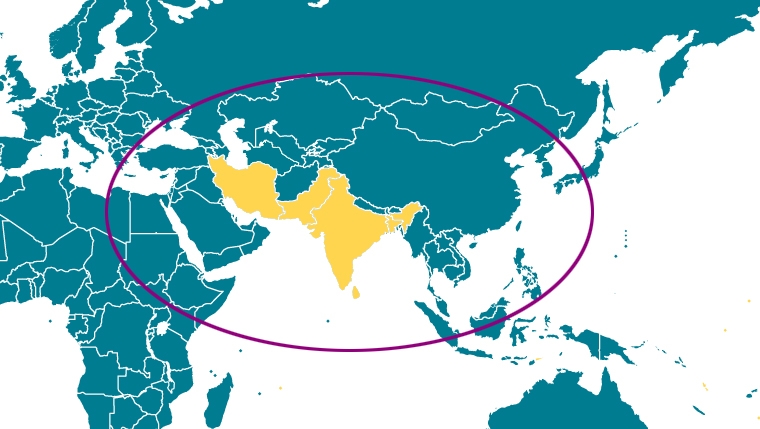
In this article, I look further to the west to what is sometimes referred to as the Asian sub-continent comprising India, Bangladesh and Pakistan, and also further west again to the great enigma of Iran.
The reason I include Iran is that it has great natural resources of oil and gas, together with a considerable and well-educated middle class. Also, there is considerable alignment with what New Zealand produces and what Iran wants. However, with President Trump at the helm, and the unilateral sanction policy conducted by the USA, the current risks are great for any NZ company going there. The bottom line is that the USA controls the international finance system and it uses this system to blacklist those who trade with Iran. More of that later.
Whenever I get into discussions with people about the need to diversify away from China, then India is typically seen as the new promised land. If only it were that easy.
Within the next ten years, India will become the world’s most populous country. Its current population is approaching 1.4 billion, with 35% urban, and a median age of 28. Its population is expected to increase to about 1.6 billion by 2050 using UN projections, with the population bulge by then being in the 35-50 age group.
Until COVID-19 came along, India was experiencing high economic growth, but right now it is in a COVID meltdown, with industrial production less than half pre-COVID and with COVID infection levels exponentiating.
For many years, New Zealand has sought a free trade agreement with India but the negotiations have never got far. Even when Indian politicians offer encouraging perspectives, the reality of the Indian bureaucracy and political system has meant that things never advance beyond there.
One of New Zealand’s problems is that India is the largest global producer of milk, probably more than seven times larger than New Zealand, although no-one knows for sure just how much milk India produces. Regardless of the precise number, the politics of India are such that there is no way they will open themselves to dairy competition from New Zealand.
India, being a Hindu country, is also not interested in our beef. As for lamb, India has always found a range of non-tariff barriers to prevent that trade from flourishing. Some horticultural products like kiwifruit face less barriers, but the cool-store facilities and logistics for perishable products are rudimentary.
Exports to India have typically been around NZ$1.7 billion per annum in recent years. This comprises about 2% of New Zealand’s exports. However, most of this is in so-called travel services, with much of it education-related. There is a smallish trade in wood and an even smaller trade in nuts and fruit. Overall exports of goods are less than 1% of New Zealand’s physical exports.
As for New Zealand’s exports to Bangladesh, there are dairy exports, typically of several hundred million dollars per year, but little else. In the case of Pakistan, dairy is once again the dominant item, but total exports of all products have never exceeded NZ$100 million in any recent year.
A key issue for South Asia is that per capita incomes in India, also Bangladesh and Pakistan, are very low when expressed at market exchange rates (see Table). Accordingly, a middle-class lifestyle based on locally produced goods is much easier than a middle-class lifestyle that depends on imported goods.
Some Market Statistics for South Asia and Iran
| Country | Population (million) |
GDP per capita (USD, IMF 2019) (market exchange rates) |
NZ export destinations 2019, goods and services (NZD, millions) |
| New Zealand | 5 | 40,600 | 83,820 (all countries) |
| China | 1,440 | 10,100 | 18,030 |
| India | 1,380 | 2,170 | 1,650 |
| Bangladesh | 165 | 1,905 | 382 |
| Pakistan | 221 | 1,388 | 85 |
| Iran | 84 | 5,738 | 114 |
Given these harsh realities, there are very limited opportunities in the three countries of South Asia for expanding trade in either the short or medium term. The short term is going to be dominated by COVID-19 issues and the medium term will be dominated by low spending power.
The one country that needs separate consideration is Iran. Iran is not usually considered as part of South Asia, but it also doesn’t fit neatly into the Middle East. Iran has been particularly hard hit by COVID-19, but it also has better epidemic control systems than in South Asia, and is further through its epidemic. However, economic sanctions have greatly impacted all aspects of Iranian society.
If Iran had free access to world markets for its oil and gas, then it would experience rapid economic growth. It already has a significant well-educated middle class, proportionately much bigger than in its South Asian neighbours.
There was a time in the 1980s when New Zealand exported 25% of its lamb to Iran. There is also natural alignment for dairy products. However, nothing can change in relation to trade with Iran unless there is a change of government in the US, and with the US then signing-up again to the 2015 multilateral accord in relation to Iran. Ironically, it was the US that played the lead role in this agreement under the Obama administration, which President Trump then abrogated unilaterally.
In the meantime, the combination of sanctions combined with American superpower status, together with control of the international finance world, makes trade with Iran too difficult. Our banks are now too scared to transfer funds to and from Iran because of US blacklisting.
Putting all of the above into perspective, there are no easy markets for New Zealand either in South Asia or to the immediate west in Iran. The search for diversity needs to continue elsewhere.
*Keith Woodford was Professor of Farm Management and Agribusiness at Lincoln University for 15 years through to 2015. He is now Principal Consultant at AgriFood Systems Ltd. . He can be contacted at kbwoodford@gmail.com. Keith’s previous COVID-19 articles are available here.
We welcome your comments below. If you are not already registered, please register to comment
Remember we welcome robust, respectful and insightful debate. We don't welcome abusive or defamatory comments and will de-register those repeatedly making such comments. Our current comment policy is here.