
Across the global beef industry there are few countries that shape the conversation as strongly as Brazil. With more cattle than any other nation and export channels stretching across Asia, the Middle East and Europe Brazil sits at the centre of a global protein market that increasingly determines how beef is priced, traded and scrutinised.
What happens there does not stay there. It echoes across international markets and ultimately reaches the farm gates of countries like New Zealand.
That reality formed the backdrop to a recent investigation carried out by the Irish Farmers Journal, whose team travelled more than 3,000 kilometres across Brazil to better understand how the country’s beef production system works in practice. Their journey took them through four states, visiting cattle farms, feedlots, livestock markets and agricultural supply stores. What they found provides a rare look inside one of the largest livestock industries in the world, and raises questions that reach well beyond Brazil itself.
For New Zealand farmers the relevance is obvious. Our beef sector operates in a global marketplace where production systems, animal health standards and food safety assurances are increasingly central to market access. When beef produced under very different systems competes in the same marketplace the differences matter.
The Irish investigation began with a simple question. What actually happens on the ground in Brazil?
Adam Woods, deputy editor of the Irish Farmers Journal, explained that curiosity about Brazilian production systems had existed for years.
“I suppose we always maybe knew that there were sub-standards taking place in Brazil,” he said. “You’re speaking to farmers every day that talk about maybe using hormones in Brazil, but we could never really prove it.”
The last time the Irish Farmers Journal had conducted a similar investigation was almost two decades earlier, in 2006 and 2007, when earlier reporting highlighted a number of practices that differed significantly from European production standards. With global trade discussions once again bringing Brazilian beef into focus, the journalists decided it was time to take another look.
Their journey began at the World Meat Congress in Cuiabá in the state of Mato Grosso, a region that alone is home to around 34 million cattle. From there the team drove across the country toward Brasília, stopping at farms, markets and supply stores along the way.
The scale of the trip itself reflected the scale of Brazilian agriculture. In just five days the team travelled more than 3,000 kilometres, often along rough roads through remote regions with limited phone reception.
“We visited farms, we visited livestock marts and we visited agricultural supply stores,” Woods said. “And it was the agricultural supply stores that really showed up something that we didn’t expect to see.”
But before the investigation reached those discoveries the journalists had already encountered the defining feature of Brazilian agriculture. Scale.
Brazil’s cattle industry is vast, operating on a physical scale that is difficult to comprehend from the perspective of most New Zealand or European farmers. Cattle numbers run into the thousands on individual properties, while feedlots capable of holding tens of thousands of animals are not uncommon.
“There are thousands of cattle on farms,” Woods explained. “Cattle are never housed over there. It’s something very different from Ireland.”
The production structure itself is layered. Many smaller farms operate cow-calf systems where calves are raised to weaning or store stage before moving into large commercial feedlots for finishing. At the other end of the spectrum are enormous finishing operations where tens of thousands of animals can be fed simultaneously.
One feedlot the journalists passed during their journey was capable of accommodating around 50,000 cattle.
“That shows you the scale,” Woods said.
Thomas Burke from the Irish Farmers Association observed that Brazil’s farming structure contains a striking mix of extremes.
“The small farmers are even smaller than ours, but the big farmers are a lot bigger than ours,” he said.
In Mato Grosso, for example, around 60 percent of farms hold fewer than 200 cattle and many operate as small subsistence enterprises. Yet neighbouring those smaller operations can be extremely large commercial farms whose production dwarfs anything commonly seen in Europe or New Zealand.
One of the most striking aspects of Brazilian finishing systems is the relatively low level of infrastructure required.
“In one particular farm with over 50,000 cattle the infrastructure consisted of timber stakes, electric fence wire and a few trucks pumping meal into feeders,” Burke explained. “No sheds, no slurry storage, no expensive equipment.”
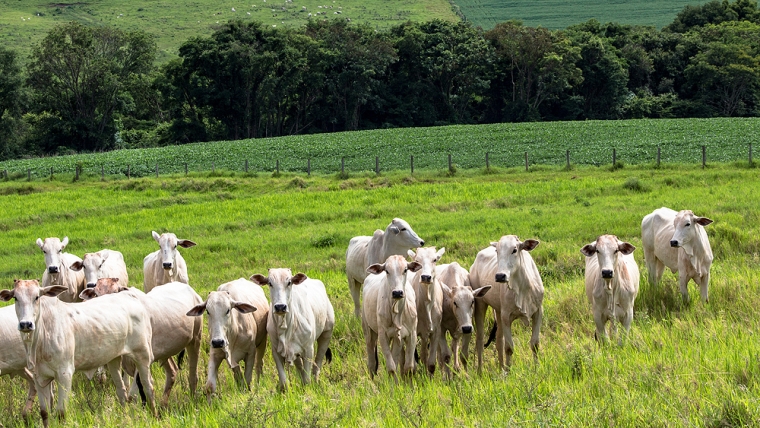
The cattle themselves also differ markedly from the breeds typically seen in New Zealand or Europe. Much of the Brazilian herd is made up of Nelore cattle, a breed adapted to tropical conditions. These animals are lighter framed and less heavily muscled than the European breeds familiar in many export markets.
For photographer Philip Doyle the differences were immediately obvious.
“The cattle are completely different,” he said. “You’re seeing a lot more ribs and it’s just not the same as what you would have here.”
Yet despite the contrasts the journalists also found familiar elements. Brazilian farmers, like farmers everywhere, were open about discussing the challenges they face.
“The farmers were really accommodating,” Woods said. “They wanted to talk about their production systems and talk about the farming systems.”
What also became clear was that Brazil’s agricultural economy extends far beyond cattle alone. The regions the journalists travelled through revealed enormous areas of cropping land producing soybeans and maize, often grown in double-cropping systems where two harvests are taken each year.
That productivity is another reminder of the sheer capacity of Brazil’s agricultural landscape.
But alongside those impressive production systems the investigation also uncovered issues that may prove more controversial internationally.
The most striking findings emerged not on farms but inside agricultural supply stores, where the journalists sought to understand how veterinary medicines are accessed by farmers.
According to Woods the process was surprisingly simple.
“Every town and village has agricultural supply stores,” he said. “We walked in with no Portuguese, no herd number, no tag number and no proof that we needed the antibiotics.”
The team approached the counter and pointed to the medicines they wanted.
“And we got them,” Woods said.
The antibiotics purchased included widely used veterinary products such as Draxxin, Tylan and Ceftiofur, drugs that also have significance in human medicine.
“No questions asked,” Woods explained. “In one store they even said, ‘Do you want two of that or is one enough?’”
The lack of traceability around those purchases was also notable. In some cases receipts were issued, in others they were not. Bottles carried no barcodes linking them to a tracking system and there was no requirement to record which farm the medicines were destined for.
For researchers studying antimicrobial resistance this raises serious questions. Around the world governments and veterinary authorities have spent decades attempting to reduce unnecessary antibiotic use in livestock, recognising the potential human health implications of antimicrobial resistance.
“If we continue to use antibiotics the way we’re using them, we won’t win the battle against AMR,” one expert interviewed in the investigation warned.
Those concerns extend far beyond national borders. Antimicrobial resistance does not respect geography and the use of antibiotics in one part of the world can influence global health outcomes.
For New Zealand the issue carries both a challenge and an opportunity. Our livestock industries have invested heavily in traceability systems, responsible antibiotic use and animal health management. Those systems are not only part of how farms operate but increasingly part of how our products are positioned in international markets.
The Irish investigation does not claim to represent every Brazilian farm or every production system. Brazil itself is too vast and diverse for simple conclusions. Yet the findings offer a reminder that the global beef industry is far from uniform.
As international trade agreements continue to evolve and global protein markets become more connected, those differences will matter more, not less.
For farmers in New Zealand the lesson is straightforward. Understanding how beef is produced elsewhere is not an academic exercise. It is part of understanding the competitive landscape our own farmers operate within.
Brazil’s scale, efficiency and export reach will continue to shape global beef markets for decades to come. At the same time, the standards applied to animal health, traceability and antibiotic use will increasingly form part of the global conversation around food production.
And in that conversation the credibility of production systems may prove just as important as the volume of beef they produce.
Have a listen to the podcast to hear the full story.
Angus Kebbell is a producer at The Weekly Hotwire. You can contact him here.
We welcome your comments below. If you are not already registered, please register to comment
Remember we welcome robust, respectful and insightful debate. We don't welcome abusive or defamatory comments and will de-register those repeatedly making such comments. Our current comment policy is here.