
This content is supplied by Rabobank
Following a dip in the final quarter of 2025, farmer confidence has reversed course and inched higher, the first Rabobank Rural Confidence Survey of the year has found.
The latest result extends a lengthy run of elevated farmer confidence, with net positive readings – more farmers expecting conditions to improve than those expecting conditions to worsen – recorded across the last seven quarters dating back to September 2024.
The latest survey — completed between 16 February and 6 March — found 39% of New Zealand farmers were now expecting the performance of the broader agri economy to improve in the year ahead (down from 40% in the previous quarter), while the number expecting conditions to worsen had also fallen to 8% (from 12% previously). The remaining 48% of farmers expected conditions to stay the same (47% previously).
Rabobank NZ CEO Todd Charteris said improved confidence among dairy farmers was the key contributor to the higher overall reading in the latest survey.
“In our last survey in December, dairy farmers dragged the overall reading lower following a surge in global milk supply at the back end of 2025 which contributed to a string of falls in the GDT, and a subsequent downgrade to Fonterra’s forecast farmgate milk price,” he said.
“This time around we’ve seen the exact opposite, with dairy farmers now more upbeat off the back of several strong GDT results across the early part of 2026 that prompted Fonterra to revise their farm gate milk price forecast back upwards in late February.”
“On top of this, Fonterra suppliers will soon be receiving a bumper capital payment from the sale of the company’s global consumer and associated businesses, and this will be powering optimism for the 12 months ahead.”
The survey found sheep and beef farmers and growers were now less optimistic about the prospects for New Zealand’s broader agri economy. “Both groups recorded historically high readings on this measure in December and, while they remain largely positive about the prospects for New Zealand wider agricultural economy, they are now less upbeat than they were three months ago,” Mr Charteris said.
Across all farmers, the survey found rising commodity prices (54%) and increasing demand (21%) were the key reasons cited by those with a positive outlook on the agri economy, while those with a negative outlook cited rising input costs (32%) as their chief concern.
Middle East conflict major threat to farmer sentiment
Mr Charteris said the ongoing conflict in the Middle East loomed as the obvious threat to farmer confidence over the weeks and months ahead. “Increasing farm input costs came through in the survey as the major concern for primary producers, with this the case even though the majority of survey responses were collected prior to the war starting on February 28,” he said. “These concerns will only have amplified since then, with prices for fuel and fertiliser having crept up over the last 10 days or so as the conflict starts to impact on global supply chains. And the longer the disruption persists, the more cost pressure may build, even if near-term supply remains adequate.”
“Shipping costs are also likely to be impacted. For New Zealand, the exposure is indirect but material. Disruption could lead to higher insurance, freight costs and route changes, with any cost increase in these areas eventually funneling through to farmers’ bottom lines.”
Mr Charteris said the healthy state of New Zealand’s food and agri sector meant it was well- placed to navigate any disruption stemming from the conflict.
“Across recent years, the sector has had to deal with a range of geopolitical shocks and natural disasters, and it’s resilience has always shone through,” he said. “These types of shocks often create sharp price reactions followed by adjustment periods, and businesses that plan early are generally better placed to steer their way through the fallout.”
Own farm business performance
Mr Charteris said dairy farmers and horticulturalists were now more positive about the prospects for their own businesses, while sheep and beef farmers remained the most optimistic overall.
“Sheep and beef farmers were back a little on where they were in December (+49% from +53%) but they are still overwhelmingly upbeat about the prospects for their own operations over the coming months,” Mr Charteris said.
“Prices for both beef and sheepmeat have held firm at elevated levels across recent months and, with demand expected to remain strong, the outlook remains rosy.”
“The prospects for horticulturalists are also strong with the latest Situation and Outlook for Primary Industries – released in mid-December 2025 – picking horticulture export revenue will increase by 5% to $9.2 billion for the year to 30 June 2026, due to continued strong yields for many crops.”
Investment intentions lower but still strong
The survey found New Zealand farmers’ investment intentions were marginally lower than last quarter with 32% (38% previously) of farmers expecting to increase investment and only 8% (from 7%) expecting investment would fall. This pushed the net reading on this measure down to +24% from +31% previously.
“Investment intentions are strong across all of the sector groupings, and if we look at where farmers are expecting to increase investment, on-farm expenditure (30%), increasing livestock numbers (19%) and property purchase to expand farming operations (15%) were the three areas most frequently cited,” Mr Charteris said.
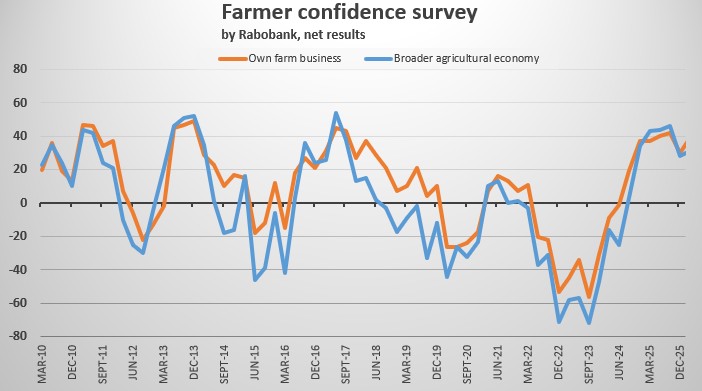
Conducted since 2003, the Rabobank Rural Confidence Survey is administered by independent research agency KANTAR, interviewing a panel of approximately 450 farmers each quarter.
We welcome your comments below. If you are not already registered, please register to comment
Remember we welcome robust, respectful and insightful debate. We don't welcome abusive or defamatory comments and will de-register those repeatedly making such comments. Our current comment policy is here.