

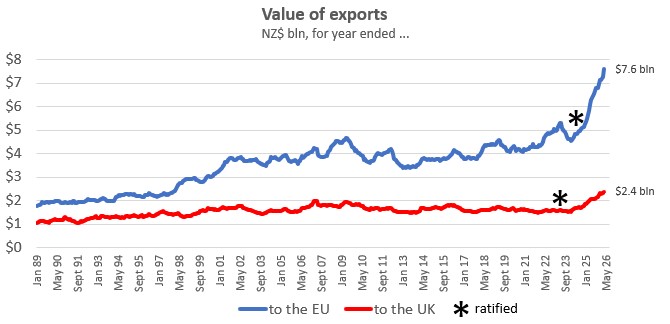
New Zealand's trade policies have been largely bi-partisan over the years (except perhaps for Winston First's election year politicking over the 'fear of others'), so it was good to see a National Party minister celebrating the successes building from the NZ-EU Free Trade Agreement (FTA), one negotiated under Damien O'Conner and the last Labour Government.
But it did remind us that Australia has also recently negotiated a Free Trade Agreement with the EU. (March 24, 2026)
However that won't come into effect until ratified and if all goes to plan that will likely be in late 2027. Parts of the AU-EU Treaty are not all public yet.
But the New Zealand FTA with the EU has been in effect since May 2024. We can measure progress of an actual deal.
Like all such agreements, there is a "most favoured nation' provision that says if either party concedes a benefit to another country later that is better than the current agreement, those better arrangements will apply too.
These sort of bilateral FTA's will become the norm, and increasingly complex, after the Trump Administration blew up the multilateral agreement system - probably starting with its walking away from the excellent TPP, something they probably live with, with regret.
But for small countries in particular, there will be ways to thread the needle to our advantage (even if we could also become collateral damage to deals done between major powers, especially ones who don't respect negotiated deals, like the US).
Like the NZ-EU FTA, the AU-EU FTA will eliminate almost all tariffs in both directions, and it contains commitments on services, investment, government procurement, digital trade, intellectual property, and trade and sustainable development.
So the question arises, how does the NZ-EU FTA compare to the 'new' AU-EU FTA?
Here is the useful comparison between the two for the red meat and diary sectors, the key ones for us, as set out by MFAT.
| Product | Australia outcome (Year 7: 2034 est.) |
NZ outcome (Year 7: 2031) |
|---|---|---|
| Beef 1 | Overall access of 35,000 tonnes, comprising: FTA: 30,600 tonnes of new access over 10 years (10,200 tonnes from entry into force in 2027 and for five years thereafter, growing to final volume from years 6-10), split as follows: - 55% grass-fed, grain-finished beef (16,830 tonnes) (0% tariff) - 45% any beef (13,770 tonnes) (7.5% tariff) WTO: Australia’s existing 4,400-tonne WTO quota will drop to a 0% tariff |
Overall access of 11,466 tonnes, comprising: FTA: 10,000 tonnes (7.5% tariff), phasing in over seven years (6,190 tonnes in 2027), raised under New Zealand's pastoral farming conditions WTO: New Zealand’s existing 1,466-tonne WTO quota dropped to a 7.5% tariff |
| Sheep meat 1 | Overall access of 30,581 tonnes, comprising: FTA: 25,000 tonnes (0% tariff) WTO: Australia’s existing 5,581 tonne WTO quota remains at 0% tariff |
Overall access of 163,769 tonnes, comprising: FTA: 38,000 tonnes (0% tariff) WTO: New Zealand’s existing 125,769-tonne WTO quota remains at 0% tariff |
| Subtotal: Red meat1 | Overall access of 65,581 tonnes of red meat, comprising 35,000t of beef and 30,581t of sheepmeat. | Overall access of 175,235 tonnes of red meat, comprising 11,466t of beef and 163,769t of sheepmeat. |
| Butter | Access for butter of 5,000 tonnes Tariff elimination over three years for other dairy fats and oils |
Overall access of 36,000 tonnes, comprising: FTA: 15,000 tonnes (at 5% of standard EU tariff) WTO: 21,000 tonnes of New Zealand’s existing WTO quota drops to 5% of the standard EU tariff. |
| Milk powder | Access for skim milk powder of 8,000 tonnes Tariff elimination over three years for whole milk powder |
Overall access of 15,000 tonnes, comprising: FTA: 15,000 tonnes for all milk powders (at 20% of standard EU tariff) |
| Cheese | Tariff elimination over 3 years (NB: mirrored by Australia for EU cheese exports to AUS) |
Overall access of 31,031 tonnes, comprising: FTA: 25,000 tonnes (0% tariff) WTO: New Zealand’s existing 6,031-tonne WTO quota dropped to a 0% tariff |
| High protein whey | 2,000 tonnes (0% tariff) | 3,500 tonnes (0% tariff) |
| Additional dairy products with tariff elimination | Tariff Elimination over three years for: Liquid milk and cream Dairy spreads & fats and oils (Infant Formula, Casein and Peptones: outcomes not yet public) |
Tariff Elimination for: Liquid Milk / Cream: 7 years Processed cheese: 7 years Buttermilk powder: 7 years Retail Infant Formula: 7 years Casein: 5 years Peptones: 7 years |
1. Beef and sheep meat volumes cited above are all expressed in carcass weight equivalent (CWE).
Notes:
- A stricter bilateral safeguard mechanism applies for products subject to quotas under the A-EU FTA, should Australian exports to the EU surge or EU prices decrease. The A-EU FTA safeguard will apply for 15 years for beef, 12 years for sheepmeat, and 8 years for butter, milk powder and milk fats and oils. The NZ-EU FTA does not contain a safeguard of this nature.
- The A-EU FTA includes a clause through which Australia may request a review of the beef and sheep meat quota volumes five years after entry into force of the FTA.
On geographical indications (GIs), Australia agreed to protect a list of terms as GIs under its FTA, as did New Zealand.
Australia will protect both ‘feta’ and ‘prosecco’ as GIs. However, existing users of the term ‘feta’ in Australia will be able to continue that use, and Australian wine producers will be able to use the term ‘prosecco’ to identify the grape variety of their wine (subject to labelling requirements) for 10-years for exports and indefinitely for domestic sales.
These terms are also protected under the NZ-EU FTA, subject to existing users being able to continue to use ‘feta’ for nine years and ‘prosecco’ for five years.
The A-EU FTA clarifies that, in Australia, ‘parmesan’ is not a translation of the Italian GI - ‘Parmigiano Reggiano’. The NZ-EU FTA does not include this clarification, however it does allow existing users of ‘parmesan’ to continue that use.
MFAT's comparison review is here.
We welcome your comments below. If you are not already registered, please register to comment
Remember we welcome robust, respectful and insightful debate. We don't welcome abusive or defamatory comments and will de-register those repeatedly making such comments. Our current comment policy is here.