

ANZ's economists have lowered their Fonterra milk price forecasts to $3.95/kg of milk solids (MS) for the current 2015/16 season, and $5.00/kg MS for 2016/17.
This a substantial revision down from the bank's previous forecasts of $4.25 and $5.50-$5.75/kg MS, respectively.
Fonterra itself has a forecast of $4.15 for the current season, although the latest GlobalDairyTrade auction suggests this will come under pressure.
ANZ's forecast for 2015/16 is lower than Westpac's and ASB's, which sit at $4.20/kg MS and $4.10/kg MS, respectively.
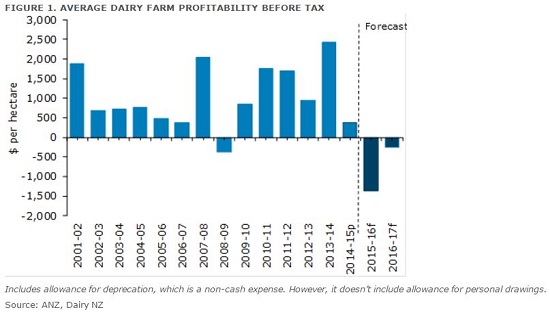
It notes its estimates suggest a cumulative loss of around $1.50/kg MS over the two seasons if its forecasts become reality, or if more cost efficiencies can’t be found over coming months.
ANZ is the country's biggest rural lender, disclosing dairy exposure of $11.3 billion as of last June. It says:
Price action is poor and European supply dynamics are very bearish at present. There simply appears too much supply for the market to handle despite some encouraging demand signals and the likes of China’s import requirements having improved.
Two important structural shifts in the form of increased European supply and a lower cost of production are dominating. Both these factors are expected to continue to suppress prices and delay expectations for a rebound.
USD dairy prices are weaker and the NZD is more elevated than what we had previously assumed. As such, it’s difficult to maintain a mid-$5/kg MS forecast for 2016/17.
We are encouraged by the steps being taken to drive cost efficiencies and improve productivity amidst a challenging payout backdrop. More of the same will be required over the years ahead. A return to positive cash-flow will now not likely be seen until 2017/18.
The economic knock-on to the dairy sector and broader economy will be substantial. Lower dairy prices are at the forefront of a near 20% fall in New Zealand’s goods terms of trade over 2016; that’s a huge hit to the economy’s purchasing power and enough to knock up to 3 percentage points off GDP growth over two years. 2016/17 will represent the second successive year of a sub-breakeven payout (in terms of pure cash-flow as opposed to the payout). The sector is just under 5% of GDP directly and with the indirect channel close to 10% of GDP. A further step lower in dairy prices is also coming at a time funding costs are on the rise; that’s a nasty mix.
With low international prices, a lower dairy payout and likely pressure on cash-flow until 2017/18 ups the ante on the OCR needing to move lower (the December MPS included a low export price scenario that required 50bps of easing), we are not yet at that juncture. The rest of the economy is generally vibrant / performing well and until we see material signs of a turn we’ll remain in the no change camp.
The New Zealand economy is more than dairy alone, but challenges in the sector need to be respected and closely monitored in terms of the economic flow-on impacts.
We welcome your comments below. If you are not already registered, please register to comment
Remember we welcome robust, respectful and insightful debate. We don't welcome abusive or defamatory comments and will de-register those repeatedly making such comments. Our current comment policy is here.