

By Brian Fallow
The Reserve Bank’s May Financial Stability Report (FSR) understandably focuses on risks to the asset side of banks’ balance sheets.
But there is also a risk sitting there on the liability side on the books in the form of a high degree of dependence on importing the savings of foreigners to fund their lending.
“Offshore credit markets are a key source of funding for New Zealand banks, representing close to a quarter of their total funding,” it says.
And indeed the statisticians tell us that at the start of this year the net foreign liabilities of deposit-taking institutions stood at $120 billion, equivalent to about a quarter their loan book at the time.
But the FSR is at pains to allay fears of any repeat of the episode during the Global Financial Crisis (GFC) when offshore funding markets froze and the Government had to hastily stand guarantor to the banks.
That fright led to the adoption of the Core Funding Ratio (CFR), which sets a minimum proportion of banks’ funding that has to come from “sticky” sources: retail deposits or long-term wholesale funding, where long-term is defined as a maturity at least a year out.
The banks’ aggregate CFR peaked at 89% last month, compared with 66% ahead of the GFC.
In March the markets delivered central banks another scare, evident in New Zealand’s case by a sharp rise in government bond yields, which prompted the Reserve Bank to immediately begin quantitative easing, something it had not had to do before.
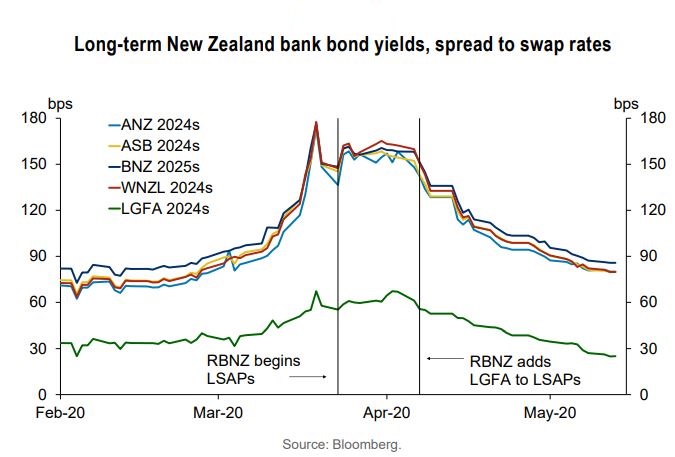
Offshore funding spreads, which reflect the cost New Zealand banks would have to pay if they were to access term funding from international markets, also briefly spiked, though not to the heights seen during the GFC.
Not to worry, though, is the message from the FSR: “However, since February no New Zealand bank has needed to issue term funding in these markets, as the extension to the average term of their funding in recent years now allows banks to wait out the market turbulence and only return to these markets when they have normalised.”
But that sanguine and soothing language implies it is possible to tell how long the current global ordeal, and its attendant risk of further turbulence in offshore credit markets, will last. And no-one knows that.
What we do know is that the world went into this crisis carrying more debt, relative to the size of economies, than before the GFC.
New Zealand is an exception. Its total debt (government, corporate and household) stood at 204% of GDP at the start of the year compared with 208% in 2007, according to the Bank for International Settlements.
By contrast for the emerging market economies as a group (which includes China) the ratio has increased from 143% to 194% over the same period. It has also increased, though not as much, for advanced economies as a group.
These debt to GDP ratios will be worsening rapidly in the context of a gruesome global recession.
Some limited debt relief has already been extended to developing countries, which have to borrow in hard currencies and which are looking at evaporating export incomes even as the pandemic bears down on them. But the clamour for more debt relief is rising.
And at the other end of the spectrum the US Federal Reserve has announced it will extend its QE purchases to some corporate debt rated “high yield”, the polite term for junk. Glass half full, it is willing to do that; glass half empty, it considers it necessary.
So how exposed are New Zealand banks to further turbulence in offshore funding markets in this environment?
The FSR tells us that as of March just under half of banks’ $135 billion of wholesale funding had a maturity of between one and five years. How much of it is closer to one year than five is unclear, as is the key uncertainty in all this: How long will the Covid crisis last?
In the mean time the Reserve Bank has been doing a bunch of things to inject liquidity into the banking system.
Quantitative easing has that effect, for a start. The money the Reserve Bank creates in order to buy government bonds increases the level of settlement cash, the money banks have on deposit at the central bank.
It has also introduced a weekly corporate open market operation facility which allows banks to use corporate debt securities as collateral when borrowing cash from the Reserve Bank. “This gives banks confidence to buy these debt instruments, secure in the knowledge they can be exchanged at the Reserve Bank for cash.”
Then there is the Term Auction Facility offering collateralised loans for up to 12 months, and the Term Lending Facility offering loans for a term of three years.
All these initiatives are evidence that the Reserve Bank, as banker to the banks, is ready to ensure they can access all the money they need to do the lending we need them to do.
Given then banks’ high reliance, in normal times, on imported credit – the flip side of New Zealand households’ collective tendency to spend more than their income – that is just as well.
The chart below comes from the Reserve Bank's Financial Stability Report.
*This article was first published in our email for paying subscribers. See here for more details and how to subscribe.
We welcome your comments below. If you are not already registered, please register to comment
Remember we welcome robust, respectful and insightful debate. We don't welcome abusive or defamatory comments and will de-register those repeatedly making such comments. Our current comment policy is here.