
By Gareth Vaughan
Stress testing of the country's major banks, kicked-off by the Reserve Bank in March as the COVID-19 pandemic took hold, shows New Zealand banks have a good level of resilience but aren't invincible, the Reserve Bank's Head of Financial System Policy and Analysis Toby Fiennes says.
The Reserve Bank modelled two hypothetical scenarios, both significantly worse than its current COVID-19 related fallout expectations.
The first was described as a pessimistic baseline scenario. The Reserve Bank characterises this as a one-in-50 to one-in-75 year event with unemployment rising to 13.4% and a 37% fall in property prices. In this all banks maintained capital ratios above regulatory minimums.
The second scenario was a very severe scenario, categorised as a one-in-200-year event. In this scenario the unemployment rate reaches 17.7% and house prices fall 50%.The Reserve Bank's own actual current forecasts are for a 5.8% drop in Gross Domestic Product this year, an unemployment peak of 8.1%, and a 9% fall in property prices. The very severe scenario is akin to what Ireland experienced in the Global Financial Crisis, Reserve Bank Manager of Financial Systems Analysis Chris Bloor says. He describes the overall stress test results as "relatively reassuring."
"The overall conclusion from the Reserve Bank’s modelling is that banks could draw on their existing capital buffers and continue lending to support lending in the economy during a downturn of the severity of the pessimistic baseline scenario. However, in the more severe scenario, banks' capital fell below the regulatory minimums and would require significant mitigating actions including capital injections to continue lending. This reinforces the need for strong capital buffers to provide resilience against severe but unlikely events," the Reserve Bank says.
"If a banking crisis were to occur on top of an existing economic crisis, the economy's ability to recover would be seriously compromised, and outcomes would become significantly worse," the Reserve Bank says.
The Reserve Bank’s modelling didn't include strategic actions or capital injections banks may undertake to mitigate severe downturns. The test results are released on an industry-wide, rather than an individual bank, basis.
Fiennes says the stress test results will help inform Reserve Bank decisions on when to start implementing planned bank regulatory capital increases, currently set for implementation over seven years from next July, and any changes to current dividend restrictions. Decisions on these two issues are expected either before or when the Reserve Bank issues its next Financial Stability Report in late November. The Reserve Bank's proposed increases to bank capital requirements, finalised last year, are touted as preparing banks for a one-in-200-year scenario.
"The Reserve Bank’s modelling of the pessimistic baseline scenario resulted in a 57% reduction in the aggregate capital buffer by the end of year two. This translates to a reduction in aggregate Common Equity Tier 1 capital ratio from 11.4% of risk-weighted assets to a trough of 7.7%. The decline in capital is mainly due to high loan impairment expense, which is partially offset by strong underlying earnings," the Reserve Bank says.
Also under the pessimistic baseline scenario all banks remain above regulatory capital minimums despite some coming close to the minimum total capital ratio, while continuing to meet credit demand from customers.
"The Reserve Bank’s modelling of the very severe scenario resulted in aggregate capital falling below regulatory minimums. The deficit in total capital reached $7 billion in year three. The very severe scenario illustrates that there are limits to the shocks banks would be able to withstand at their current capital positions. Provision of credit would come under considerable strain in this scenario, and capital injections would be necessary to ensure banks’ survival."
Under the very severe scenario both aggregate tier one and total capital fall below the regulatory minimum requirements.
Banks' current minimum regulatory capital requirements are a Common Equity Tier 1 capital ratio of at least 4.5% of risk weighted exposures, a Tier 1 capital ratio of at least 6%, Total Capital ratio of at least 8%, and a buffer ratio of at least 2.5%. You can see more on bank capital, including the Reserve Bank's proposed increases, here.
Nine banks stress tested
Nine banks holding 92% of total New Zealand bank loans - ANZ, ASB, BNZ, Westpac, Kiwibank TSB, SBS Bank, Heartland Bark and The Co-operative Bank - featured in the stress tests. The five biggest - ANZ, ASB, BNZ, Westpac and Kiwibank - submitted results based on their own modelling and provided mitigating actions.
"Overall the capital outcomes of the bank modelled submissions were similar to the desktop exercise in the pessimistic baseline scenario, but less severe in the very severe scenario. The submissions provided a challenge to the Reserve Bank’s desktop model and some of our assumptions were revised as a result," the Reserve Bank says.
The Reserve Bank launched the stress tests in March to determine the resilience of banks and the financial system to the risks posed by COVID-19. Stress testing is a tool used by bank regulators to give them a forward looking view of risks to the financial system. It involves modelling the impact of hypothetical severe shocks on financial institutions in a sort of health check of a bank's balance sheet to see if they hold enough capital to support lending during stressed times.
"Banks have increased their capital buffers significantly since the Global Financial Crisis. The stress test period began at December 2019, with the nine banks in the desktop stress test having an aggregate capital buffer of $19 billion above regulatory minimums, to absorb losses during times of stress. This stress test is one gauge of whether the current buffer is sufficient," the Reserve Bark says.
Being prepared for the unexpected
The two scenarios tested by the Reserve Bank drew on elements of scenarios developed by Treasury in April combined with different degrees of global economic stress.
“The onset of the COVID-19 pandemic provides a stark reminder to us all of the importance of being prepared for the unexpected, especially when you are a systemically important bank at the core of New Zealand’s financial system. The more capital a bank holds, the better it can weather economic storms and meet customer needs during tough times like now," Reserve Bank Deputy Governor Geoff Bascand says.
“Our stress test assesses the impact of significant, hypothetical, economic downturns on the profitability and capital of the largest banks in New Zealand. The results show us that banks can, and should, draw on their capital buffers to continue meeting customers’ needs during very challenging economic times."
“Even though these scenarios are severe, they are not unprecedented internationally, and the economic costs of such bank failures are significant. There is a limit to the comfort these stress tests provide, given that they are only simulated. In particular, the user knows how the stress ends and can act rationally. This is not the case in real time. The more bank capital there is, the less the banks and the New Zealand economy are exposed to the risks of decision making under uncertainty,” Bascand says.
Considering more severe ‘black swan’ events in stress test scenarios
The Reserve Bank says the onset of the COVID-19 pandemic has emphasised to both banks and regulators the importance of considering more severe ‘black swan’ events in stress test scenarios. Speaking to interest.co.nz in May Bascand said in previous bank stress testing, dating back to 2009, the Reserve Bank hadn't modelled a pandemic-type scenario.
"They tended to be more epidemic or foot in mouth type scenarios really rather than full blown pandemic. But we've had SARS in the past and we've had thoughts about these things. But this is a real live one," Bascand said in May.
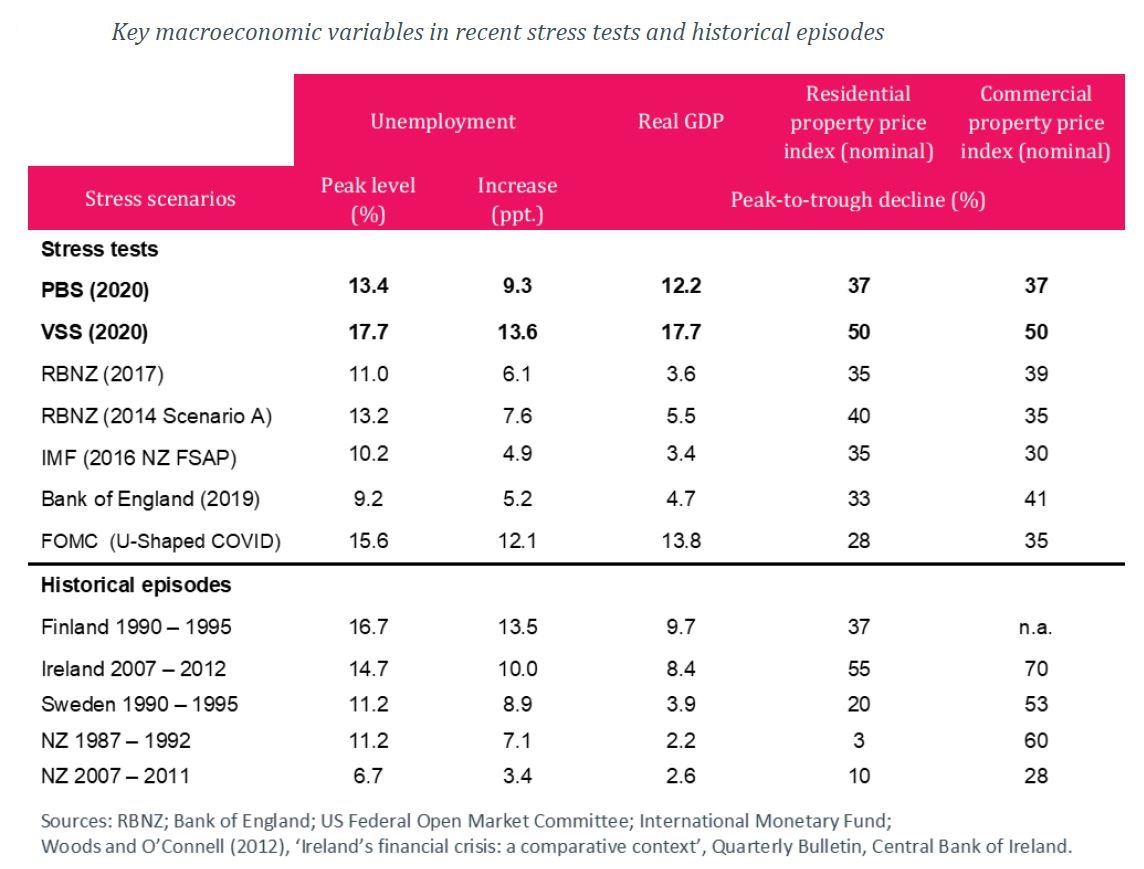
The two charts below relate to the Reserve Bank's pessimistic baseline scenario.
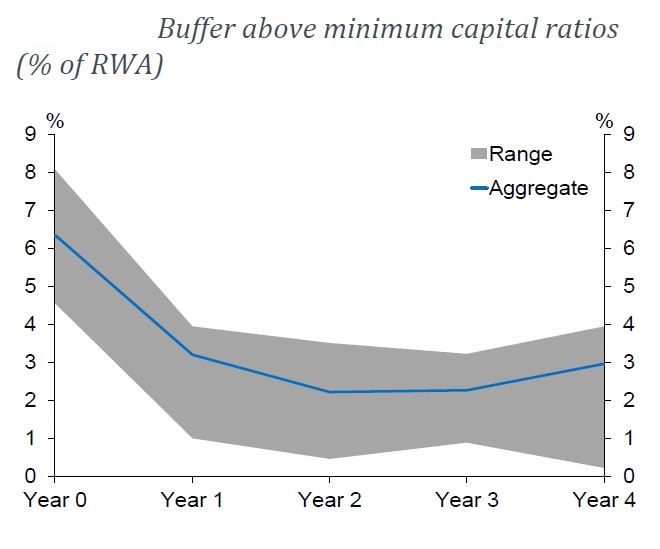
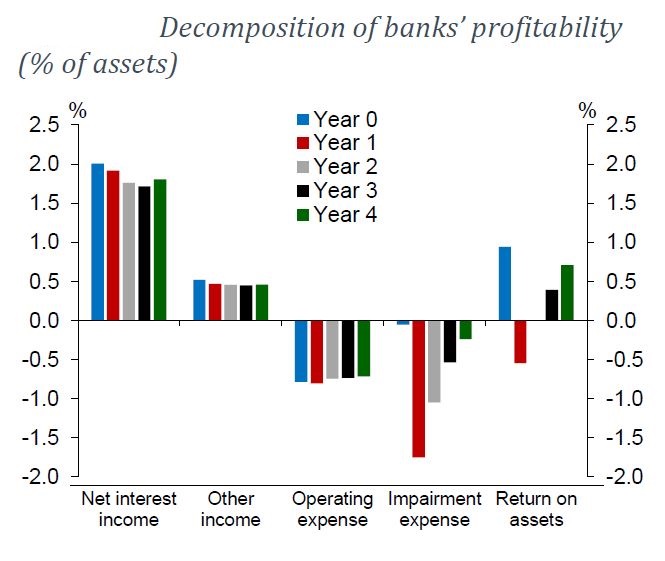
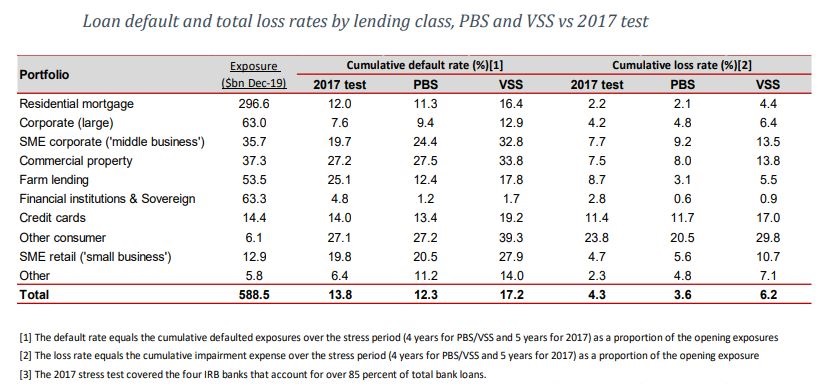
Here's the Reserve Bank's conclusion for its pessimistic baseline scenario (PBS):
The Reserve Bank’s overall assessment of the PBS is that the New Zealand banking system can absorb such a downturn and continue lending to support the economy. All banks maintain their capital ratios above regulatory minimums. Banks will have much lower capital levels at the end of the scenario and will require time to rebuild buffers. Banks may consider applying timely mitigating actions, not modelled in the desktop, to lessen this task.
And here's its conclusion for the very severe scenario (VSS):
The Reserve Bank’s overall assessment in the VSS is that the banking system would come under pressure to stay above regulatory minimum capital requirements. Significant mitigating actions, including raising new capital, would be necessary for banks to avoid breaching regulatory minimums under this scenario.
A RBNZ Bulletin article on the stress testing is here, a summary here, and data here.
We welcome your comments below. If you are not already registered, please register to comment
Remember we welcome robust, respectful and insightful debate. We don't welcome abusive or defamatory comments and will de-register those repeatedly making such comments. Our current comment policy is here.