

By Gareth Vaughan
The Reserve Bank's use of so-called macro-prudential tools to dampen a credit boom or bubble would ultimately see borrowers paying their banks higher loan rates, analysis commissioned by the New Zealand Bankers' Association (NZBA) says.
The analysis, by auditing and financial advisory firm PwC, is included in the bank lobby group's submission on the Reserve Bank's consultation paper on macro-prudential policy instruments and a framework for New Zealand.
The NZBA says it would've liked to see analysis from the Reserve Bank on the costs and benefits of a range of scenarios where macro-prudential tools might be used. But in the absence of this the NZBA says it decided to hire PwC to take a look.
PwC says although macro-prudential tools might be effective at improving financial system stability in a time of solely bank related stress, they don't appear effective in removing wider economic factors that may cause financial system stress, which is a critical reason the Reserve Bank is investigating the possible use of the tools. Furthermore, the use of macro-prudential tools could result in higher mortgage rates, PwC says.
"Our primary assumption is that the deployment of macro-prudential tools is aimed at restricting the supply of funds available to the mortgage market, with a particular focus on mortgages with a high loan-to-value ratio (LVR)," says PwC. "Restricting the quantity of funds available for mortgage lending results in higher borrowing rates for loans."
The four macro-prudential tools the Reserve Bank is considering, which would only apply to registered banks and wouldn't affect existing loan agreements, are:
- the countercyclical capital buffer, effectively banks holding more capital during credit booms;
- adjustments to the minimum core funding ratio, altering the amount of retail funds and longer-term wholesale funding banks have to hold;
- sectoral capital requirements, or increasing bank capital in response to sector-specific risks;
- restrictions on high LVR residential mortgage lending, which, for example, could mean borrowers having to have at least 15% or 20% equity.
Finance Minister Bill English said in February he expected to sign a deal with Reserve Bank Governor Graeme Wheeler by the middle of the year on the macro-prudential tools, but said they wouldn't be a silver bullet to cool a hot housing market.
NZBA doesn't like LVR caps
The NZBA says use of the tools would come at a cost to the economy and any decision to implement one or more of them must therefore be made carefully. Of the four tools under consideration by the Reserve Bank the NZBA says caps on high LVR residential mortgage lending is its least favoured option, something the Reserve Bank itself appeared to agree with in its consultation material.
The NZBA says there are three "significant problems" for the Reserve Bank in deciding to use macro-prudential tools. The first is identifying that there's an asset price bubble developing, the second is identifying whether it's a credit driven bubble or irrational exuberance, and thirdly what the appropriate policy response is, - whether it be monetary policy or a mix of macro-prudential tools.
Furthermore the NZBA says the use of macro-prudential tools comes down to a judgement about developing circumstances and a decision about the appropriate response.
"The consultation document does not discuss this issue," The NZBA says. "Instead there is an assumption that the boundaries and roles for each of monetary policy and macro-prudential tools are clear when this may not be the case."
"Decisions to implement macro-prudential tools will not be costless to the economy and must be taken with due caution."
The NZBA describes LVR caps as being a "weak tool with low welfare gains from a policy perspective," and being difficult and costly to implement for the banks. And it says the two week timeframe suggested by the Reserve Bank for the implementation of LVR caps by banks is way too short, with three to six months actually required. The NZBA cites the use of LVR caps in Canada, Hong Kong and Sweden, and suggests not all LVR caps are created equally and they are heavily reliant on the specific institutional arrangements that underpin them.
The NZBA goes on to say that if economic policy settings are right, the circumstances in which macro-prudential tools might be used would be rare.
"We would therefore like to see the Reserve Bank play a more visibly public role in the discourse on economic policy settlings."
'Macro-prudential tools could reduce housing supply'
PwC says there are other potential impacts stemming from the introduction of macro-prudential tools that could do with further analysis. These include adverse impacts on residential building, which could hurt the supply side of the housing market. Secondly competition effects within the housing market, with macro-prudential tools having the potential to change the competitive nature of the banking sector, given the potential to provide a short-term competitive advantage to banks with better access to capital and lower cost of capital structures. PwC argues this would give increased market dominance to some banks.
And thirdly, PwC sees potential for "disaggregated effects" such as the reliance of small and medium sized enterprises (SMEs) on the home equity of owner-managers to fund their businesses. It says there's potential for the restriction of capital, and at increased cost, to impose operating and growth restrictions on SMEs.
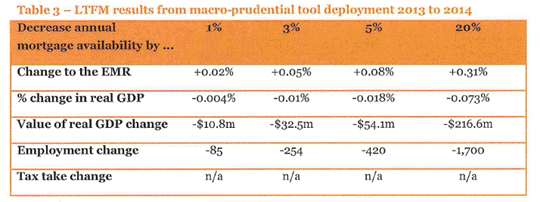
Furthermore PwC says if the use of macro-prudential tools leads to a contraction in the supply of funds available to the loan market, this is equivalent to a decrease in the demand for funds due to an increase in the effective mortgage rate (EMR). Ultimately the firm says this could impact Gross Domestic Product and employment, which it demonstrates in the chart below using Treasury's long-term fiscal model (LTFM).
The Reserve Bank says the macro-prudential tools wouldn't replace the existing prudential regulation of banks, but would be supplementary tools, used from time to time to help manage risks arising from the credit cycle. The four tools are the ones identified by the Reserve Bank that it says "may" have a role in promoting financial system stability.
The central bank's consultation document runs through four steps the Reserve Bank would take in deciding to apply one or more of the tools, starting with a systemic risk assessment and focus on whether debt levels and asset price imbalances are, or are likely to become, excessive and whether lending standards may be too loose. This will be followed by mulling whether macro-prudential intervention is warranted, selecting the appropriate instrument(s), and determining how the individual tool(s) should be applied.
"In some cases, the optimum response might involve using more than one instrument," the Reserve Bank says. "For example, during a credit boom it might be appropriate to not only constrain the build-up of leverage in the banking system with the countercyclical capital buffer but also to target high risk borrowing more directly (eg through the use of LVR restrictions)."
See all our stories on macro-prudential tools here.
This article was first published in our email for paid subscribers. See here for more details and to subscribe.

We welcome your comments below. If you are not already registered, please register to comment
Remember we welcome robust, respectful and insightful debate. We don't welcome abusive or defamatory comments and will de-register those repeatedly making such comments. Our current comment policy is here.