

By Gareth Vaughan
Britain's financial markets regulator may have blocked the issue of what it calls contingent convertible securities to retail investors, which have been used by New Zealand banks to help meet regulatory capital requirements, but there are no plans for a similar restriction in New Zealand.
“We consider the warning statements and additional disclosures are appropriate for the two products currently on offer, but we will continue to talk to providers about the retail take up of the products," Simone Robbers, the FMA's head of primary markets and investor resources, told interest.co.nz via a spokesman.
"It is not our intention to restrict retail investor access to these products as long as we are seeing responsible selling practices from providers and well informed investors," Robbers said.
Earlier this year ASB borrowed $400 million and Kiwibank $100 million through subordinated debt issues to raise Tier 2 capital to meet the Reserve Bank's regulatory capital requirements. ASB's 10-year subordinated, unsecured debt securities will pay investors annual interest of 6.65% for the first five years. And Kiwibank's 10-year unsecured subordinated capital notes, issued by sister company Kiwi Capital Funding Limited (KCFL), will pay 6.61% for the first five years.
The Kiwibank issue has a BB+ speculative, or "junk", credit rating from Standard & Poor's reflecting its subordination and loss absorption features. The ASB issue has a BBB+ S&P credit rating. ASB and Kiwibank themselves have AA- and A+ credit ratings, respectively, from S&P. See credit ratings explained here.
This year's Kiwibank's issue follows a $150 million unsecured, subordinated "junk" bond issue in 2012 also done to raise funds to meet Tier 2 capital requirements.
A Financial Markets Authority (FMA) warning included with both this year's ASB and Kiwibank offers noted the investments were riskier than bank deposits, and the securities on offer were complex instruments and might not be suitable for many investors. The FMA went on to warn that the ASB notes notes carry the same risk as shares, but don't have the same growth opportunity as shares.
And, the FMA added, if ASB or Kiwibank experienced severe financial difficulty these securities could be converted to ordinary shares or written off, with investors having no say in this, and potentially no chance to sell before the conversion or write-off.
Not appropriate for British retail investors, for now at least
Britain's Financial Conduct Authority (FCA) last week announced it was blocking the distribution of such securities to the mass retail market. Contingent convertible securities, or CoCos, are highly complex and not appropriate for the mass retail market, the FCA said.
It has restricted their distribution to professional, institutional and sophisticated or high net worth retail investors ahead of consulting on permanent rules later this year. This restriction applies from October 1 this year until October 1, 2015.
“In a low interest rate environment many investors might be tempted by CoCos offering high headline returns. However, they are complex and can be highly risky, and the FCA has used its new powers to ensure that CoCos are not inappropriately made available to the mass retail market while still allowing access for experienced investors," said Christopher Woolard, the FCA's director of policy, risk and research.
"CoCos can be written off (in part or entirely) or converted into equity when the issuer’s capital position falls, while issuers can have unusually broad discretion in relation to coupon payments making it extremely difficult for investors to assess, understand and price CoCos. At present there is little experience of how CoCos operate in practice," Woolard added.
The Australian Securities and Investments Commission, meanwhile, has a page on its website warning investors about bank hybrid securities. It's headlined "big risk without a big return" and says "you take all the risk."
"If the bank experiences financial difficulty, bank hybrids can be converted into bank shares, which may be worth less than your initial investment, or even written off completely, meaning you could lose all of your capital," says ASIC.
'RBNZ's emphasis is on the financial strength of banks and the system at large'
Here in New Zealand the Reserve Bank has left responsibility for whether these securities are appropriate for retail investors squarely at the FMA's door.
"As the Reserve Bank’s remit is to focus on promoting the maintenance of a sound and efficient financial system, its emphasis is on the financial strength of banks and the system at large. The FMA are responsible for promoting the confident and informed participation of market participants in financial markets," a Reserve Bank spokeswoman told interest.co.nz.
"We understand that the FMA have undertaken work on the level of information required to be provided to retail investors in relation to Basel III compliant instruments. We would suggest approaching the FMA on this issue."
Robbers said the products in question are relatively new to the New Zealand market.
“Retail investors may not always understand how these products work, their complexity and what the risks are. Because it can be hard for investors to assess and price the risks involved, we worked closely with the banking industry earlier this year to agree the form of the mandatory warning in the investment statement," said Robbers.
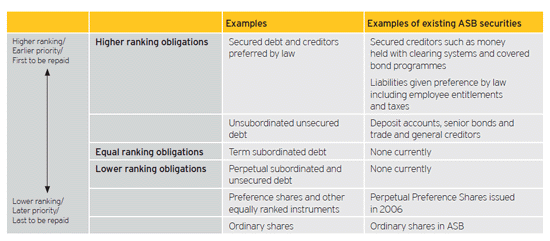
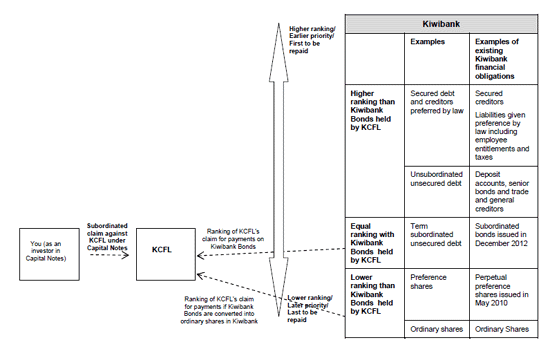
"This warning needs to be included on the front of the investment statement as well as additional disclosures and tables in the investment statement to explain, for example, who gets paid first in the event of a default by the bank."
"We would like retail investors to understand that the instruments do not operate like bank deposits or savings accounts, and if the bank gets into financial difficulty their investment will convert into shares that are likely to have a very low value, or their investment may be written off altogether," said Robbers.
"We recognise that for some investors, there may well be a place for complex instruments within a diversified portfolio, however we would strongly encourage anyone thinking of investing in these instruments to seek financial advice before doing so.”
The diagrams below are taken from the FMA warnings in firstly, the investment statement for ASB's bond issue, and secondly Kiwibank's capital notes prospectus.
This story was first published in our email for paying subscribers on Wednesday morning. See here for more details and how to subscribe.
We welcome your comments below. If you are not already registered, please register to comment
Remember we welcome robust, respectful and insightful debate. We don't welcome abusive or defamatory comments and will de-register those repeatedly making such comments. Our current comment policy is here.