

Economists at the country's biggest bank ANZ have changed their call and now pick that the widely expected Reserve Bank cut to the Official Cash Rate early next month, taking it down to a record low 1.75%, will be the last one in the current cycle.
Previously ANZ's economists had "pencilled in" another cut early next year, which would have seen the OCR bottoming at 1.5%.
In their latest weekly Market Focus, however, the economists say they now see the OCR stabilising at 1.75%.
"There are certainly still reasons why the RBNZ could get dragged back to the easing table (a global event, ongoing weak tradable inflation through NZD strength, or failure of inflation expectations to lift). But when balanced against strong domestic growth, emerging capacity strains, rising domestic inflation pressures and some signs of a turn in the global inflation cycle, additional OCR cuts have become harder to justify as a central scenario," the economists say.
'More tenuous by the day'
Factors the economist see as making the case for easing "more tenuous by the day" include: Strong domestic demand in the economy, emerging capacity pressures, a tightening labour market, rising domestic inflation pressures (despite the low 'headline' inflation figure), and the fact that the housing market still needs to slow.
Against these factors, reasons that could yet see the RBNZ be "dragged back to the easing table" next year include: the still evident global deflationary forces, the still high New Zealand dollar, lower than ideal inflation expectations in New Zealand, and the current tightening credit conditions.
The ANZ economists say they do expect economic activity growth to moderate in 2017, "but it’s not the sort of moderation to which the RBNZ should respond".
"First, we are talking about a ‘gallop to a canter’ moderation; from 3½-4% [gdp growth] to somewhere closer to 3%. Second, it’ll be partially driven by capacity constraints. The economy cannot continue to grow at a rate above trend for too long. With each passing day, the capacity anecdotes come more to the fore.
"And finally, the impact of a required slowdown in credit growth should not be under-estimated. Credit is being rationed more tightly as late cycle excesses become apparent. That’s a good thing. A failure to rein in credit growth and associated excesses would only up the odds on a starker turn in the economic cycle down the track, which has been New Zealand’s historical experience. In the short term, credit rationing will dampen growth. However, given the momentum in the economy currently and its desirability in a medium-term context, it is not the kind of ‘slowdown’ that monetary policy needs to concern itself about offsetting."
Visible uplift
On inflation, the economists say over the past week or so there has been a visible uplift in the inflation backdrop around the globe.
"US headline inflation is at a 23-month high, China annual PPI inflation has returned to positive territory for the first time since early 2012 (which has some leading indicator properties for inflation in the likes of the G7) and UK PPI input inflation is running north of 7% y/y. In fact, inflation surprise indices are the highest in close to four years for major economies and near the same for emerging markets."
The economists say, therefore, that it is becoming clear that global headline inflation "has based".
"That shouldn’t really be a surprise," they say.
"Due to the stabilisation in energy prices, base effects alone will naturally see headline inflation rates rise further over the coming quarters. There certainly remains uncertainty over whether underlying inflation is going to follow suit in a world where excess capacity exists, but higher headline inflation rates should at least take some pressure off central banks to deliver easier monetary policies, particularly with market-based measures of inflation expectations now rising again too."
'Inflation has passed its lows'
In New Zealand, it is a similar picture, with headline inflation having passed its lows, but like offshore, questions surround whether there will be a sustained lift in core or underlying inflation.
"Certainly our Monthly Inflation Gauge has continued to provide a benign signal outside of housing. And within the Q3 data, most of the Statistics NZ and RBNZ measures of underlying inflation (trimmed mean, weighted median, Sectoral Factor Model etc) were unchanged in the quarter. Additionally, firms’ pricing intentions are historically low."
Against that, however, the economists say that price increases are broadening.
"The proportion of the CPI basket with annual inflation above 2% has risen to 41% – the highest in over four years (see chart). You’d have to think that if the prices of more things are going up, that would influence the formation of peoples’ inflation expectations."
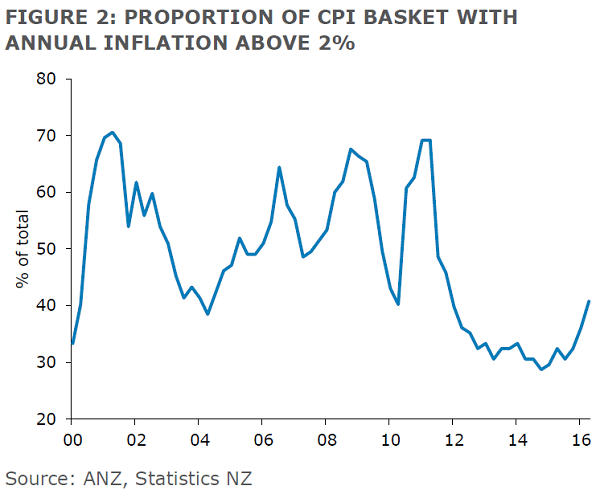
The economists says some temporary influences dampening non-tradable inflation "should normalise" soon. They say central and local government charges (about an 11% weight in the CPI) are currently running at ‑0.5% y/y. This is in part, but not entirely, due to ACC levy reductions. Since 1995 annual government charges inflation has averaged 3.6%.
'Not without risks'
Additionally, excluding ‘uncontrollables’, domestic inflation does look to be responding to the economic cycle. Non-tradable inflation excluding central and local government charges and tobacco – a better gauge of pure domestic inflation pressures – is rising at 2.3% y/y. The economists say that is still low in a historical context, but is the strongest rate in two-and-a-half years and fully consistent with the tightening in capacity pressures evident across the economy.
As well, the prices of labour-intensive services are also rising.
"While services-related inflation in general is low overall (-0.5% y/y), when we just look at the ~15% of CPI components that seem likely to have a particularly heavy labour input (eg restaurant meals, hairdressing, repair services etc), we estimate it is running at 2.6%. This is the highest in two-and-a-half years," the economists say.
"So there are certainly some elements of the inflation picture that are changing. And while low headline inflation and inflation expectations are important to consider, when there is growing evidence that inflation pressures are now responding to the economic cycle – and “traditional” drivers of inflation are starting to gain prominence again – that is important to consider too. Letting some parts of the economy overheat in order to counter the influence of low inflation in other parts is certainly not a strategy without its risks."
We welcome your comments below. If you are not already registered, please register to comment
Remember we welcome robust, respectful and insightful debate. We don't welcome abusive or defamatory comments and will de-register those repeatedly making such comments. Our current comment policy is here.